New York Appellate Court Overturns Foreclosure Order on Babylon Property Over Defective Pre-Suit Notice and Standing Deficiencies
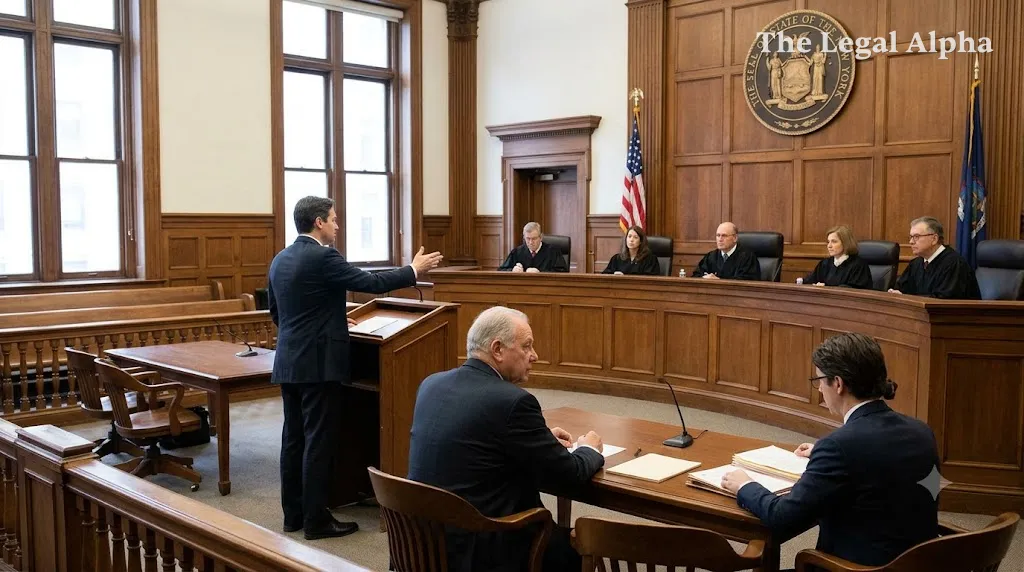
A long-running mortgage dispute spanning over a decade has seen a critical reversal by a New York state appellate court. On October 21, 2026, the New York Supreme Court, Appellate Division, Second Department, overturned a lower court's judgment of foreclosure and sale involving a residential property in Babylon, New York.
The controversy began when Michael McNamara executed a $400,000 promissory note in January 2006, while both he and his wife, Alice McNamara, signed the accompanying mortgage. Following Michael’s death in 2010 and an alleged default dating back to 2009, Bank of America commenced a foreclosure action in 2014. Alice actively fought the foreclosure, challenging the bank’s legal standing and its failure to satisfy statutory pre-foreclosure notice rules. Following Alice's death during the protracted proceedings, the executor of her estate, Robert Maddox, was substituted to maintain the defense. The Second Department held that the bank failed to establish that it properly served the required statutory notices or proved its standing, nullifying the foreclosure judgment.
Legal Topic
Area of Law: Real Estate Law / Civil Procedure
Sub-topic: Residential Mortgage Foreclosure / Statutory Pre-Suit Notice & Standing
Core Legal Issue
The primary legal questions were whether a surviving spouse who signed a mortgage—but not the underlying promissory note—is legally entitled to the statutory 90-day pre-foreclosure notice mandated under New York law, and whether the foreclosing lender submitted competent proof of compliance with those notice rules and proved its standing to commence the foreclosure.
What Did the Court Decide?
The Appellate Division, Second Department, reversed the lower court’s order and judgment of foreclosure and sale that had permitted the lender to sell the Babylon home.
The court determined that the lender was not entitled to summary judgment. Specifically, it ruled that:
-
Alice McNamara was legally entitled to receive the statutory pre-foreclosure notice because she signed the mortgage instrument as a borrower and had covenanted to pay the indebtedness secured by the property.
-
The bank’s affidavit in support of service was legally insufficient; while it submitted evidence of certified mailing, it failed to substantiate that the notice was also dispatched via first-class mail more than 90 days prior to suit.
-
The bank failed to properly establish its legal standing to enforce the debt at the inception of the action.
Consequently, the directive authorizing the sale was vacated, returning the dispute to the lower court with the bank’s summary judgment motion denied regarding those defenses.
Key Legal Points
-
Co-Mortgagors Qualify as Borrowers for Statutory Notice: A co-signer on a mortgage deed remains a protected "borrower" entitled to mandatory 90-day foreclosure warnings, even if that person did not personally execute the underlying promissory note.
-
Twin Mailing Requirement is Mandatory: New York mortgage statutes require dual dispatch—both registered/certified mail and first-class mail. Proof of certified delivery alone does not fulfill the statutory condition precedent.
-
Business Record Affidavits Must Demonstrate Actual Office Practice: Mere reliance on secondary record reviews without personal knowledge or detailed descriptions of standard mailing office procedures cannot establish proper service.
-
Strict Stricture on Standing: A foreclosing plaintiff carries the burden of affirmatively demonstrating that it held or was assigned the note prior to commencing litigation.
Relevant Law
-
New York Real Property Actions and Proceedings Law (RPAPL) § 1304: Imposes a mandatory condition precedent requiring lenders to serve a 90-day notice via both registered/certified mail and regular first-class mail before filing a residential foreclosure complaint.
-
New York Civil Practice Law and Rules (CPLR) 3212: Governs the standards for summary judgment, placing the burden of prima facie proof on the moving lender.
-
New York Civil Practice Law and Rules (CPLR) 1015 / 1021: Governs substitution of parties upon the death of a litigant.
Arguments of the Parties
Appellant (Estate of Alice McNamara / Robert Maddox, Executor)
The estate argued that the foreclosure was fatally flawed from inception. It asserted that Alice McNamara was a designated borrower on the mortgage instrument and thus strictly protected by RPAPL § 1304. The estate contended that Bank of America failed to present competent evidence establishing that the required 90-day pre-suit notice was sent via first-class mail, and further argued that the bank had not shown continuous, proper chain of custody establishing standing when the complaint was filed.
Respondent (Bank of America, N.A.)
The bank maintained that it held the right to foreclose based on an uncontested default in monthly payments stretching back to May 2009. The lender submitted bank records and an officer affidavit to show business mailing procedures and argued that its submissions were adequate to confirm default, delivery under RPAPL § 1304, and its possession of the underlying loan instruments.
Why Does It Matter?
This ruling underscores the unforgiving, strictly interpreted procedural barriers surrounding residential foreclosures in New York. It serves as a vital reminder to institutional servicers and lenders that technical notice provisions under RPAPL § 1304 are strict conditions precedent rather than formalistic technicalities.
For surviving spouses and heirs who sign property security agreements but not personal notes, the decision reaffirms that they cannot be bypassed or stripped of essential consumer-protection notices. For lending institutions, the judgment makes clear that decades-long litigation can be undone if initial mailing protocols and evidentiary affidavits fail to conclusively document both certified and first-class postal delivery.
Legal Takeaway
In New York residential foreclosure actions, lenders must strictly satisfy all statutory pre-suit notice requirements—including simultaneous first-class and certified mailings—to every individual who signed the mortgage as a borrower. Any evidentiary failure to prove compliance or establish standing prevents summary foreclosure, regardless of how long the underlying default has persisted.
Sources
Primary Source
-
Bank of America, N.A. v. Maddox, Appellate Division of the Supreme Court of New York, Second Department (Appellate Docket No. 2018-13041; Decision handed down October 21, 2026).
Additional Sources
-
Case Record: Bank of America, N.A. v. McNamara et al., Supreme Court of the State of New York, Suffolk County (Index No. 000781/2014).
-
New York State Unified Court System, Appellate Division, Second Judicial Department, Decisions Handdown List (October 21, 2026).