Federal Prosecutors and Defense Clash Over Evidentiary Boundaries Following Supreme Court Immunity Precedent
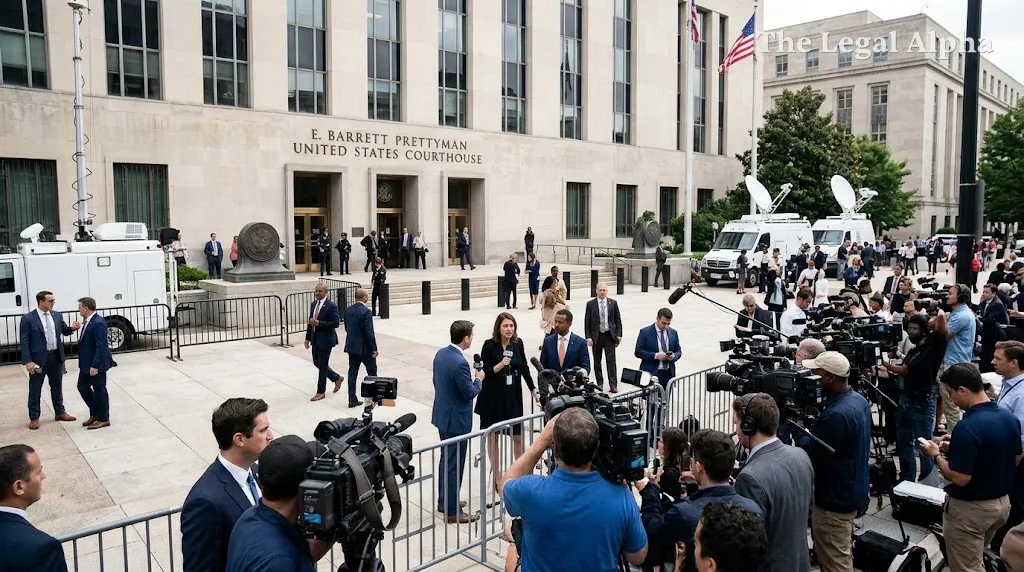
The legal defense team representing Donald Trump has initiated aggressive pre-trial challenges seeking to exclude critical evidentiary exhibits and witness testimonies gathered by prosecutors, contending that the material infringes upon constitutional presidential protections. The filings come before the U.S. District Court as proceedings advance under the evidentiary standards governing executive acts.
The contested dispute centers on whether specific communications, official records, and conduct during the post-2020 election period constitute private acts by an outgoing political candidate or official presidential actions that are legally shielded from presentation to a jury.
Legal Topic
-
Area of Law: Constitutional Law & Criminal Procedure
-
Sub-topic: Presidential Immunity & Admissibility of Evidence
Core Legal Issue
The primary legal controversy concerns the threshold for determining admissibility under the evidentiary restrictions established in presidential immunity jurisprudence.
The court must decide whether evidence touching on executive branch communications can be introduced to substantiate charges involving private election-related conduct, or whether the constitutional doctrine of separation of powers mandates the complete suppression of such material, regardless of its probative relevance to the criminal indictment.
What Did the Court / Authority Decide?
The presiding court has directed a structured evidentiary review process to dissect the prosecution’s proposed trial record line by line.
Rather than issuing a blanket exclusion of the challenged records or granting wholesale admission, the court established a multi-tiered review framework requiring parties to substantiate whether each evidentiary item derives from official executive functions or private electoral campaign efforts. The court made clear that while core constitutional prerogatives remain entirely protected from prosecution inquiry, unofficial conduct falls outside that shield. The substantive determination on which specific exhibits survive the exclusion threshold remains pending under this ongoing pre-trial scrutiny.
Key Legal Points
-
Separation of Official and Unofficial Capacities: Under governing precedent, criminal immunity shields only actions taken within a president's constitutional authority; acts undertaken solely as an office-seeker or private citizen are subject to statutory prosecution.
-
Evidentiary Exclusion Beyond Direct Liability: Under recent Supreme Court standards, the evidentiary barrier extends beyond substantive charges, prohibiting the government from using immune official acts as circumstantial evidence to prove motives or liability for non-immune offenses.
-
Burden of Overcoming Presumptive Shielding: For official actions within the outer perimeter of presidential responsibility, the prosecution bears the high burden of demonstrating that utilizing the evidence poses no intrusive risk to the functions of the Executive Branch.
-
Judicial Scrutiny of Pre-trial Records: Courts are compelled to evaluate context, institutional relationships, and factual context rather than relying solely on the facial relevance of the documents.
Relevant Law
-
U.S. Constitution, Article II: Executive power, the Vesting Clause, and the Take Care Clause.
-
Federal Rules of Evidence (FRE 401, 403): Governing the baseline test of relevance and the exclusion of relevant evidence on grounds of unfair prejudice or constitutional defect.
-
Trump v. United States (2024): Landmark precedent holding that former presidents possess absolute immunity for core constitutional duties, presumptive immunity for official acts, and no immunity for private conduct, while restricting the evidentiary use of official acts.
Arguments of the Parties
Petitioner / Defense
Counsel for the defense argued that the disputed evidentiary records involve internal executive operations, communications with subordinate federal personnel, and official presidential discourse. They contended that placing this material before a jury directly violates the Supreme Court's mandate prohibiting the weaponization of protected executive conduct in criminal proceedings. The defense submitted that allowing the prosecution to introduce these materials would distort executive independence and introduce irreparable constitutional error.
Respondent / Special Prosecution
The government contended that the challenged evidence pertains strictly to Donald Trump's private capacity as an electoral candidate seeking to challenge state election returns. Prosecutors argued that the records and witness statements document private strategy sessions and third-party interactions that had no constitutional nexus to the official duties of the presidency. They maintained that excluding such material would improperly expand presidential immunity to cover purely political conduct.
Why Does It Matter?
This procedural battle provides a clear test case for how trial courts must operationalize appellate immunity rulings during the pre-trial phase. By testing the perimeter between protected presidential duties and personal political conduct, the court's evidentiary rulings will establish crucial guidelines for future criminal proceedings involving high-ranking public officials.
If the defense's standard is adopted broadly, any official touchpoint could shield extensive evidence from criminal discovery; conversely, a narrow standard will empower future special prosecutors to pierce through executive privilege assertions whenever candidate-related motives predominate.
Legal Takeaway
The critical takeaway is that presidential immunity operates not only as a defense against substantive criminal charges, but as a rigid evidentiary barrier that can bar relevant documents and witness accounts from reaching a jury. For trial lawyers and prosecutors alike, the threshold task now hinges on establishing whether a defendant's communication occurred in a constitutional capacity or as an unprotected private actor.
Sources
Primary Source:
-
U.S. District Court for the District of Columbia, United States of America v. Donald J. Trump, Case No. 1:23-cr-00257 (Pre-trial Motion Practice & Evidentiary Scheduling Filings).
- Supreme Court of the United States, Trump v. United States, 603 U.S. ___ (2024).
Additional Sources:
-
AlterNet Legal Analysis Reports (Thomas Kika).
- Federal Rules of Evidence and Department of Justice Special Counsel Filings.
-