Land Office Serves Six-Day Eviction Notice on New Delhi’s Heritage Race Course Mosque
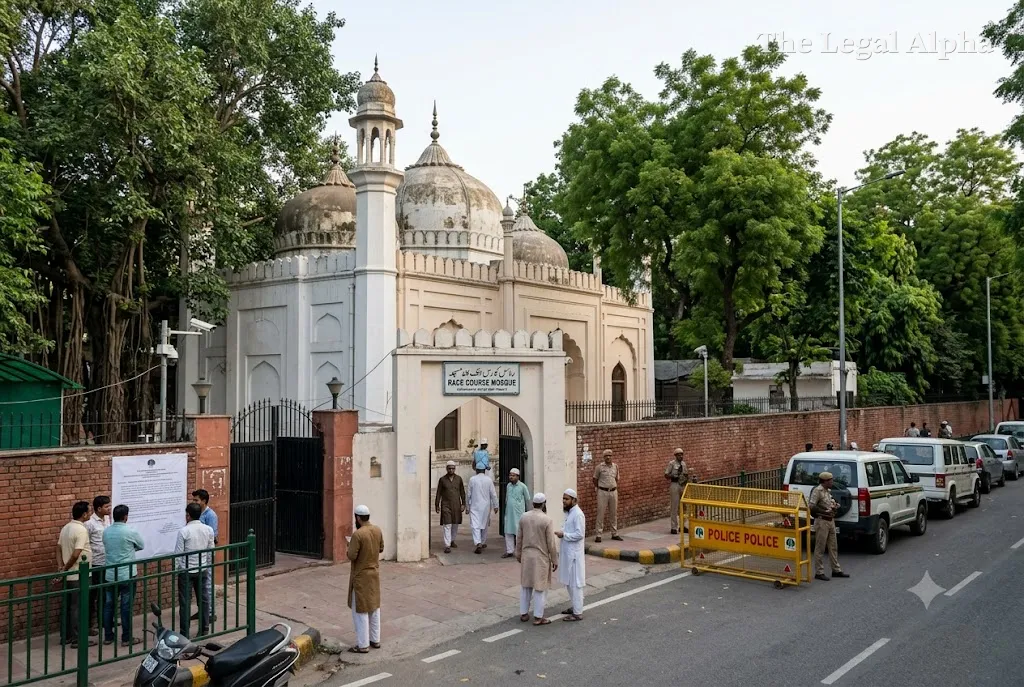
The Land and Development Office under the Union Ministry of Housing and Urban Affairs has issued a six-day eviction notice directing the vacation and removal of the historic Race Course Mosque located near Lok Kalyan Marg in New Delhi. The order has triggered significant administrative and legal concerns after essential civic amenities, including electricity and water supply to the premises, were reportedly cut off and physical access restricted.
Because the Delhi Waqf Board has remained largely unconstituted and inactive, political leaders and community organisations—including AIMIM President Asaduddin Owaisi and delegations from the Jamiat Ulama-i-Hind—have directly approached Union Minority Affairs Minister Kiren Rijiju seeking urgent administrative intervention to halt coercive steps against the site.
Legal Topic
-
Area of Law: Property Law / Administrative Law
-
Sub-topic: Waqf Properties, Eviction of Unauthorised Occupants, and Heritage Conservation
Core Legal Issue
The fundamental legal question is whether central land authorities can treat a notified heritage site and gazetted waqf property as an unauthorised encroachment on government land subject to summary eviction, and whether public authorities may withdraw essential services such as water and power prior to judicial determination by a competent forum.
A related procedural question arises over statutory remedies: where a State Waqf Board is defunct or not properly constituted, what legal avenues protect registered waqf assets from irreversible adverse action by municipal and central land agencies?
What Did the Court / Authority Decide?
The Land and Development Office issued a formal notice directing the occupants to clear the premises within six days, taking the position that the structure stands on central government land.
No court order has authorised demolition or eviction yet. While community representatives and the mosque's management appealed for the Delhi Waqf Board to challenge the notice in court, the absence of an active Board has led stakeholders to pursue direct representations before the Union Ministry of Minority Affairs. The Ministry has acknowledged the representations, with the minister assuring that the situation will be examined.
Key Legal Points
-
Jurisdictional Clashes Over Property Title: Central land administration authorities often invoke special summary powers to clear central land, but registered waqf properties fall under the specialized adjudicatory framework of the Waqf Act.
-
Statutory Presumption of Waqf Status: The property was notified as a waqf property in official gazettes in 1977. Once a site is gazetted and consistently used for religious purposes ("waqf by user"), it carries statutory protection against unilateral executive reclassification.
-
Heritage Status Safeguards: The mosque appears on the New Delhi Municipal Council’s heritage register, which imposes distinct municipal obligations against summary demolition or alteration without heritage clearance.
-
Right to Basic Utilities and Natural Justice: Cutting off essential civic services such as water and electricity without concluding statutory proceedings infringes on basic procedural safeguards and fundamental protections under Article 21.
Relevant Law
-
Public Premises (Eviction of Unauthorised Occupants) Act, 1971: Sections 4 and 5 (governing issuance of show-cause notices and eviction from central government land).
-
Waqf Act, 1995: Section 5 (publication of list of waqf properties), Section 32 (powers and functions of Waqf Boards), and Section 83 (jurisdiction of the Waqf Tribunal to decide title and possession disputes).
-
Constitution of India: Article 21 (protection of life and personal liberty, including access to basic necessities) and Article 26 (freedom to manage religious affairs).
-
New Delhi Municipal Council Act, 1994: Heritage conservation regulations and bylaws governing registered historic structures.
Arguments of the Parties
The Land Authorities The central government and land-owning agency maintain that the property sits on prime government-owned land and that the current occupancy lacks valid, continuing leasehold title or formal sanction, thereby qualifying it for clearance under public premises norms.
Mosque Representatives and Interveners Representatives of the mosque and community leaders argue that the site has been dedicated for religious worship for generations and was formally gazetted as a protected waqf asset as early as 1977. They further contend that because the site is an NDMC-recognized heritage structure, summary eviction notices and the abrupt disconnection of water and electricity violate procedural fairness and statutory heritage protections.
Why Does It Matter?
This development highlights a recurring structural conflict between urban development agencies managing central land pools and historical religious sites recognized under waqf enactments. When state waqf boards lapse into administrative limbo due to lack of timely appointments, properties under their jurisdiction are left vulnerable to summary administrative action without institutional defense before tribunals or High Courts.
The matter also tests the legal force of municipal heritage listings versus central land-clearance directives, underscoring whether listing a building as a heritage asset provides enforceable protection against summary eviction.
Legal Takeaway
A property gazetted as waqf and recognized on local heritage registers cannot be arbitrarily cleared under summary administrative notices without adhering to specialized statutory procedures and natural justice. Until a competent judicial forum or Waqf Tribunal resolves competing title claims, the deprivation of basic amenities like water and electricity remains legally suspect under constitutional due process.
Sources
Primary Source:
-
Land and Development Office (L&DO), Ministry of Housing and Urban Affairs, Eviction Notice dated October 19, 2026; Delhi Administration Gazette Notification (Waqf Properties, 1977).
Additional Sources:
-
Official Heritage Register, New Delhi Municipal Council (NDMC).
-
Formal representations submitted by Jamiat Ulama-i-Hind and official communications to the Union Ministry of Minority Affairs.