CNN Threatens Contempt Action Against White House Over Exclusion From Air Force One Press Pool
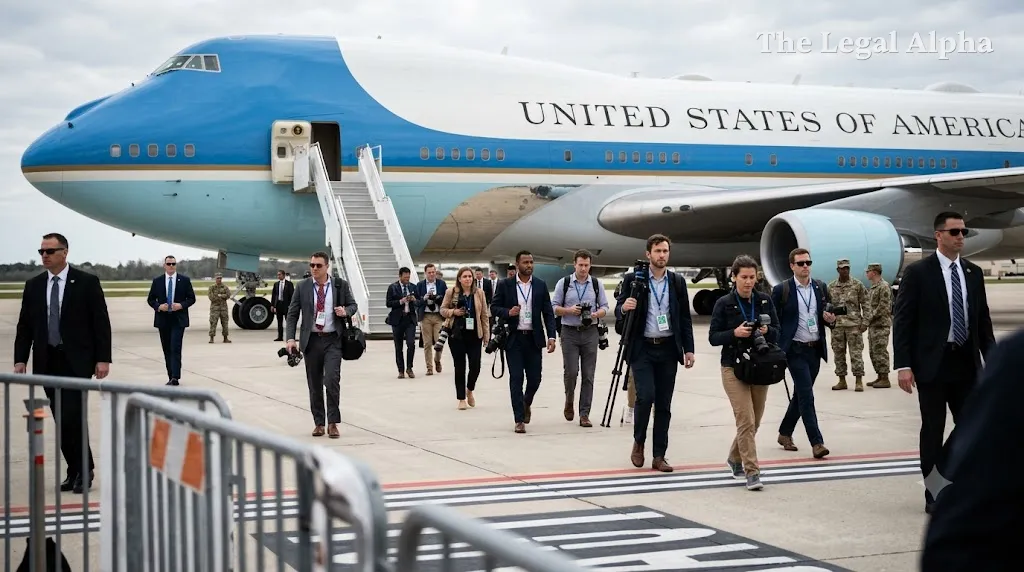
Attorneys representing CNN have issued a formal legal ultimatum to the United States Department of Justice, warning that the network will initiate immediate enforcement proceedings unless the White House ends its ongoing exclusion of CNN journalists from presidential travel coverage aboard Air Force One.
The demand letter, authored by veteran First Amendment litigator Theodore J. Boutrous Jr., gives the administration a strict deadline to confirm in writing that it will restore the network to the rotating television press pool. The dispute follows a preliminary injunction issued by U.S. District Judge Timothy J. Kelly, which blocked executive orders barring reporters from CNN, MS NOW, and Politico from White House press facilities. While the administration complied with the order regarding access to the White House complex, it has continued to bar CNN crews from Air Force One travel and selective pool briefings, prompting accusations that executive officials are circumventing a federal court injunction.
Legal Topic
-
Area of Law: Constitutional Law / Administrative Law
-
Sub-topic: First Amendment Press Freedoms, Fifth Amendment Procedural Due Process, and Enforcement of Preliminary Injunctions
Core Legal Issue
The controversy turns on whether the executive branch can circumvent a judicial injunction protecting credentialed media access by selectively barring disfavored news outlets from designated presidential "pool" rotations—specifically tight-space assignments like Air Force One and Oval Office pool duty.
Legally, the issue focuses on whether press pool rotations arranged to cover the President constitute an extension of government-designated press facilities subject to First and Fifth Amendment protections against viewpoint discrimination and arbitrary exclusion, or whether presidential travel accommodations remain within unreviewable executive discretion.
What Did the Court / Authority Decide?
-
Prior Preliminary Injunction: U.S. District Judge Timothy J. Kelly of the U.S. District Court for the District of Columbia granted an indefinite preliminary injunction prohibiting the Trump administration from enforcing an across-the-board credential revocation against CNN, MS NOW, and Politico. The court found that the media organizations demonstrated a high likelihood of success on the merits, ruling that the administration offered no substantiated national security justification and likely violated the journalists' First Amendment rights and Fifth Amendment procedural due process protections.
-
The Unresolved Ambiguity: Judge Kelly’s written decision focused directly on the restoration of permanent White House press passes (hard passes) and general access to the White House briefing room, leaving open whether the administration could restrict individual outlets from discretionary travel pools such as Air Force One.
-
Current Status: No judicial ruling has yet been entered on the Air Force One exclusions. The current phase is a pre-litigation enforcement demand: if the Department of Justice does not provide written assurances by the stated deadline, CNN intends to move for emergency judicial enforcement, clarification of the injunction, or civil contempt sanctions.
Key Legal Points
-
Prohibition on Content-Based Retaliation: Under settled constitutional doctrine, the government cannot restrict or condition press access based on an outlet’s viewpoint or editorial tone.
-
Procedural Due Process in Press Credentialing: Established D.C. Circuit precedent requires notice, an opportunity to respond, and clear, articulated standards before the executive can deprive a journalist or media company of customary press access.
-
Scope and Evasion of Injunctive Relief: Federal courts retain inherent authority to sanction parties that comply with the literal letter of an injunction while intentionally subverting its substantive mandate through indirect exclusionary tactics.
-
Public Function of Press Pools: When the government establishes a shared pool mechanism to act on behalf of the entire press corps in confined operational settings, denying entry to specific outlets on arbitrary grounds triggers constitutional scrutiny.
Relevant Law
-
U.S. Constitution, First Amendment: Guarantees freedom of the press and prohibits government viewpoint discrimination and retaliatory state action against speech.
-
U.S. Constitution, Fifth Amendment (Due Process Clause): Requires fair notice, transparent criteria, and procedural safeguards before revoking established professional access granted to members of the press.
-
Federal Rule of Civil Procedure 65: Governs the issuance, binding scope, and enforcement of preliminary injunctions against parties and their agents.
-
Sherrill v. Knight, 569 F.2d 124 (D.C. Cir. 1977): The landmark decision holding that White House press credentials cannot be denied or revoked arbitrarily or without procedural due process.
-
Cable News Network, Inc. v. Trump, 345 F. Supp. 3d 44 (D.D.C. 2018): Precedent establishing that revoking White House press credentials without established guidelines and fair process violates the Fifth Amendment.
Arguments of the Parties
Petitioner / Applicant (CNN)
CNN contends that excluding its reporting crews from Air Force One and select White House pool duties is an unlawful, retaliatory measure designed to punish the network for critical news coverage. Outside counsel argued that the physical spaces used to brief the press—including transport assets like Air Force One—belong to the public rather than to any single administration. The network submitted that the administration's actions violate both the First Amendment and the core objective of Judge Kelly’s preliminary injunction, leaving the network no choice but to seek judicial intervention if the discriminatory exclusions continue.
Respondent / Executive Branch (The Administration)
The administration has argued that the President possesses inherent Article II authority to manage executive spaces and determine which individual journalists receive privileged, close-proximity access in secure environments. Spokespersons maintained that the preliminary injunction applies strictly to general press grounds and credentials, not to discretionary pool spots or travel arrangements aboard Air Force One. The administration has asserted that excluded outlets remain free to report on presidential actions from non-restricted areas and that physical proximity is not a constitutional entitlement.
Why Does It Matter?
This standoff tests the boundaries of judicial authority over executive branch operations and press management. If an administration can bypass a court order restoring general press credentials by simply barring disfavored outlets from traveling press pools, the protections established under the First Amendment and Sherrill v. Knight could be substantially weakened.
Because presidential travel pools provide the historical record and immediate verification of executive conduct during foreign trips and off-site events, selective exclusion restricts public access to independent reporting. A motion to enforce the injunction will force the federal judiciary to rule on where general media access ends and non-reviewable executive security discretion begins.
Legal Takeaway
A government entity cannot evade a court order against press censorship by substituting indirect logistical bans for formal credential revocations. If public access or shared pool mechanisms are provided to the media, exclusions based on editorial viewpoints remain subject to strict constitutional scrutiny and judicial enforcement.
Sources
Primary Source:
-
CNN, MS NOW, and Politico v. Donald J. Trump, et al., Memorandum Opinion and Preliminary Injunction Order, U.S. District Court for the District of Columbia (Judge Timothy J. Kelly presiding).
Additional Sources:
-
Legal Demand Letter from Theodore J. Boutrous Jr. (Counsel for CNN) to Michael K. Velchik (U.S. Department of Justice), dated October 2026.
-
Official public statements from the White House Press Office and Department of Justice filings.