Father’s Foreign Citizenship Does Not Strip Minor of Indian Nationality: Madras High Court
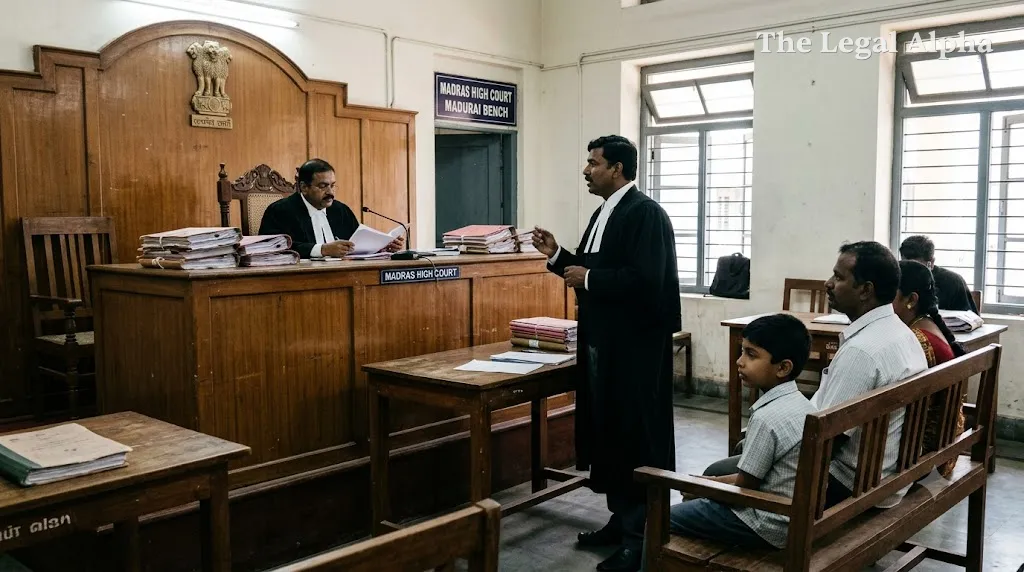
The Madurai Bench of the Madras High Court held that a minor child born in India to Indian parents does not automatically lose his Indian citizenship merely because his father subsequently acquired foreign nationality.
Justice Senthilkumar Ramamoorthy delivered the ruling while hearing a writ petition filed on behalf of a 10-year-old child through his father. The child was born in Salem in January 2016 to parents who were Indian citizens at the time. Later, in 2021, the child’s father acquired citizenship in the United Kingdom. When the family sought to renew the child’s Indian passport ahead of its October 2026 expiry, passport authorities in Madurai stalled the process, contending that the father’s naturalisation abroad had simultaneously ended the child’s Indian citizenship. The High Court rejected that stance and directed the authorities to process the renewal.
Legal Topic
-
Area of Law: Constitutional & Nationality Law
-
Sub-topic: Citizenship by Birth / Termination vs. Renunciation of Citizenship
Core Legal Issue
The dispute centered on whether the statutory forfeiture of a child’s Indian citizenship under Section 8(2) of the Citizenship Act, 1955, applies when a parent acquires foreign nationality under Section 9, or whether it is strictly limited to voluntary renunciation under Section 8(1).
Specifically, the court had to determine whether an Indian citizen by birth under Section 3(1) can be stripped of nationality without explicit statutory authority solely because a parent obtained foreign citizenship.
What Did the Court / Authority Decide?
The High Court allowed the petition and directed the Regional Passport Officer in Madurai to process and dispose of the minor’s passport renewal application within a maximum period of three months.
The court ruled that in the absence of explicit statutory sanction, a minor cannot be deprived of Indian citizenship merely because his father chose to acquire citizenship in the United Kingdom. The judge confirmed that the child gained citizenship by birth under Section 3(1) of the Act and that this status remained intact.
Key Legal Points
-
Protection of Citizenship by Birth: An individual who acquires Indian citizenship by birth under Section 3(1) cannot be stripped of it without clear, unambiguous statutory authority.
-
Distinction Between Sections 8 and 9: Section 8 of the Citizenship Act governs voluntary renunciation, whereas Section 9 governs termination upon acquiring another country’s citizenship.
-
Inapplicability of Section 8(2) to Section 9 Cases: The provision in Section 8(2)—which ends a minor’s citizenship when a parent renounces Indian nationality—cannot be extended by analogy to instances where a parent acquires foreign citizenship under Section 9.
Relevant Law
-
Section 3(1) of the Citizenship Act, 1955: Pertains to citizenship by birth.
-
Section 8(1) and 8(2) of the Citizenship Act, 1955: Pertains to renunciation of citizenship and the status of minor children upon such declaration.
-
Section 9 of the Citizenship Act, 1955: Pertains to the automatic termination of Indian citizenship upon the voluntary acquisition of citizenship of another country.
-
Article 226 of the Constitution of India: Writ jurisdiction of the High Court.
Arguments of the Parties
Petitioner / Applicant
Counsel for the minor argued that the child was born in Salem when both parents were Indian citizens, conferring undeniable citizenship by birth under Section 3(1) of the Act. It was further contended that the authorities misapplied the law: Section 8(2) strictly applies to formal declarations of renunciation made under Section 8(1), not to situations falling under Section 9, where a parent acquires citizenship of a foreign country by naturalisation or registration.
Respondent / Passport Authority
The Central Government Standing Counsel representing the passport authorities argued that upon the father acquiring UK citizenship in 2021, the minor’s citizenship also ceased pursuant to Section 8(2) of the Citizenship Act. The authorities additionally raised procedural concerns regarding the absence of documentation concerning legal custody of the minor.
Why Does It Matter?
This ruling clarifies the boundaries of the Citizenship Act, 1955, for diaspora families and children born in India. Passport authorities frequently conflate Section 8 (renunciation) with Section 9 (termination by acquisition of foreign nationality). By refusing to import the harsh consequences of Section 8(2) into Section 9 cases, the High Court has established that a minor’s vested right to Indian citizenship by birth cannot be curtailed absent explicit legislative authority.
The decision provides strong precedent for children of overseas Indian workers and naturalised foreign nationals who seek to maintain their Indian travel documents and citizenship status independently of their parents' naturalisation choices.
Legal Takeaway
Indian citizenship acquired by birth under Section 3(1) cannot be extinguished without explicit statutory sanction. A parent’s subsequent acquisition of foreign citizenship under Section 9 does not automatically trigger the derivative loss of nationality for minor children under Section 8(2).
Sources
Primary Source:
-
Aarush Shanmugam Gurudev v. The Regional Passport Officer, WP(MD) No. 25412 of 2026, Madras High Court (Madurai Bench) (Order by Justice Senthilkumar Ramamoorthy).
Additional Sources:
-
The Citizenship Act, 1955 (Act No. 57 of 1955), Sections 3, 8, and 9.
-
High Court Proceedings Report, Verdictum & The New Indian Express, October 2026.