Madras High Court Rules Religious Order Holds Rights Over Catholic Priest’s Acquired Assets, Denies Family’s Succession Claim
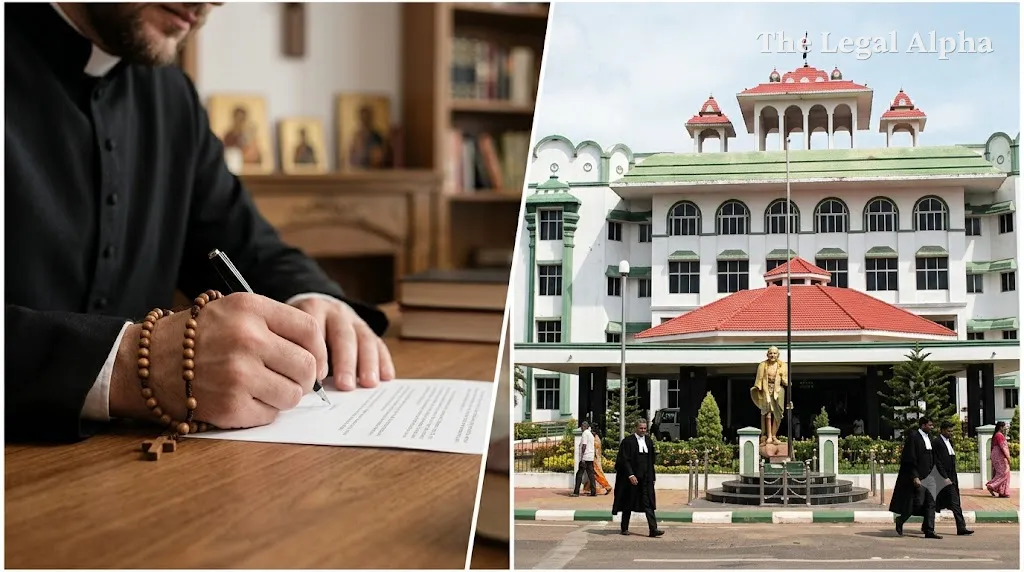
The Madurai Bench of the Madras High Court overturned a trial court order that had granted a succession certificate to the biological relatives of a deceased Catholic priest for fixed deposits worth ₹56 lakh.
The dispute arose after the death of Rev. Father Deivakumar Arulanantham, an ordained member of the ABVM Society of the Catholic Apostolate (Pallottines). Following his passing in 2018, his two brothers and niece sought succession rights to six State Bank of India fixed deposits standing in his individual name. The religious society contested the claim, asserting that the underlying funds were derived from property acquired during his priestly service and belonged to the order by virtue of his religious vows and written undertakings. In September 2024, the Principal District Judge, Karur, ruled in favor of the family. Setting that decision aside on appeal, a Division Bench of the High Court held that the funds belonged to the religious congregation, ordering the family to refund the money.
Legal Topic
Area of Law: Succession and Property Law
Sub-topic: Religious Renunciation / Status of Assets Held by Religious Order Priests
Core Legal Issue
The court had to decide whether bank deposits standing in the personal name of a deceased priest belonging to a Roman Catholic religious order constitute his personal estate—inheritable by biological legal heirs under secular succession law—or whether entering a religious order and taking vows of poverty and renunciation vests post-ordination acquisitions in the religious society.
What Did the Court Decide?
The Division Bench comprising Justice N. Anand Venkatesh and Justice K.K. Ramakrishnan allowed the appeals filed by the ABVM Society of the Catholic Apostolate.
The court set aside the Karur District Court’s grant of a succession certificate to the relatives and dismissed their petition. The Bench directed the three relatives to refund the ₹56 lakh to the Society within one month. Should they fail to make the repayment within the stipulated time, the amount will carry an interest rate of 9% per annum from the date of the judgment until realization. Additionally, the Bench held that the trial judge made a procedural error by conducting simultaneous hearings instead of consolidating both succession petitions into a single joint trial.
Key Legal Points
-
Distinction Between Order Priests and Diocesan Priests: The court drew a clear line between diocesan (secular) priests, who do not take vows of poverty and may hold personal property, and priests belonging to religious orders or congregations who take solemn vows renouncing worldly attachments.
-
Renunciation and Religious Undertakings: Upon taking perpetual vows, an order priest severs civil ties to personal estate building; assets acquired in the course of religious service are held for the benefit of the congregation.
-
Evidentiary Value of Pre-Ordination Declarations: While an unattested handwritten document signed by the priest before ordination could not operate as a valid will, the court treated it as an enforceable religious declaration and undertaking outlining that personal acquisitions would vest in the Society.
-
Protection for Inherited Ancestral Assets: The Bench clarified that while acquisitions made post-ordination belong to the religious society, properties independently inherited from the family or pre-dating the entry into the order remain protected and do not automatically pass to the institution.
Relevant Law
-
Section 384 of the Indian Succession Act, 1925: Governs statutory appeals against orders granting or refusing succession certificates.
-
Section 63 of the Indian Succession Act, 1925: Pertaining to the execution and attestation requirements of wills (examined while assessing the unproved testamentary paper).
-
Canon Law (Code of Canon Law): Relevant provisions concerning the evangelical counsel of poverty and the temporal goods of religious institutes versus diocesan clergy.
-
Judicial Precedents: Prior high court rulings delineating the civil status and property rights of ordained members of religious congregations versus secular diocesan priests.
Arguments of the Parties
Appellant (The Religious Society)
The ABVM Society contended that Father Arulanantham had renounced his worldly ties and committed to a life of poverty under the Pallottine order. Counsel argued that the ₹56 lakh deposited in Kulithalai originated from the sale proceeds of a Bengaluru property acquired during his active priesthood, rather than ancestral wealth. The Society also produced a signed 1988 undertaking indicating that his personal acquisitions belonged to the institution, which had also borne his medical and living expenses until his death.
Respondents (The Family Members)
The late priest's brothers and niece maintained that they were his natural legal heirs under ordinary succession law. They contended that the fixed deposits were held solely in his individual name at the State Bank of India without nomination or an institutional trust tag. They further submitted that the 1988 document was an unproved, unattested will incapable of overriding the statutory line of succession.
Why Does It Matter?
This ruling provides practical clarity on property disputes between religious congregations and biological families of clergy in India. By refusing to treat individual bank accounts as automatic private assets of an order priest, the High Court reinforced the legal enforceability of ecclesiastical vows and internal institutional undertakings against claims by statutory heirs.
Crucially, the decision establishes a balanced boundary: it safeguards religious societies from losing mission-derived funds while simultaneously shielding a priest's ancestral family inheritance from being absorbed by religious institutions. It serves as a precedent for trial courts handling succession certificates involving monastic, ascetic, or religious order members across faiths where civil renunciation is practiced.
Legal Takeaway
A member of a Catholic religious order who has taken vows of poverty cannot accumulate personal wealth for secular family succession from assets acquired during their religious service. Even when funds stand in the priest’s individual name, the beneficial ownership vests in the religious congregation unless the property represents an independent family inheritance.
Sources
Primary Source:
-
Common Judgment of the Madras High Court (Madurai Bench) in The ABVM Society of the Catholic Apostolate (Pallottines) v. A. Deiva Nayagam & Ors. [C.M.A. (MD) Nos. 560 and 623 of 2026, decided on October 13, 2026; Coram: N. Anand Venkatesh & K.K. Ramakrishnan, JJ.].
Additional Sources:
-
Certified proceedings and record of S.O.P. No. 6 of 2019 and S.O.P. No. 30 of 2019, Principal District Court, Karur.
-
High Court reporting and analysis by Verdictum and The Print.