Federal Court Halts East Potomac Overhaul as White House Sets November Start Date
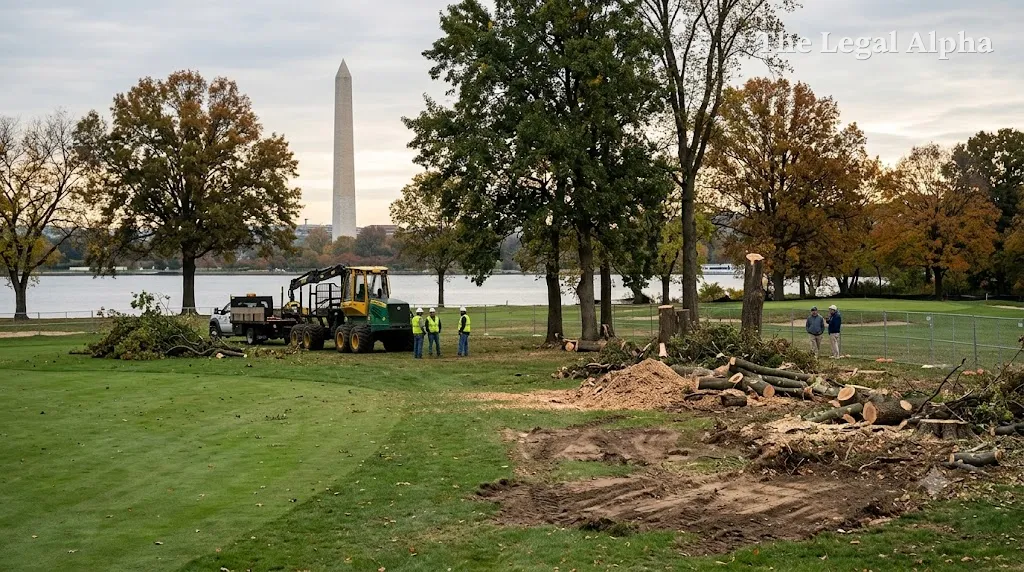
The Trump administration announced plans to close Washington, D.C.’s historic East Potomac Golf Links on November 15 for a comprehensive 15-month redevelopment, setting up an immediate conflict with ongoing federal court proceedings. Just days prior, a federal district judge restricted the government from carrying out irreparable modifications—specifically halting large-scale tree clearing—without giving formal advance notice to the court and opposing litigants. The legal battle intensified after federal contractors removed several hundred trees from the municipal site, triggering emergency litigation from local preservationists and recreational users.
Legal Topic
Area of Law: Administrative Law & Environmental Law
Sub-topic: Preliminary Injunctions / Historic Preservation & Public Land Management
Core Legal Issue
The dispute centers on whether federal agencies complied with mandatory statutory review procedures—including environmental impact assessments and historic property preservation mandates—prior to executing material physical alterations on federally owned public parkland.
At this interlocutory stage, the court must resolve whether immediate government action causes irreparable harm to historic resources and whether the administration bypassed requisite procedural oversight and judicial notice requirements before undertaking irreversible site redevelopment.
What Did the Court / Authority Decide?
U.S. District Judge Ana Reyes granted emergency interim relief restricting the federal government from undertaking further "irreparable modification" or tree clearing at the East Potomac site without providing three business days' advance notice to both the court and the plaintiffs.
The interim protective order was issued following unauthorized tree removal over a holiday weekend. In response to the judicial scrutiny and restraining orders, Department of Justice attorneys filed a motion seeking to disqualify Judge Reyes from the matter, asserting judicial bias against the executive branch. A definitive ruling on permanent injunctive relief and the recusal motion remains pending.
Key Legal Points
-
Interlocutory Restraint Against Irreparable Harm: The court conditioned executive action on mandatory advance notice, reaffirming that the permanent destruction of mature trees and historic site features constitutes irreversible harm warranting judicial intervention.
-
Judicial Recusal Challenge: The federal government invoked statutory disqualification standards, contending that judicial comments during preliminary injunction proceedings demonstrated improper antipathy toward executive policy.
-
Procedural Enforceability on Federal Enclaves: The litigation tests whether fast-tracked federal redevelopment projects remain subordinate to standard administrative consultation procedures governing National Park Service properties.
Relevant Law
-
National Environmental Policy Act (NEPA) (42 U.S.C. § 4321 et seq.): Mandates thorough environmental impact assessments prior to major federal actions significantly altering public lands.
-
National Historic Preservation Act (NHPA) — Section 106 (54 U.S.C. § 306108): Requires federal agencies to evaluate the impact of their undertakings on historic properties and provide advisory bodies opportunity to comment.
-
Federal Rules of Civil Procedure — Rule 65: Governs the issuance of temporary restraining orders and preliminary injunctions to preserve the status quo.
-
28 U.S.C. § 455: Outlines statutory grounds for the disqualification or recusal of federal judges where impartiality might reasonably be questioned.
Arguments of the Parties
Petitioner / Applicant (D.C. Preservation League & Local Golfers)
The plaintiffs argued that the federal government acted ultra vires by initiating destructive land clearance on a public historic resource without complying with statutory environmental reviews and historical preservation assessments. They contended that sudden, unannounced tree removal irreparably damages the character of the municipal course and deliberately frustrates meaningful judicial review.
Respondent / Opposing Party (Federal Government)
The government maintained that executive stewardship permits necessary site remediation, asserting the property suffered from deteriorating infrastructure, diseased timber, and hazardous seawall conditions requiring prompt overhaul. Furthermore, the administration submitted that judicial intervention exceeded appropriate oversight, arguing in its disqualification motion that the presiding judge exhibited disqualifying bias against the administration's policy execution.
Why Does It Matter?
This dispute underscores the constitutional friction between executive discretion over federal assets and statutory constraints imposed by administrative and environmental law. When an administration announces firm project execution dates while subject to active judicial restrictions, it directly challenges the judiciary's ability to maintain the status quo pending final adjudication.
For public interest groups and administrative law practitioners, the case demonstrates the tactical necessity of obtaining immediate emergency injunctions to prevent executive agencies from creating irreversible facts on the ground before statutory claims can be heard on the merits.
Legal Takeaway
Public land management remains strictly subject to statutory environmental and preservation reviews, regardless of executive prioritization. Even when a redevelopment project is announced by the White House, federal courts retain plenary authority to enjoin ground-disturbing activities to prevent irreparable harm while legal challenges remain unresolved.
Sources
Primary Source:
D.C. Preservation League et al. v. National Park Service et al., Order Granting Emergency Interim Relief and Motion for Judicial Disqualification, U.S. District Court for the District of Columbia (Docket No. 1:26-cv, Oct. 2026) (per Judge Ana Reyes).
Additional Sources:
Public statements and case filings reported via Reuters Legal, CBS News, and Associated Press (October 18–19, 2026).