Targeted Place of Worship Plot Triggers Congressional Demand for Federal Hate Crime Investigation
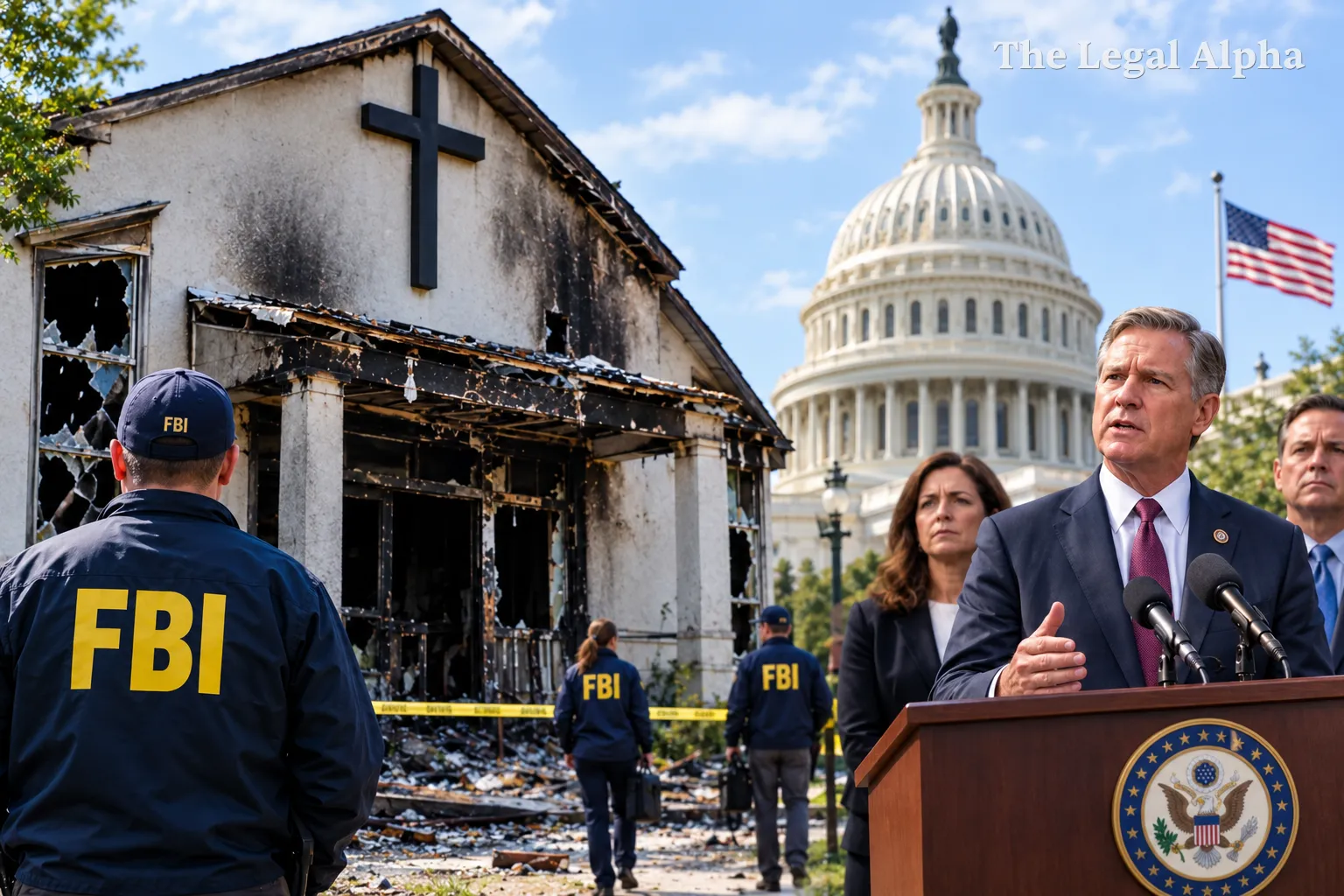
A bipartisan coalition of 105 United States lawmakers has formally petitioned the Federal Bureau of Investigation (FBI) to open a federal hate crime investigation into an attempted mass shooting at a Hindu temple in Illinois.
The incident took place outside the Sri Venkateswara Swami (Balaji) temple in Aurora, Illinois, where 19-year-old Alexandros Paporakis allegedly attempted to open fire on an individual outside the facility before his firearm jammed, preventing casualties. State prosecutors noted that the suspect harbored neo-Nazi affiliations. The congressional intervention, spearheaded by Representative Raja Krishnamoorthi alongside several federal lawmakers, urges FBI Director Kash Patel to deploy federal resources, examine extremist links, and evaluate whether federal hate crime statutes were violated.
Legal Topic
Area of Law: Criminal Law / Civil Rights Law
Sub-topic: Federal Hate Crimes and Protection of Religious Institutions
Core Legal Issue
The core legal question centers on the threshold required to escalate a state-level violent offense into a federal civil rights prosecution. Specifically, the inquiry focuses on whether an attempted firearm attack at a religious institution—foiled by weapon malfunction—meets the statutory criteria of targeted racial, ethnic, or religious animus required to establish federal jurisdiction and warrant charges under federal hate crime statutes.
What Did the Court / Authority Decide?
At present, no judicial ruling or federal charging indictment has been issued; the case remains in the investigatory and pre-trial phase.
-
State Proceedings: Alexandros Paporakis has been arrested and charged by local prosecutors in Illinois, with proceedings active regarding state-level firearm and attempted violence offenses.
-
Congressional Demands: In a formal oversight communication, lawmakers requested that the FBI examine online extremism, probe any coordinated networks behind the suspect, and evaluate hate crime designations. The letter sets an administrative response deadline for the bureau to outline its enforcement steps.
-
Federal Jurisdiction: The Department of Justice and the FBI have not yet filed separate federal charges, maintaining their ongoing role in supporting local authorities while determining if federal hate crime counts are applicable.
Key Legal Points
-
Jurisdictional Interplay Between State and Federal Law: Violent acts are primarily prosecuted under state criminal codes; federal intervention under civil rights statutes typically requires an explicit finding that animus based on religion, race, or ethnicity motivated the conduct.
-
Statutory Requirement of Specific Intent: A federal hate crime charge necessitates proving beyond a reasonable doubt that the accused selected the target or victim specifically because of protected characteristics, such as religious affiliation or perceived national origin.
-
Attempt Liability Under Federal Civil Rights Statutes: Federal civil rights law penalizes not only completed assaults or damage to property of worship, but also deliberate attempts to inflict bodily injury using dangerous weapons.
-
Heightened Scrutiny on Extremist Networks: Congressional oversight in bias-motivated crimes often compels investigators to analyze digital footprints to determine whether the act constitutes lone-actor violence or a broader conspiratorial offense.
Relevant Law
-
Matthew Shepard and James Byrd, Jr., Hate Crimes Prevention Act (18 U.S.C. § 249): Prohibits willfully causing, or attempting to cause, bodily injury to any person through the use of a firearm or dangerous weapon because of the actual or perceived race, color, religion, or national origin of any person.
-
Church Arson Prevention Act / Damage to Religious Property (18 U.S.C. § 247): Prohibits intentionally defacing, damaging, or destroying religious real property because of religious character, or obstructing any person in the enjoyment of their free exercise of religious beliefs.
-
First Amendment Considerations: Requires federal investigators to distinguish constitutionally protected extremist speech from unprotected true threats, incitement, and actionable criminal conduct.
Arguments of the Parties
The Petitioning Lawmakers Contended:
The signatories argued that targeting a place of worship accompanied by neo-Nazi affiliations creates a prima facie showing of bias-motivated violence. They submitted that the severity of a planned mass casualty event requires a coordinated federal response to protect civil rights, deter anti-religious violence, and uncover potential digital networks that encourage attacks against minority communities.
The Regulatory & Defense Context:
Federal investigators adhere to established dual-sovereignty principles and statutory thresholds, which require distinct evidentiary thresholds showing discriminatory motivation before federal indictments can be certified by the Attorney General. Counsel for the accused in ongoing state proceedings will assess procedural defenses, the sufficiency of the physical evidence, and whether online materials meet the high legal bar for establishing criminal intent rather than ideological posture.
Why Does It Matter?
This development highlights the evidentiary and procedural hurdles involved in classifying foiled domestic attacks as federal hate crimes. Federal hate crime statutes carry severe statutory penalties—including enhanced sentencing structures—that extend beyond standard state attempted murder or weapons charges.
Beyond this specific incident, the congressional push tests how federal law enforcement prioritizes emerging bias threats against religious and ethnic minorities facing escalating online rhetoric. An official federal indictment would set precedent regarding how aggressively the Department of Justice applies civil rights statutes to foiled attacks where physical harm was averted solely by mechanical firearm failure.
Legal Takeaway
For an attempted mass violent act to cross the threshold into a federal hate crime prosecution, federal authorities must establish a concrete evidentiary nexus connecting the defendant's acts directly to bias against a protected religious or racial group. Where state charges handle the underlying physical conduct, federal hate crime statutes provide a distinct civil rights remedy focused on deliberate discriminatory animus.
Sources
Primary Source:
Official Congressional Oversight Letter led by Representative Raja Krishnamoorthi to Federal Bureau of Investigation Director Kash Patel (October 20, 2026).
Additional Sources:
-
Case filings and public statements from the Office of the State's Attorney, DuPage/Kane County, Illinois regarding State of Illinois v. Alexandros Paporakis.
-
Federal Bureau of Investigation Hate Crime Data Collection Guidelines, Civil Rights Division, U.S. Department of Justice.