Sodium In Water Is Not An Explosive Substance: Karnataka High Court Quashes FIR Against YouTuber Over Science Demonstration
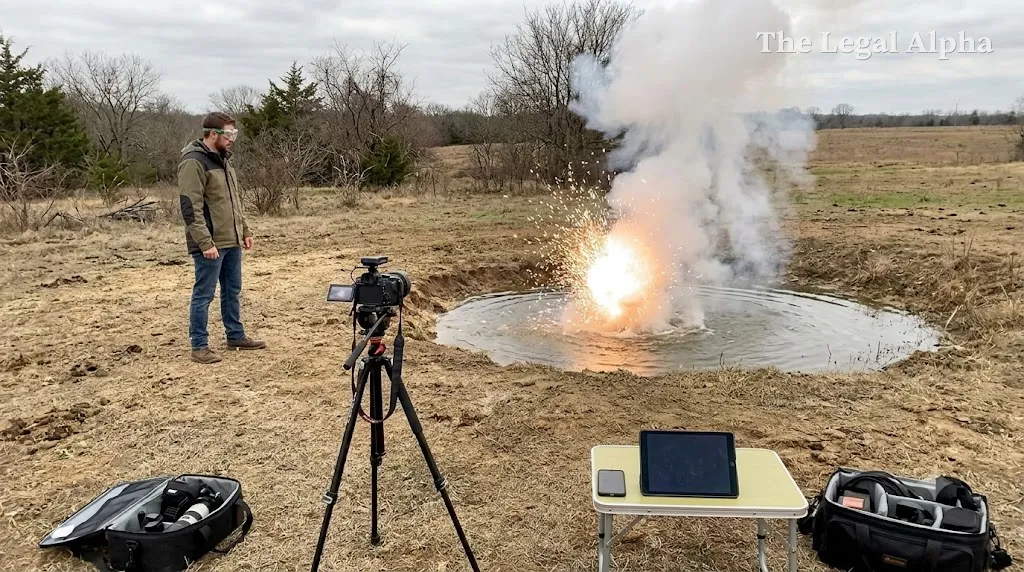
The Karnataka High Court has quashed a criminal case registered against online content creator and science educator Prathap N.M., popularly known as "Drone Prathap," after he filmed a chemistry experiment involving sodium and water.
The prosecution stemmed from a police complaint alleging that Prathap caused a dangerous blast by dropping roughly 100 grams of sodium metal into an artificial pond filled with water on a private farm. The demonstration, intended to illustrate concepts from the Class 10 NCERT syllabus, was recorded and shared on YouTube. Police initiated criminal proceedings invoking anti-explosive laws, alleging the act endangered surrounding life and safety. Justice Suraj Govindaraj set aside the First Information Report (FIR), holding that the incident lacked malicious intent and failed to fulfill the essential statutory elements of an offense under explosive control laws.
Legal Topic
Area of Law: Criminal Law / Statutory Interpretation
Sub-topic: Explosive Substances Act / Mens Rea in Scientific Demonstrations
Core Legal Issue
The primary legal question before the High Court was whether dropping elemental sodium into water to record an exothermic chemical reaction constitutes an unlawful and malicious act causing an explosion under Section 3 of the Explosive Substances Act, 1908.
Additionally, the Court evaluated whether creating a chemical reaction for open educational content on video amounts to culpable negligence or criminal endangerment under general penal provisions in the absence of a malicious intent to injure persons or property.
What Did the Court Decide?
The High Court allowed the petition and quashed the FIR and consequential criminal proceedings against the creator. Justice Suraj Govindaraj ruled that sodium in isolation does not qualify as an explosive substance within the statutory definition. Furthermore, the essential ingredient of acting "maliciously and unlawfully" under Section 3 of the Explosive Substances Act was entirely missing, as the demonstration was carried out openly for educational purposes on private property.
While granting relief, the Bench explicitly refused to endorse the safety measures or manner of conducting the experiment. The Court administered a stern caution that any future high-risk stunts or similar uncontrolled demonstrations by the petitioner would invite severe legal consequences. Liberty was granted to the creator to approach the jurisdictional Magistrate to seek the return of his seized production gear, including his camera, iPad, and mobile phone.
Key Legal Points
-
Elemental Classification: Sodium in itself is an elemental metal and does not fall within the statutory classification of an "explosive substance" under the Explosive Substances Act.
-
Requirement of Malice: A prosecution under Section 3 of the Explosive Substances Act requires proof that the accused acted unlawfully and maliciously; publishing an educational science demonstration on public platforms negates an inference of covert or malicious intent.
-
Distinction Between Recklessness and Criminality: Conducting a dramatic chemical experiment without adequate clearance may warrant caution, but absent statutory ingredients and mens rea, it cannot be sustained under anti-terror or stringent explosive penal statutes.
-
Return of Seized Gadgets: When criminal proceedings are quashed for lack of statutory merit, the accused retains the liberty to apply for the expeditious return of electronic equipment seized during the investigation.
Relevant Law
-
Section 3, Explosive Substances Act, 1908: Punishment for causing explosions likely to endanger life or property, which strictly mandates an "unlawful and malicious" act.
-
Section 288, Bharatiya Nyaya Sanhita (BNS), 2023 / Section 286, Indian Penal Code (IPC): Negligent conduct with respect to explosive or combustible substances.
-
Section 482, Code of Criminal Procedure (CrPC) / Section 528, Bharatiya Nagarik Suraksha Sanhita (BNSS): Inherent powers of the High Court to quash criminal proceedings to prevent abuse of the process of law.
Arguments of the Parties
Petitioner
Counsel for the petitioner submitted that the demonstration was a textbook science experiment illustrating basic alkali metal reactivity taught in secondary school syllabi. The defense emphasized that the exercise was conducted inside an artificial pit measuring 10 feet by 10 feet on a private farm, away from residential clusters, with requisite precautions. It was further argued that sodium metal by itself is not an explosive substance under Indian law and that openly uploading the footage proved there was no illicit or malicious intent.
Respondent / State
The State contended that the occurrence of a physical blast inside the water body was undisputed. The prosecution argued that the creator knowingly combined water and sodium knowing well that a violent chemical reaction and explosion would follow, creating potential risks for anyone in the vicinity. Consequently, the State urged that the investigation ought to proceed to determine whether public safety laws were breached.
Why Does It Matter?
The decision establishes an important line between legitimate scientific demonstration and criminal endangerment under India's stringent explosive safety framework. By examining the statutory prerequisite of malicious intent, the High Court checked the over-application of harsh anti-explosive statutes to everyday chemical reactions filmed for educational platforms.
At the same time, the ruling delivers a clear warning to digital content creators and educators: social media engagement does not grant legal immunity from basic public safety obligations, and future uncontrolled experiments risking public or environmental harm remain susceptible to regulatory and legal action.
Legal Takeaway
For charges under the Explosive Substances Act to survive, the substance involved must statutorily qualify as an explosive, and the act must be accompanied by proven unlawful and malicious intent. Conducting an educational chemistry experiment using standard reactive elements—even if dramatically filmed—does not constitute an offense under Section 3 of the Act without malice.
Sources
Primary Source:
High Court of Karnataka, Pratap N.M. v. State of Karnataka and Another, Criminal Petition, Neutral Citation: 2026:KHC:53677 (Order delivered by Justice Suraj Govindaraj).
Additional Sources:
Verified filings and case reportage via LawStreet Journal and Verdictum Legal News Service.