Court Recordings Are Not Public Property: Karnataka High Court Rules Litigants Have No Inherent Right to Archived Footage
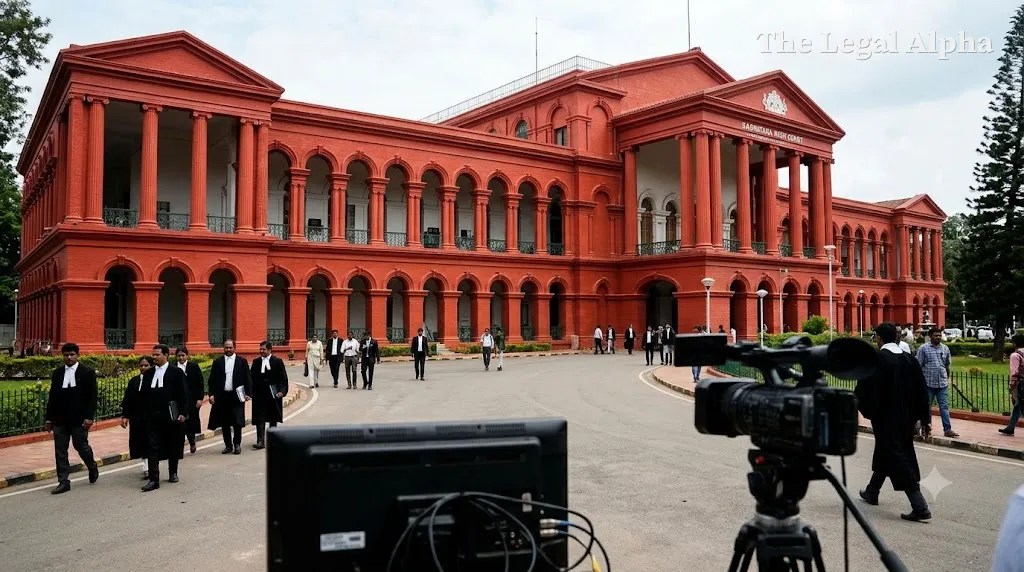
The Karnataka High Court dismissed a writ petition filed by a 72-year-old litigant who contested the administrative rejection of his request to obtain copies of archived audio-visual recordings of his courtroom hearings.
The petitioner sought access to the footage under the High Court’s live-streaming framework, contending that litigants should have access to records of their own hearings. However, the High Court clarified that court recordings do not automatically form part of the official judicial record and held that administrative authorities cannot release archived recordings unless the presiding bench issues an express judicial direction.
Legal Topic
Area of Law: Constitutional & Administrative Law
Sub-topic: Court Administration / Electronic Records & Live Streaming
Core Legal Issue
The principal question before the High Court was whether a litigant possesses an enforceable statutory or fundamental right to demand copies of archived audio-visual recordings of court proceedings in the absence of a specific judicial order directing that such footage form part of the official court record.
What Did the Court Decide?
Justice C.M. Poonacha dismissed the petition, holding that litigants have no vested or enforceable right under the procedural rules to obtain archived video recordings of hearings.
The Court held that:
-
The High Court registry’s administrative refusal to provide the requested recordings was lawful and did not suffer from procedural arbitrariness.
-
Without a specific judicial order from the concerned bench declaring the footage to be part of the official case record, administrative staff cannot release archived video.
-
Because the petitioner held no substantive right to the media files, his claim alleging a violation of Article 14 of the Constitution could not stand.
Key Legal Points
-
Archived Footage Is Not the Official Record: Under Rule 10 of the applicable rules, video streams and digital archives do not constitute the official record of court proceedings unless expressly designated as such by an order of the Bench.
-
Absence of Enforceable Right: Litigants cannot compel the registry through a writ petition to furnish internal audio-visual archives without first securing an order from the judge who heard the matter.
-
Scope of Administrative Discretion: Administrative authorities and registry officials cannot create rights of inspection or copying for electronic archives beyond the boundaries circumscribed by statutory rules.
Relevant Law
-
Karnataka Rules on Live Streaming and Recording of Court Proceedings, 2021:
-
Rule 8: Regulates the storage, archiving, and authorized usage of court recordings.
-
Rule 10(1)(ii): Mandates that archival data does not constitute the official record of court proceedings unless otherwise directed by the Bench.
-
-
Constitution of India:
-
Article 14: Invoked by the petitioner to claim equal access to administrative records, but rejected by the Court due to the absence of an underlying legal right.
-
Article 226: Under which the writ petition was filed seeking mandamus against the High Court administration.
-
Arguments of the Parties
Petitioner
-
The petitioner argued that as a party to the proceedings, he was entitled to review what transpired during his case hearings and that denying him access was arbitrary and violated Article 14.
-
He further prayed for a writ directing the High Court administration to frame and publish standard operating procedures to govern requests under Rule 8.
Respondent (High Court Administration)
-
The administrative authorities maintained that Rule 10(1)(ii) unambiguously provides that archival recordings do not constitute part of the judicial record unless ordered by the Bench.
-
Because no bench had directed the footage to be integrated into the case record, the registry lacked the authority to release digital archives to private parties.
Why Does It Matter?
As courts across India adopt live-streaming and digital archiving to advance the open-court principle, this judgment establishes a clear boundary between public viewing and official judicial records. Live streams and video archives are maintained to facilitate transparency, not to serve as an uncurated pool of secondary evidence or material for collateral dispute outside the written case file.
The ruling clarifies that the formal written record remains supreme. Litigants who wish to rely on video footage must apply directly to the presiding bench for judicial authorization rather than seeking routine administrative copies from court registries.
Legal Takeaway
Audio-visual recordings of judicial proceedings are not public domain records available upon request. A party cannot obtain copies of archived court footage unless the presiding bench explicitly orders that the recording be made part of the official judicial record.
Sources
Primary Source:
-
A. Sathyanarayana Swamy v. High Court of Karnataka, Writ Petition, High Court of Karnataka (Decided on October 21, 2026, per Justice C.M. Poonacha).
Additional Sources:
-
Karnataka Rules on Live Streaming and Recording of Court Proceedings, 2021.