Fifth Circuit Clears AIG in Bad-Faith Claim Despite $16.1 Million Hurricane Damage Appraisal
The U.S. Court of Appeals for the Fifth Circuit affirmed a jury verdict in favor of AIG Property Casualty Co., rejecting bad-faith insurance claims brought by a Louisiana physician couple.
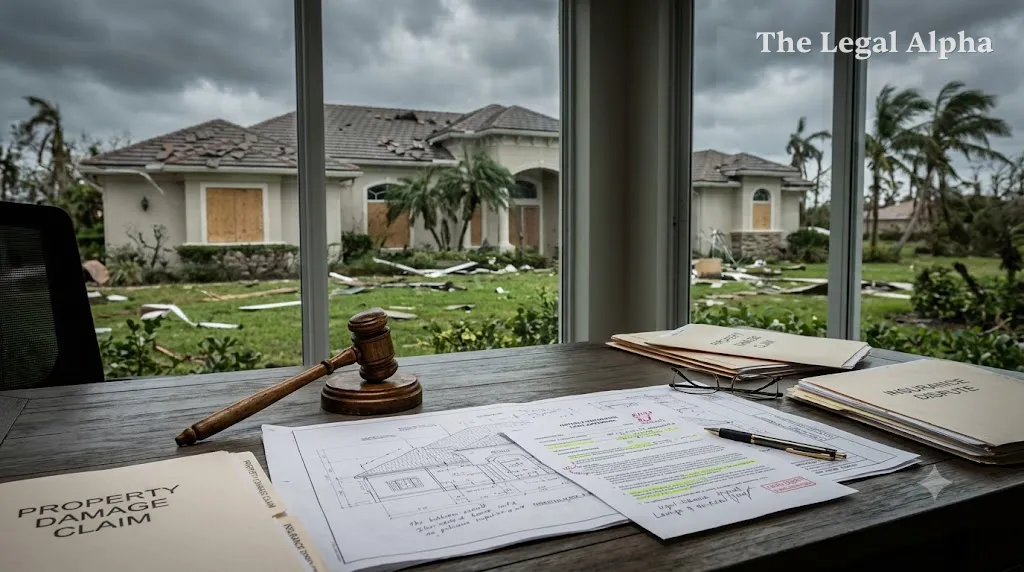
The dispute originated from severe property damage caused by Hurricane Ida to the New Orleans-area estate owned by the homeowners. While independent appraisal proceedings ultimately assessed property repairs at $16.1 million—far exceeding AIG's initial assessment of approximately $359,000 and intermediate payments—the insurer timely satisfied the final appraisal award. The property owners nonetheless pursued statutory penalties and bad-faith damages, contending that AIG acted arbitrarily and capriciously by refusing to accept their consultant's initial multimillion-dollar repair scope. A federal jury found that AIG did not act in bad faith, and the Fifth Circuit upheld that verdict.
Legal Topic
Area of Law: Insurance Law
Sub-topic: First-Party Property Claims / Statutory Bad-Faith Penalties
Core Legal Issue
The central legal question before the Fifth Circuit was whether an insurer acts in bad faith by declining to pay an insured’s unilateral repair estimate when the policyholder and insurer have a genuine, legitimate dispute over the scope and materials required for property restoration.
Specifically, the court examined whether a substantial gap between an insurer's early adjustment figures and a subsequently entered appraisal award automatically establishes arbitrary, capricious, or bad-faith claim handling under Louisiana insurance law.
What Did the Court Decide?
A three-judge panel of the Fifth Circuit affirmed the judgment of the U.S. District Court for the Eastern District of Louisiana, upholding the jury's verdict in favor of AIG.
The appellate court left intact the district court's prior summary judgment rulings, which established that AIG had complied with statutory deadlines by timely tendering undisputed payments and fulfilling the ultimate $16.1 million appraisal award. Because the remaining question of bad faith was submitted to the jury based on competing evidence regarding the reasonableness of AIG’s claim investigation, the Fifth Circuit determined there was sufficient evidentiary support for the jury's finding that AIG's resistance to the insured's demand did not constitute bad faith.
Key Legal Points
-
Disparity in Valuation Does Not Prove Bad Faith: A large difference between an insurer’s initial estimate and the final appraisal figure does not by itself establish that the insurer acted arbitrarily or without probable cause.
-
Genuine Disputes Shield Insurers: An insurer is entitled to contest disputed damages and replacement scopes—such as contentious material upgrades—without incurring statutory bad-faith liability, provided its position rests on a bona fide assessment.
-
Jury Deference on Reasonableness: Whether an insurer’s denial or withholding of disputed funds is arbitrary or capricious is primarily a question of fact, and appellate courts will not disturb a jury verdict supported by competent trial evidence.
-
Appraisal Compliance: Timely payment of undisputed amounts and prompt satisfaction of an umpire-rendered appraisal award can insulate an insurer from late-payment bad-faith claims regarding the award itself.
Relevant Law
-
Louisiana Revised Statutes (La. R.S.) § 22:1892: Governs the duty of insurers to pay claims within 30 days of receiving satisfactory proof of loss, establishing penalties for failure to pay without probable cause.
-
Louisiana Revised Statutes (La. R.S.) § 22:1973: Imposes an affirmative duty of good faith and fair dealing on insurers, subjecting them to penalties for arbitrary, capricious, or vexatious claim practices.
-
Fifth Circuit Rule 47.5: Appellate standard governing unpublished, non-precedential decisions.
Arguments of the Parties
Appellants (Insured Property Owners)
-
Argued that AIG's initial damage estimates and intermediate adjustment amounts were grossly inadequate relative to the catastrophic devastation sustained.
-
Submitted that AIG acted arbitrarily and in bad faith by rejecting the comprehensive proof of loss prepared by ATA Loss Consulting and forcing the matter through lengthy appraisal proceedings.
-
Claimed that the final $16.1 million appraisal confirmed that the insurer had vastly underpaid and improperly lowballed the covered loss.
Appellee (AIG Property Casualty Co.)
-
Maintained that it responded promptly by advancing emergency funds, securing expert engineering evaluations, and continually revising estimates as site conditions developed.
-
Contended that the insureds sought unwarranted property upgrades—such as replacing Santa Fe roof tiles with significantly more expensive Ludowici tiles, an adjustment likened at trial to jumping from an ordinary passenger car to a luxury vehicle.
-
Argued that a bona fide dispute existed regarding water intrusion and restoration materials, and that full payment of the binding appraisal award fulfilled all contractual and statutory duties.
Why Does It Matter?
This decision offers clear guidance on the relationship between contractual appraisal awards and statutory bad-faith litigation. In catastrophe-heavy jurisdictions like the U.S. Gulf Coast, policyholders often argue that an appraisal award significantly higher than an insurer’s estimate serves as proof of bad-faith adjustment.
The ruling reinforces that the appraisal mechanism exists precisely to resolve legitimate scope and pricing disagreements. So long as an insurer acts reasonably, relies on independent consulting reports, and pays undisputed portions within statutory deadlines, the mere fact that an appraisal panel awards a substantially higher sum will not automatically trigger statutory penalties.
Legal Takeaway
A policyholder cannot convert a good-faith disagreement over repair costs into statutory bad-faith penalties merely because an appraisal panel awards a much larger sum. Where an insurer maintains a reasonable, evidence-backed coverage defense and pays the final appraisal award on time, courts will uphold jury findings rejecting bad faith.
Sources
-
Primary Source: Talluri v. AIG Property Casualty Co., No. 24-30744 (5th Cir. Feb. 10, 2026) (per curiam) (affirming U.S. District Court for the Eastern District of Louisiana, Case No. 2:23-cv-00377).
-
Additional Sources: U.S. Court of Appeals for the Fifth Circuit docket records and trial proceedings; Louisiana statutory insurance provisions (La. R.S. §§ 22:1892, 22:1973).