Maneka Gandhi v. Union of India (1978): The Judgment That Redefined Personal Liberty
In Maneka Gandhi v. Union of India (1978), the Supreme Court transformed the constitutional understanding of personal liberty by holding that the procedure depriving a person of liberty must be fair, just and reasonable. This landmark judgment reshaped the relationship between Articles 14, 19 and 21 and strengthened constitutional scrutiny of executive power.
Maneka Gandhi v. Union of India (1978)
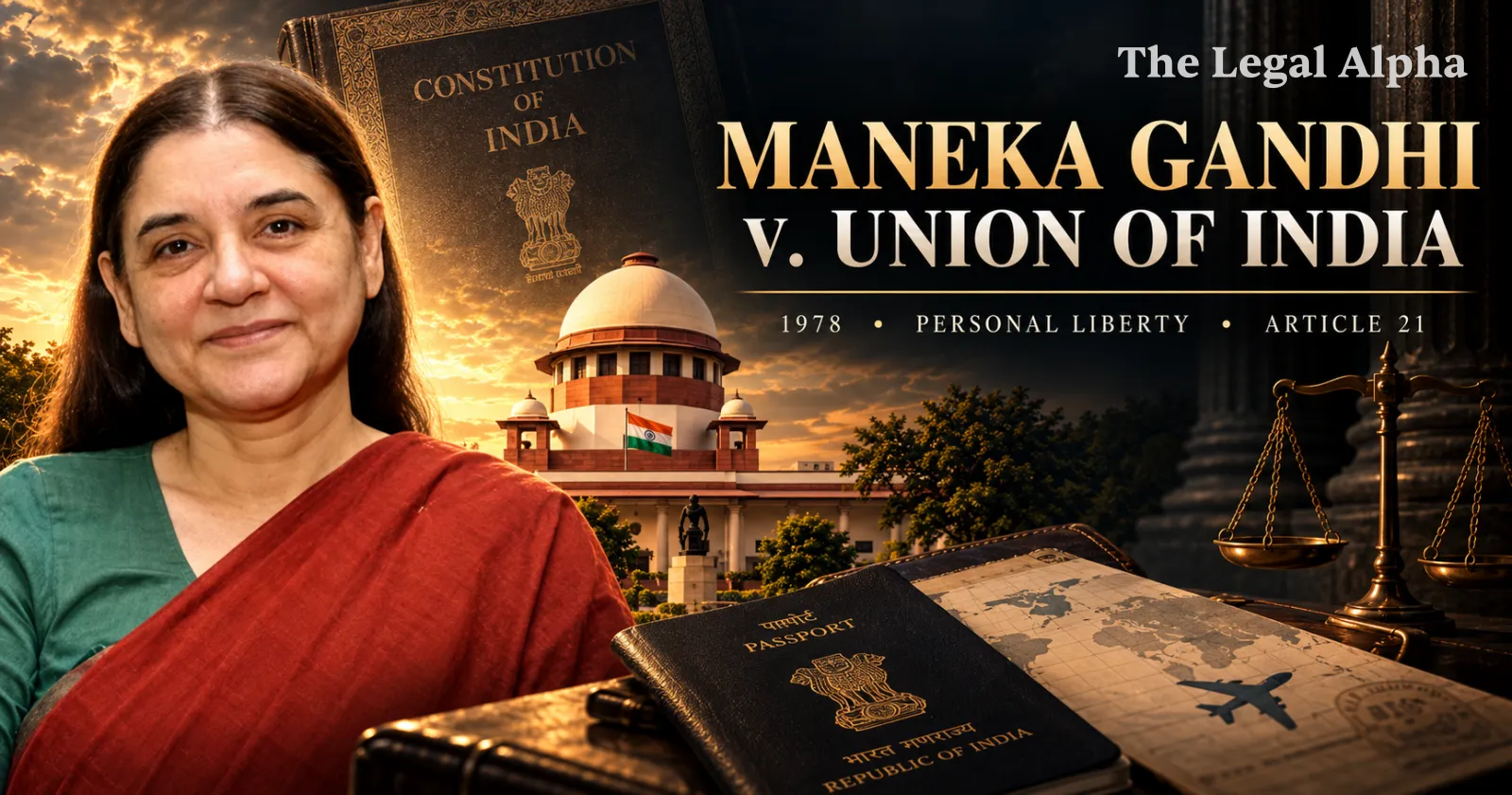
The Supreme Court’s landmark decision in Maneka Gandhi v. Union of India (1978) is a defining authority on personal liberty, procedural fairness, and the relationship between Articles 14, 19 and 21 of the Constitution. The case arose from the impounding of Maneka Gandhi’s passport without furnishing the reasons for the decision, bringing into question the limits of executive power over individual liberty. The Court held that the procedure established by law must be right, just and fair, and not arbitrary, fanciful or oppressive, transforming Article 21 from a narrow procedural guarantee into a powerful constitutional safeguard against arbitrary State action.
The Legal Alpha | Landmark Judgement
Citation: Maneka Gandhi v. Union of India, (1978) 1 SCC 248, AIR 1978 SC 597, [1978] 2 SCR 621.
Court: Supreme Court of India
Date of Judgment: 25 January 1978
Bench: M.H. Beg, C.J., Y.V. Chandrachud, P.N. Bhagwati, V.R. Krishna Iyer, N.L. Untwalia, S.M. Fazal Ali and P.S. Kailasam, JJ.
Proceeding: Writ Petition (Civil) No. 231 of 1977 under Article 32 of the Constitution of India
Area of Law: Constitutional Law, Personal Liberty, Fundamental Rights, Natural Justice, Administrative Law and Judicial Review
The Case in 60 Seconds
What happened?
The impounding of a passport brought before the Supreme Court a question that reached far beyond the right to travel abroad: could the State deprive an individual of personal liberty merely by following a procedure enacted by law, or was that procedure itself required to satisfy constitutional standards of fairness?
Maneka Gandhi's passport was impounded under the Passports Act, 1967, in the interests of the general public. The government declined to disclose its reasons. Her challenge required the Court to examine the relationship between Articles 14, 19 and 21, the scope of executive discretion, and the place of natural justice in administrative decisions affecting fundamental rights. [1]
The seven-judge bench did not invalidate the Passports Act. It did, however, reject the idea that the existence of a legally prescribed procedure necessarily concluded the inquiry under Article 21. In the influential opinion delivered by Justice P.N. Bhagwati, the Court explained that the procedure depriving a person of personal liberty must be fair, just and reasonable, and not arbitrary, fanciful or oppressive. The judgement also affirmed that fundamental rights cannot be treated as watertight compartments where a State action engages more than one constitutional guarantee. [2]
The consequence was a substantial change in Indian constitutional adjudication. The question was no longer confined to whether the executive had statutory authority to act. Courts would also have to examine the constitutional validity of the law and the procedure through which that authority was exercised.
Why the Case Reached the Supreme Court
A passport is an instrument through which international travel is ordinarily facilitated. Its impounding can prevent its holder from leaving the country, with consequences for personal freedom, professional activity and the ability to pursue commitments abroad. Whether the State may impose such a restriction is a legitimate question of public administration. Whether it may do so without complying with the Constitution is a different question.
The distinction had become especially important in the development of Indian fundamental-rights jurisprudence. Article 21 provides that no person shall be deprived of life or personal liberty except according to procedure established by law. The language does not expressly reproduce the American constitutional phrase “due process of law". The interpretation of that difference had shaped the Court's approach to personal liberty since the early years of the Republic.
In A.K. Gopalan v. State of Madras, the Supreme Court had adopted an approach that treated the guarantees in Part III largely as separate constitutional compartments. The existence of a procedure prescribed by legislation carried decisive weight in the Article 21 inquiry, while the applicability of other fundamental rights was examined through a more compartmentalised framework.[3]
That position had already been qualified by later decisions. In R.C. Cooper v. Union of India, the Court rejected the assumption that the constitutional character of State action could be determined exclusively by its formal object or by assigning it to one particular fundamental right. The actual effect of the measure upon protected rights also mattered.[4]
Maneka Gandhi brought these developments into the examination of personal liberty. Its importance lay not simply in the right to travel abroad, but in the standards against which the State's power to restrict that right would be judged.
Facts of the Case
The Statutory Background
The Passports Act, 1967, was enacted to regulate the issue of passports and travel documents and the departure from India of citizens and other persons. Its enactment followed the Supreme Court's decision in Satwant Singh Sawhney v. D. Ramarathnam, which had recognised that the right to travel abroad fell within personal liberty and could not be taken away without authority of law. [5]
Section 10(3)(c) of the Passports Act empowered the passport authority to impound or revoke a passport where it considered such action necessary in the interests of the sovereignty and integrity of India, the security of India, friendly relations with a foreign country, or the interests of the general public.
Section 10(5) required the passport authority to record in writing a brief statement of reasons for an order impounding or revoking a passport and, upon demand, furnish a copy to the holder. The provision also permitted the authority to withhold the statement where disclosure was considered contrary to the specified public interests. [6]
The statute therefore contained both a power to restrict travel and a mechanism governing the recording and communication of reasons. The constitutional challenge concerned the limits of that power and the fairness of the procedure through which it was exercised.
The Impounding Order
Maneka Gandhi had been issued a passport on 1 June 1976. By a letter dated 2 July 1977, received on 4 July 1977, she was informed that the Government of India had decided to impound her passport under Section 10(3)(c) in the interests of the general public. She was directed to surrender it within seven days. [7]
Gandhi requested a statement of the reasons for the decision under Section 10(5). On 6 July 1977, the Ministry of External Affairs informed her that the Government had decided, in the interests of the general public, not to furnish the reasons.[8]
The order thus restricted her ability to travel abroad while withholding the grounds on which the restriction had been imposed.
The Government subsequently explained its position in the proceedings before the Supreme Court. Its case included the possibility that Gandhi's presence might be required in connection with proceedings before the Shah Commission of Inquiry. [9] The Court was consequently required to consider not only the statutory power to impound a passport but also whether the procedure followed afforded adequate protection to the person affected.
The Constitutional Challenge
Gandhi invoked Article 32, alleging that the impounding order infringed her fundamental rights. The challenge included Articles 14, 19(1)(a), 19(1)(g) and 21, raising questions concerning equality, freedom of expression, professional activity and personal liberty. [10]
The challenge was not that Parliament could never authorise the impounding of passports. Section 10 expressly conferred such a power in specified circumstances. The question was whether the power could be exercised through a procedure that was constitutionally unfair and whether the statutory framework itself satisfied the applicable guarantees.
This distinction shaped the entire case. A statutory power may be validly conferred while remaining subject to constitutional limits. Equally, the fact that an individual is affected by an administrative decision does not by itself establish that the decision is unlawful. The relevant questions concern the source of power, the rights affected, the procedure adopted and the constitutional standards applicable to that exercise of power.
The Constitutional Questions
The proceedings raised several connected questions:
- Does the right to travel abroad form part of personal liberty under Article 21?
- What does “procedure established by law” require when the State deprives a person of personal liberty?
- Can a procedure prescribed by legislation be constitutionally valid if it is arbitrary or unfair?
- Are Articles 14, 19 and 21 mutually exclusive, or must their guarantees be considered together where State action engages more than one of them?
- Do the principles of natural justice apply to administrative decisions that affect fundamental rights?
- Can the absence of a prior hearing be justified, and what role can a subsequent hearing play?
- Does the statutory power to withhold reasons remove the decision from constitutional scrutiny?
- What relief was appropriate in light of the Government's explanation and the undertakings made before the Court?
The answers were interrelated, but each concerned a different aspect of constitutional control. The recognition of a right to travel abroad did not establish that the right was absolute. The validity of a statutory power did not determine whether every order made under it was lawful. Nor did the requirement of a fair procedure necessarily prescribe one uniform form of hearing for every administrative decision.
The Arguments Before the Court
Maneka Gandhi's Case
Gandhi argued that the right to travel abroad formed part of personal liberty under Article 21 and could not be restricted except in accordance with a constitutionally valid procedure. She challenged the adequacy of the procedure under the Passports Act, including the absence of an opportunity to be heard and the refusal to disclose reasons for the impounding order.[11]
She also challenged Section 10(3)(c) and the impugned order under Articles 14, 19(1)(a), 19(1)(g) and 21. Her case was that the restriction affected more than the possession of a travel document, it could interfere with her freedom to express views abroad and pursue professional activity, while also depriving her of the ability to travel.[12]
The constitutional argument therefore required the Court to consider the actual effect of the impounding order, rather than accept its classification as an administrative measure under a statute as sufficient to resolve the matter.
The Government's Case
The Government relied on the statutory authority conferred by the Passports Act and the public interests identified in Section 10(3)(c). It also relied on Section 10(5), which permitted reasons to be withheld in the circumstances specified by the provision.
The Government's position raised a genuine institutional concern, disclosure of information may, in some circumstances, undermine the very public interest that justifies administrative action. The question was whether that concern could justify withholding reasons in the particular case and how the power remained subject to constitutional control.
The Court was not required to choose between an unrestricted executive power and a rule prohibiting passport impounding altogether. It had to determine how a statutory power affecting personal liberty could operate within the constitutional framework.
The Court's Reasoning
1. The Right to Travel Abroad Forms Part of Personal Liberty
The starting point was Satwant Singh Sawhney v. D. Ramarathnam. In that case, the Supreme Court had held that the right to travel abroad fell within the protection of personal liberty under Article 21. The State could not deprive a person of that liberty without authority of law.[13]
The Passports Act supplied a statutory framework for the exercise of that authority. But the existence of the Act did not settle every constitutional question raised by the impounding order.
The right to travel abroad was not absolute. Parliament could provide for restrictions in circumstances recognised by law, and the executive could exercise the authority conferred by the statute. The issue was whether the legal framework and its implementation satisfied the Constitution.
This distinction is essential to understanding the decision. The Court did not convert the right to travel abroad into a freedom immune from regulation. It placed the restriction within the constitutional scrutiny applicable to the deprivation of personal liberty.
2. The Limits of the A.K. Gopalan Approach
The most consequential part of the judgment concerned the relationship between Article 21 and the other fundamental rights.
In A.K. Gopalan, the Court had approached the guarantees in Part III largely as separate provisions governing distinct subjects. A law dealing with preventive detention was examined principally through the provisions considered applicable to that subject, particularly Articles 21 and 22. The approach left limited room for examining the same law through the requirements of other fundamental rights.
The development did not end with Gopalan. In R.C. Cooper, the Supreme Court held that the assumption that particular constitutional articles exclusively governed particular subjects could not be accepted as a complete account of fundamental-rights protection. The effect of State action upon protected rights mattered, even where the action had been formally framed as an exercise of a different power.[14]
That development was relevant to personal liberty because a single State action may affect more than one constitutional interest. A restriction may implicate Article 21 while also raising questions under Article 14 or, where the facts engage a protected freedom, Article 19.
Justice Bhagwati's opinion in Maneka Gandhi developed this reasoning. The majority's constitutional analysis did not permit Article 21 to be treated as a self-contained answer to every challenge involving personal liberty. A procedure affecting liberty also had to satisfy the requirements of the other fundamental rights applicable to the action.[15]
The consequence was not that all fundamental rights became identical. Each provision retained its own language and scope. Rather, the State could not avoid scrutiny under one applicable guarantee merely by satisfying the requirements of another.
3. The Meaning of “Procedure Established by Law”
Article 21 provides: “No person shall be deprived of his life or personal liberty except according to procedure established by law.”
The constitutional issue was whether the existence of a procedure prescribed by legislation was sufficient, or whether the procedure itself had to satisfy standards of fairness.
Justice Bhagwati's opinion answered that question by connecting the requirement of procedure under Article 21 with the prohibition of arbitrariness under Article 14. The principle of reasonableness, he explained, is an essential element of equality and non-arbitrariness. The procedure contemplated by Article 21 must therefore be “right and just and fair” and not “arbitrary, fanciful or oppressive.”[16]
The significance of this reasoning lies in its treatment of procedure as a constitutional safeguard rather than a mere legislative formality. A procedure could not be regarded as constitutionally adequate simply because the legislature had prescribed it. Its content and operation had to satisfy the applicable constitutional requirements.
This did not mean that the Court simply substituted the American phrase “due process of law” for the language chosen in Article 21. The Court interpreted the Indian constitutional text in conjunction with the guarantees contained in Part III, particularly Articles 14 and 21.
The resulting principle was substantial. The State could not justify a deprivation of personal liberty solely by pointing to a statute. The constitutional validity of the procedure remained open to examination.
4. The Interrelationship Between Articles 14, 19 and 21
The decision is frequently associated with the expression “golden triangle,” referring to the relationship between Articles 14, 19 and 21. That expression describes the result of the Court's reasoning, but the constitutional analysis is more precise than the slogan suggests.
Article 14 guarantees equality before the law and equal protection of the laws. Its prohibition on arbitrary State action is relevant to the validity of procedures that affect individual liberty.
Article 19 protects specified freedoms, subject to the restrictions permitted by the Constitution. Article 21 protects life and personal liberty against deprivation except according to constitutionally valid procedure.
The provisions are not interchangeable. The right to travel abroad is not expressly listed as a separate freedom under Article 19(1), and the Court's recognition of that right under Article 21 did not make it an independent Article 19(1) freedom.
The significance of the judgment is that, where a law or State action engages multiple fundamental rights, each applicable guarantee must be considered. Compliance with Article 21 does not automatically answer a challenge under Article 14 or Article 19. Similarly, the fact that an action falls within a statutory power does not exempt it from scrutiny under the fundamental rights it affects.[17]
The constitutional inquiry must therefore follow the effect of the State action and the requirements of the provisions engaged by it.
This was an important development from the compartmentalised approach associated with Gopalan. It built upon the reasoning of R.C. Cooper, which had already rejected the assumption that the formal character of State action alone determined the fundamental-rights analysis.
5. Natural Justice Applies to Administrative Decisions Affecting Rights
The absence of a prior hearing raised a distinct issue. Was the passport authority required to hear Gandhi before impounding her passport?
Justice Bhagwati's opinion examined the development of natural justice in administrative law. Earlier approaches had drawn a rigid distinction between judicial or quasi-judicial proceedings, to which natural justice applied, and administrative decisions, which were often treated as outside its reach. That distinction had progressively weakened through decisions recognising that administrative action could have consequences as serious as judicial determinations.[18]
The Court's reasoning drew upon the principle that the purpose of natural justice is to secure a fair decision and prevent miscarriage of justice. The applicability of the principles depends on the nature of the power, the legal framework and the consequences for the person affected.
The power to impound a passport was significant because its exercise impaired the holder's ability to travel abroad. The decision was not merely an internal administrative matter without consequences for the individual. It affected personal liberty and therefore required the authority to act fairly.
The judgment thus rejected the idea that the label “administrative” was sufficient to exclude natural justice. The relevant question was whether fairness required an opportunity to be heard in the circumstances.
This principle did not turn every administrative decision into a trial. It required the procedure to be appropriate to the power exercised, the rights affected and the circumstances of the case.
6. The Prior Hearing and the Possibility of a Subsequent Hearing
The case also required the Court to consider whether a hearing must always precede an adverse administrative decision.
A prior hearing ordinarily allows the affected person to address the proposed action before it is taken. A hearing after the decision may serve a different purpose, it gives the person an opportunity to challenge the basis of the order and seek reconsideration.
The Court recognised that the requirements of natural justice are flexible. What constitutes a reasonable opportunity to be heard depends on the practical necessities of the situation. A hearing may be full or limited, and in appropriate circumstances it may take place after the initial decision.[19]
That recognition should not be read as a general rule that a post-decisional hearing always cures the absence of a prior hearing. The adequacy of a later hearing depends on the circumstances, the effect of the original decision and whether the opportunity to make representations is genuine and effective.
The distinction mattered in Maneka Gandhi because the Government's position and the undertakings made before the Court formed part of the circumstances in which the petition was disposed of. The case therefore cannot be reduced to a universal proposition that every administrative restriction on liberty may be imposed first and justified later.
The constitutional principle is that the procedure must satisfy the requirements of fairness in the particular legal setting. The form and timing of the hearing are relevant to that assessment.
7. Reasons, Disclosure and Public Interest
The Government's refusal to disclose its reasons raised a question under Section 10(5) of the Passports Act. The provision required reasons to be recorded and ordinarily furnished to the passport holder on demand, while permitting withholding in specified circumstances.
The statutory exception was relevant. There may be circumstances in which disclosing particular information would conflict with a public interest recognised by law. But the existence of an exception did not automatically establish that the impounding order itself was constitutionally valid.
Reasons serve an important function in public administration. They enable the affected person, where disclosure is permitted, to understand the basis of the decision and make an informed representation. They also assist a reviewing court in determining whether the authority acted within the limits of its power.
Where reasons are withheld under a statutory exception, the affected person may face difficulty challenging the decision. That difficulty does not itself prove that the order is invalid, but neither does the statutory power to withhold reasons place the underlying exercise of authority beyond judicial review.
The relevant questions remain whether the power was exercised under lawful authority, whether the statutory conditions were met and whether the applicable constitutional safeguards were respected. Public interest is a recognised consideration under the Act, not an unrestricted formula that resolves every question of legality.
8. The Validity of the Statute and the Legality of the Order
The constitutional challenge also required a distinction between the validity of Section 10(3)(c) and the legality of the order made under it.
Section 10(3)(c) authorised impounding in specified circumstances, including the interests of the general public. The Court did not hold that Parliament lacked power to confer such authority. Nor did it strike down the Passports Act in its entirety.
The issue was whether the statutory power and the procedure governing its exercise complied with the Constitution. A valid statutory power can be exercised unlawfully in a particular case. Conversely, the allegation that a particular order was unfair does not necessarily establish that the statute authorising it is invalid.
The judgment strengthened the constitutional control of administrative discretion by making clear that statutory authority is not the end of the inquiry. The exercise of the power remains subject to the fundamental rights applicable to it.
The Opinions of the Seven-Judge Bench
The judgment was delivered through separate opinions. The principal constitutional propositions are commonly associated with Justice Bhagwati's opinion, but the separate reasoning matters to the precise scope of the decision.
Chief Justice M.H. Beg
Chief Justice Beg agreed with the conclusions reached by Justices Bhagwati and Krishna Iyer on the principal issues, while offering his own approach to the constitutional questions.
He recognised the right to travel abroad as part of personal liberty and emphasised the importance of natural justice in decisions affecting fundamental rights. He also considered the Government's explanation and the opportunity available to Gandhi to challenge the grounds relied upon for impounding her passport.[20]
Chief Justice Beg's opinion is significant for its emphasis on the need for executive action to be free from the appearance of arbitrariness, unreasonableness or unfairness. He considered the Government's undertaking to deal with Gandhi's case fairly and to inform her of any grounds for impounding her passport. In his view, the order ought to be quashed, although he agreed that the undertaking could make further action by the Court unnecessary.
Justice Y.V. Chandrachud
Justice Chandrachud agreed with the proposed disposition. His opinion addressed the relationship between the constitutional guarantees and the significance of the Government's undertaking to provide a further opportunity to be heard.
He considered the absence of a hearing before or soon after the impounding order a serious procedural concern, while also taking account of the Government's statement that it was willing to hear Gandhi and to limit the duration of any adverse decision made after that hearing.[21]
His opinion illustrates the importance of reading the procedural issue in the context of the actual proceedings rather than treating the judgment as an abstract ruling on the timing of hearings.
Justice P.N. Bhagwati, with Justices Untwalia and Fazal Ali
Justice Bhagwati delivered the principal opinion on the constitutional questions, with Justices Untwalia and Fazal Ali agreeing with him.
The opinion addressed the scope of personal liberty, the relationship between Articles 14, 19 and 21, the requirement of fair procedure and the application of natural justice to administrative decisions. Its statement that the procedure under Article 21 must be fair, just and reasonable became one of the most influential formulations in Indian constitutional law.[22]
The opinion also examined the argument that the Passports Act was invalid because of the discretion conferred on the passport authority. The constitutional issue required attention to the statutory framework, the nature of the power and the safeguards applicable to its exercise. The judgment did not treat every grant of administrative discretion as inherently unconstitutional; it required the exercise of that discretion to remain within the limits imposed by the Constitution.
Justice V.R. Krishna Iyer
Justice Krishna Iyer delivered a separate opinion that approached the constitutional questions through the relationship between personal liberty and the legal control of executive power.
His opinion contributed to the Court's broader examination of the nature of personal liberty and the constitutional significance of procedural fairness. It should be read alongside the other opinions rather than treated as identical to Justice Bhagwati's reasoning on every point.[23]
Justice P.S. Kailasam
Justice Kailasam also delivered a separate opinion. His approach differed from aspects of the reasoning adopted by the other judges, particularly in the treatment of the relationship between the fundamental rights and the constitutional questions arising from the impounding order.
The separate opinion is important because it demonstrates that the Bench did not express every proposition in identical terms. The judgment's principal constitutional principles must be understood in the context of the opinions and the points on which the Court's decision rests.[24]
The Final Order
The Supreme Court did not formally quash the impounding order or strike down the Passports Act. Having regard to the majority view and the statement made by the Attorney-General, the Court considered it unnecessary to interfere formally with the impugned order. The writ petition was disposed of without passing a formal order; the passport was to remain in the custody of the Registrar of the Court until further orders, and there was no order as to costs.[25]
This procedural outcome matters. It would be inaccurate to state that the Court simply invalidated the passport order and directed the immediate return of the passport. Chief Justice Beg expressed the view that the order should be quashed, but the Court's operative order disposed of the petition without formal interference.
The case's constitutional importance therefore lies principally in the standards articulated by the Court concerning personal liberty, fair procedure and the relationship between fundamental rights not in a final order striking down the impounding power.
Ratio Decidendi
The central principle emerging from Maneka Gandhi is that the procedure by which a person is deprived of personal liberty under Article 21 must satisfy the applicable constitutional requirements of fairness and non-arbitrariness. A procedure cannot be regarded as constitutionally sufficient merely because it has been prescribed by legislation.[26]
The judgment also establishes that Articles 14, 19 and 21 cannot be treated as entirely separate compartments where State action engages more than one of their guarantees. The law and the action taken under it must satisfy the requirements of the fundamental rights applicable to the case.[27]
Natural justice is relevant to administrative decisions affecting rights and liberty. The form of the hearing may depend on the circumstances, but administrative classification alone does not exclude the obligation to act fairly.[28]
These principles do not establish an absolute right to travel abroad, invalidate every restriction on liberty or require identical procedural safeguards in every administrative decision. They require the State's exercise of power to remain within the constitutional limits applicable to it.
Subsequent Development of the Doctrine
Sunil Batra v. Delhi Administration (1978)
In Sunil Batra v. Delhi Administration, the Supreme Court examined the treatment of prisoners and the constitutional limits on the exercise of authority within prisons.[29] The decision demonstrated that imprisonment does not extinguish all protection under Article 21. Its specific holdings concerning prison conditions and treatment must be understood through that case's own facts and reasoning.
Francis Coralie Mullin v. Administrator, Union Territory of Delhi (1981)
In Francis Coralie Mullin v. Administrator, Union Territory of Delhi, the Court developed the understanding of life under Article 21 beyond mere physical existence, connecting it with human dignity and the conditions necessary for a meaningful life.[30] This was a further development of Article 21 jurisprudence rather than a proposition that had been fully resolved in Maneka Gandhi.
Mithu v. State of Punjab (1983)
In Mithu v. State of Punjab, the Court invalidated the mandatory death penalty prescribed by Section 303 of the Indian Penal Code.[31] The decision illustrates the constitutional scrutiny of a legal rule that deprived a person of life, including the fairness and validity of the statutory scheme itself.
Olga Tellis v. Bombay Municipal Corporation (1985)
In Olga Tellis v. Bombay Municipal Corporation, the Court examined the relationship between livelihood and the right to life under Article 21 in the context of the eviction of pavement dwellers.[32] The decision demonstrates how the constitutional understanding of life and liberty continued to develop through cases involving different forms of State action.
K.S. Puttaswamy v. Union of India (2017)
In K.S. Puttaswamy v. Union of India, a nine-judge Bench recognised privacy as a fundamental right protected by the Constitution.[33] The judgment considered dignity, autonomy, liberty and the relationship between fundamental rights, drawing upon the development of constitutional jurisprudence that included Maneka Gandhi.
The privacy judgment is a later doctrinal development, not merely a restatement of Maneka Gandhi. Its significance lies in the constitutional protection of privacy and the distinct questions that arise when State action interferes with it.
Related Cases
| Case | Connection with Maneka Gandhi |
|---|---|
| A.K. Gopalan v. State of Madras, [1950] SCR 88 (India) [3] | The earlier compartmentalised approach to fundamental rights against which Maneka Gandhi marked a significant doctrinal shift. |
| Satwant Singh Sawhney v. D. Ramarathnam, [1967] 3 SCR 525 (India) [5] | Recognised that the right to travel abroad falls within personal liberty and cannot be taken away without authority of law. |
| R.C. Cooper v. Union of India, (1970) 1 SCC 248 (India) [4] | Emphasised the effect of State action on fundamental rights and helped displace a strictly compartmentalised approach to constitutional guarantees. |
| Sunil Batra v. Delhi Administration, (1978) 4 SCC 494 (India) [29] | Applied constitutional protection to the treatment of prisoners and the exercise of authority within prisons. |
| Francis Coralie Mullin v. Administrator, Union Territory of Delhi, (1981) 1 SCC 608 (India) [30] | Developed the understanding of Article 21 by connecting life with human dignity and the conditions necessary for a meaningful life. |
| Mithu v. State of Punjab, (1983) 2 SCC 277 (India) [31] | Examined the constitutional validity of a mandatory death-penalty provision, illustrating scrutiny of the fairness and validity of a statutory scheme affecting life. |
| Olga Tellis v. Bombay Municipal Corporation, (1985) 3 SCC 545 (India) [32] | Considered livelihood as an aspect of Article 21 in the context of eviction, extending the jurisprudence into the conditions necessary to sustain life. |
| K.S. Puttaswamy v. Union of India, (2017) 10 SCC 1 (India) [33] | Recognised privacy as a fundamental right and developed the constitutional relationship between liberty, dignity, autonomy and fundamental rights. |
These decisions should not be read as interchangeable applications of a single rule. Each addressed a distinct legal question, but together they illustrate the development of constitutional scrutiny of State action affecting life, liberty and other fundamental rights.
The Present Legal Position
Maneka Gandhi remains a foundational authority for the interpretation of Article 21 and the constitutional control of administrative action affecting personal liberty. The procedure established by law cannot be treated as sufficient merely because it has been enacted. Its constitutional validity must be assessed against the applicable requirements of fairness and non-arbitrariness.
The relationship between Articles 14, 19 and 21 remains important in determining the validity of State action. The provisions retain distinct scopes, but a measure that engages more than one fundamental right must be examined against each applicable guarantee.
Natural justice also remains a central part of administrative law. Whether a prior hearing is required, whether a subsequent hearing can be sufficient and what form the hearing must take depend on the governing statute, the nature of the power and the consequences of the decision. Maneka Gandhi does not establish that every procedural defect necessarily invalidates every administrative order.
Nor does the judgment prevent the State from restricting liberty where the Constitution permits it. The legal inquiry remains whether the State acted under lawful authority and complied with the constitutional safeguards applicable to the restriction.
Practical Significance
The practical importance of Maneka Gandhi is that a challenge to State action affecting personal liberty need not end with the identification of a statutory provision authorising the action. The law, the procedure it prescribes and the way the power has been exercised may each raise distinct constitutional questions. The precise grounds of challenge will depend on the right affected and the governing legal framework. [16], [17], [18], [19]
- For constitutional litigation: Where the facts engage more than one fundamental right, the challenge should identify each applicable constitutional guarantee rather than assume that Article 21 alone determines the issue. Articles 14, 19 and 21 retain distinct scopes, even though their protections may overlap in a particular case. [17]
- For public authorities: Statutory discretion must be exercised within the limits of the enabling legislation and the Constitution. The existence of a power does not exempt the decision made under it from scrutiny for arbitrariness, procedural unfairness or failure to satisfy statutory conditions. [16], [26], [27], [28]
- For procedural fairness: The need for a prior hearing, the possibility of a subsequent hearing and the adequacy of the opportunity to make representations must be assessed in context. Maneka Gandhi does not establish that a post-decisional hearing automatically cures every procedural defect. [18], [19], [28]
- For reasons and judicial review: A statutory basis for withholding reasons does not, by itself, establish that the underlying decision is lawful or place it beyond review. The relevant statutory conditions and applicable constitutional safeguards remain important. [6], [8], [16]
- For individuals affected by State action: The judgment provides a framework for questioning not only whether an authority was empowered to act, but whether the procedure and the resulting action complied with the constitutional protections applicable to the case. It does not, however, make every restriction on liberty invalid or guarantee that every challenge will succeed.
The practical lesson is therefore one of constitutional method, identify the source of power, determine the rights engaged, examine the procedure followed and test the action against the legal and constitutional standards that apply.
The Legal Alpha Analysis: The Limits of State Power
The constitutional significance of Maneka Gandhi v. Union of India lies in its rejection of the idea that legislative authorisation, by itself, is sufficient to justify a deprivation of personal liberty. The existence of a law may establish the legal source of executive power, but it does not conclude the question of whether that power has been exercised in a manner consistent with the Constitution. By bringing the procedure depriving a person of liberty within the scrutiny of Articles 14, 19 and 21, the Supreme Court placed a substantive constitutional limit on the manner in which the State may exercise its authority.
This was a consequential shift in the relationship between the individual and the State. Constitutional protection would have limited practical value if the government could justify an interference with liberty merely by identifying a statutory provision that authorised it. The legality of the power and the constitutionality of its exercise are distinct questions.
Maneka Gandhi reinforced this distinction by requiring the procedure through which liberty is restricted to be examined against the applicable constitutional guarantees. The State's authority to act could no longer be treated as an answer to every objection concerning how that authority had been exercised.
The judgment's approach to the relationship between fundamental rights is equally important. The Constitution's guarantees cannot be understood as entirely separate compartments, each insulated from the requirements of the others. Where State action affects personal liberty and engages other fundamental rights, its validity must be assessed in light of the constitutional protections that apply. This approach makes constitutional review more meaningful, the government cannot avoid scrutiny of an action's broader constitutional consequences merely because the action can be traced to a particular statutory power.
However, the importance of Maneka Gandhi should not be overstated. The judgment did not eliminate executive discretion, prohibit every restriction on personal liberty or establish that every administrative decision must follow an identical procedure. Nor does procedural fairness require the same safeguards in every factual setting. The question is whether the procedure adopted satisfies the constitutional requirements applicable to the particular exercise of power. The judgment's treatment of hearings, the disclosure of reasons and claims of public interest demonstrates why these questions must be assessed in context rather than resolved through absolute rules.
That distinction remains significant whenever the State relies on confidentiality, administrative necessity or statutory discretion to defend a decision affecting individual rights. There may be circumstances in which the disclosure of information is legitimately restricted or a prior hearing is impracticable. But the existence of such circumstances does not, by itself, establish that the resulting decision is constitutionally valid. Equally, the possibility of a subsequent hearing should not be treated as an automatic answer to every challenge concerning procedural fairness. The adequacy of a safeguard depends on whether it provides a meaningful opportunity to challenge the decision and whether it offers effective protection against arbitrary State action.
The judgment's subsequent influence must also be understood with doctrinal precision. Decisions concerning prison conditions, livelihood and privacy developed constitutional protections in their respective contexts; those later developments should not be treated as though every aspect of the law had already been settled in 1978. The enduring contribution of Maneka Gandhi was to strengthen the constitutional method through which State action affecting fundamental rights could be examined. Its legacy lies not only in the outcome of the passport dispute, but also in the more rigorous scrutiny of the legal authority, procedure and constitutional guarantees involved in the exercise of public power.
Ultimately, Maneka Gandhi v. Union of India established a principle essential to constitutional government, the existence of legal authority does not place the exercise of that authority beyond constitutional scrutiny. A government may possess the power to act, but the exercise of that power remains subject to the limitations imposed by the Constitution. The rule of law, therefore, cannot be satisfied merely by showing that the State has acted under a law. It also requires the State to remain answerable to the Constitution in the manner in which that law is applied.
Important Provisions
Article 14, Constitution of India: Equality before the law and equal protection of the laws.
Article 19, Constitution of India: Protection of specified freedoms, subject to the restrictions permitted by the Constitution.
Article 21, Constitution of India: Protection of life and personal liberty against deprivation except according to procedure established by law.
Article 32, Constitution of India: Remedy for enforcement of fundamental rights; the jurisdiction invoked by Gandhi.
Section 10(3)(c), Passports Act, 1967: Statutory power to impound or revoke a passport in the circumstances specified by the provision.
Section 10(5), Passports Act, 1967: Recording and communication of reasons for impounding or revoking a passport, subject to the statutory exceptions.
Quick Revision
- The dispute concerned the impounding of Maneka Gandhi's passport under Section 10(3)(c) of the Passports Act, 1967.
- The Government declined to disclose the reasons, relying on Section 10(5).
- The Court examined the relationship between personal liberty under Article 21 and the other applicable fundamental rights.
- Justice Bhagwati's opinion held that the procedure under Article 21 must be fair, just and reasonable, not arbitrary, fanciful or oppressive.
- Articles 14, 19 and 21 cannot be treated as isolated compartments where State action engages more than one of them.
- Natural justice applies to administrative decisions affecting rights, subject to the circumstances and governing legal framework.
- The Court did not strike down the Passports Act or formally quash the impounding order in its operative order.
- The judgment remains foundational to the constitutional review of procedures affecting personal liberty.
Primary Authorities and Footnotes
[1] Maneka Gandhi v. Union of India, (1978) 1 SCC 248, 621–23 (India); AIR 1978 SC 597; [1978] 2 SCR 621.
[2] Maneka Gandhi, [1978] 2 SCR at 676–80 (Bhagwati, J.); id. at 643–57 (Beg, C.J.); id. at 712–34 (Krishna Iyer, J.).
[3] A.K. Gopalan v. State of Madras, [1950] SCR 88 (India).
[4] R.C. Cooper v. Union of India, (1970) 1 SCC 248 (India); [1970] 3 SCR 530.
[5] Satwant Singh Sawhney v. D. Ramarathnam, [1967] 3 SCR 525 (India).
[6] Passports Act, No. 15 of 1967, § 10(3)(c), § 10(5) (India).
[7] Maneka Gandhi, [1978] 2 SCR at 621–22.
[8] Id. at 622–23.
[9] Id. at 657–62 (Chandrachud, J.); id. at 643–57 (Beg, C.J.).
[10] Id. at 622–23.
[11] Id. at 622–23.
[12] Id.
[13] Satwant Singh Sawhney, [1967] 3 SCR at 525; Maneka Gandhi, [1978] 2 SCR at 667–71 (Bhagwati, J.).
[14] R.C. Cooper, (1970) 1 SCC 248; Maneka Gandhi, [1978] 2 SCR at 646–53 (Beg, C.J.), 683–89 (Bhagwati, J.).
[15] Maneka Gandhi, [1978] 2 SCR at 646–53 (Beg, C.J.), 683–89 (Bhagwati, J.).
[16] Id. at 676 (Bhagwati, J.).
[17] Id. at 646–53 (Beg, C.J.), 683–89 (Bhagwati, J.).
[18] Id. at 676–80 (Bhagwati, J.); see also A.K. Kraipak v. Union of India, (1969) 2 SCC 262 (India).
[19] Maneka Gandhi, [1978] 2 SCR at 680–82 (Bhagwati, J.).
[20] Id. at 643–57 (Beg, C.J.).
[21] Id. at 657–62 (Chandrachud, J.).
[22] Id. at 663–712 (Bhagwati, J., with Untwalia and Fazal Ali, JJ.).
[23] Id. at 712–34 (Krishna Iyer, J.).
[24] Id. at 735–76 (Kailasam, J.).
[25] Id. at 776 (Order of the Court).
[26] Id. at 676 (Bhagwati, J.).
[27] Id. at 646–53 (Beg, C.J.), 683–89 (Bhagwati, J.).
[28] Id. at 676–82 (Bhagwati, J.).
[29] Sunil Batra v. Delhi Administration, (1978) 4 SCC 494 (India).
[30] Francis Coralie Mullin v. Administrator, Union Territory of Delhi, (1981) 1 SCC 608 (India).
[31] Mithu v. State of Punjab, (1983) 2 SCC 277 (India).
[32] Olga Tellis v. Bombay Municipal Corp., (1985) 3 SCC 545 (India).
[33] K.S. Puttaswamy v. Union of India, (2017) 10 SCC 1 (India).