R.G. Anand v. Deluxe Films (1978): Idea, Expression and the Limits of Copyright Protection
The Supreme Court’s landmark decision in R.G. Anand v. Deluxe Films established the distinction between an unprotected idea and protected expression, laying down the principles for determining copyright infringement in cases involving substantial similarity and adaptation.
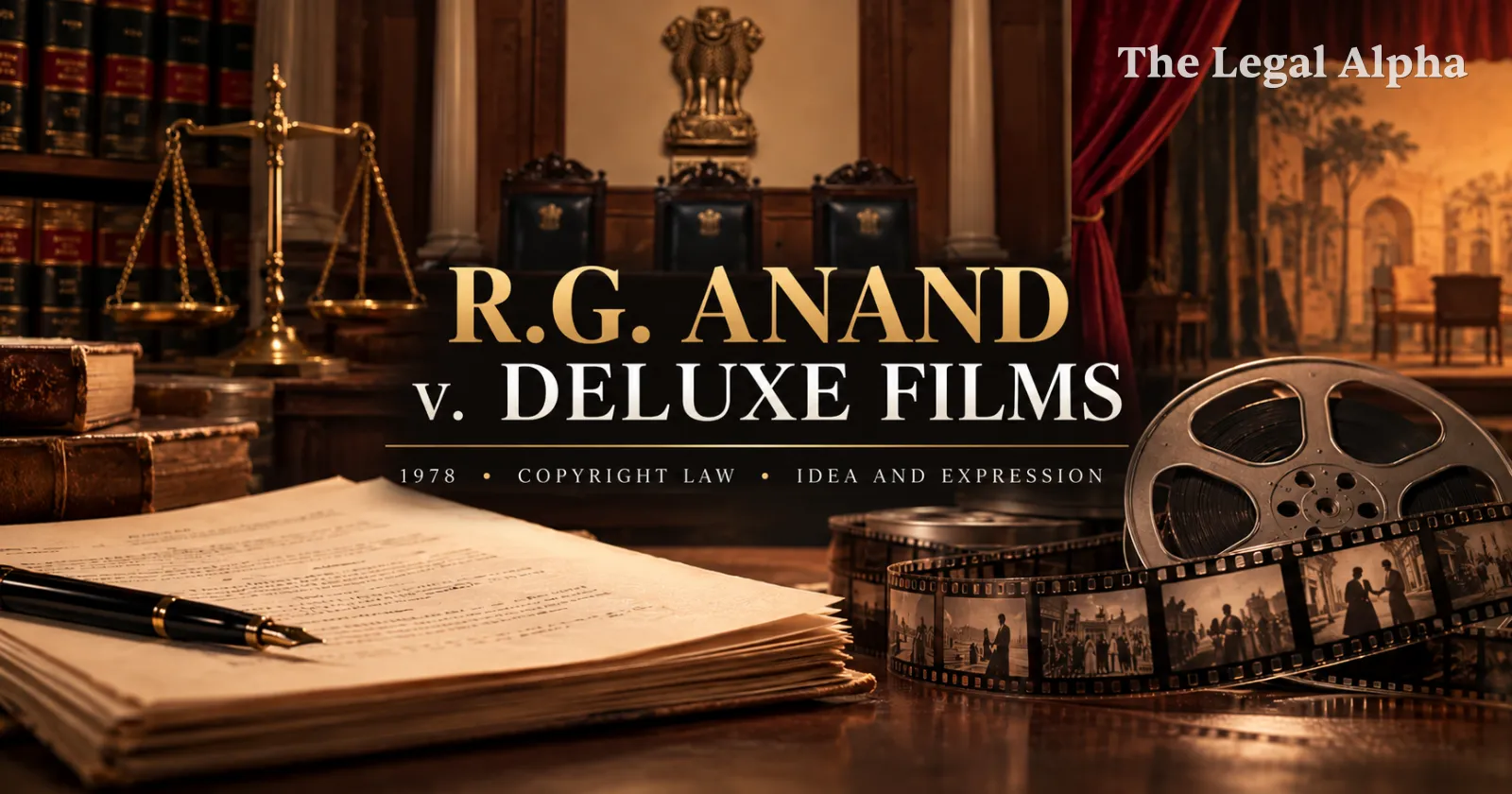
R.G. Anand v. Deluxe Films (1978)
The Supreme Court’s landmark decision in R.G. Anand v. Deluxe Films is a leading authority on copyright infringement and the idea-expression distinction. The case concerned the alleged copying of a stage play into a film and established that copyright protects expression, not the underlying idea. The Court held that infringement depends on whether the later work appropriates a substantial and material part of the protected expression, creating an unmistakable impression of copying.
The Legal Alpha | Landmark Judgement
Case Name: R.G. Anand v. M/s Deluxe Films & Ors.
Citation: (1979) 1 SCR 218; (1978) 4 SCC 118; AIR 1978 SC 1613
Court: Supreme Court of India
Date of Judgement: 18 August 1978
Bench: Syed Murtaza Fazal Ali, Jaswant Singh and R.S. Pathak, JJ.
Case Number: Civil Appeal No. 2030 of 1968
Area of Law: Copyright Law; Intellectual Property Law; Idea-Expression Dichotomy; Copyright Infringement
Subject: Infringement of copyright in a dramatic work by a cinematographic film
The Case in 60 Seconds
What happened?
R.G. Anand, a playwright and producer of stage plays, wrote a Hindi play titled Hum Hindustani in 1953. The play was staged in 1954 and became popular.
In November 1954, Anand received a letter from Mohan Sehgal, a film producer and director, asking for a copy of the play because he was considering making a film based on it. Anand and Sehgal subsequently met in Delhi, where the play was narrated to Sehgal.
In 1955, Sehgal announced the production of a motion picture titled New Delhi. The film was released in September 1956. Anand watched the film and believed that it had been based on his play. He alleged that Sehgal had appropriated the story and treatment of Hum Hindustani and had therefore infringed his copyright.¹
What was the legal problem?
The dispute was not simply whether the two works contained similar incidents. The central question was whether the similarities amounted to copying of the protected expression of Anand’s play or whether both works merely used the same broad idea of provincialism and developed it independently.
What did the Supreme Court decide?
The Supreme Court dismissed Anand’s appeal. Although the Court recognised a number of similarities between Hum Hindustani and New Delhi, it held that the similarities were not substantial or material enough to constitute copyright infringement. The treatment, development, characters, incidents, social themes and climax of the film were sufficiently different from the play.
The central idea of provincialism could not itself be protected by copyright.²
The principle to remember
Copyright does not protect an idea, theme, plot or subject matter as such. It protects the particular expression of that idea. Infringement occurs when the later work appropriates the protected expression in a substantial and material manner, producing an unmistakable impression of copying.
Why This Judgement Matters
Copyright law constantly operates between two competing concerns.
On one side is the author. A writer spends time, imagination, skill and labour developing a work. The law cannot permit another person to appropriate that work merely by changing its language, rearranging a few incidents or adding superficial material.
On the other side is the public domain. Ideas, themes, historical events, social problems and general concepts cannot be locked away by the first person who writes about them. If copyright could be claimed over an idea itself, subsequent authors would effectively require permission before developing common subjects in their own way.
R.G. Anand is important because it draws this boundary.
The Court accepted that two authors may legitimately begin with the same idea. What copyright protects is not the raw idea but the form in which the author has developed and expressed it.
The judgement therefore established a practical method for deciding infringement. Courts must look beyond isolated similarities and examine the works as a whole. The question is whether the later work appropriates the substantial and material features of the protected expression so that an ordinary viewer, reader or spectator would receive an unmistakable impression that the later work is a copy.
This became particularly important for films. A film based on a common theme can contain similarities with a play without infringing it. But a producer cannot simply take the protected structure of the play, change some names, add new scenes and claim that the resulting film is independent.
The distinction between legitimate inspiration and unlawful appropriation is at the heart of R.G. Anand.
Background & Facts
R.G. Anand was an architect by profession and also a playwright, dramatist and producer of stage plays. Before Hum Hindustani, he had written and produced several plays, including Des Hamara, Azadi and Election.
The dispute concerned Hum Hindustani. Anand wrote the play in 1953. It was enacted in 1954 and became popular. The play dealt with provincialism and the prejudice that people belonging to one State could harbour against people from another State. Anand developed this idea through the relationship between two families: one Punjabi and one Madrasi.
The two families initially maintained cordial relations as neighbours. The conflict began when Amni, the son of the Madrasi family, fell in love with Chander, the daughter of the Punjabi family. Their parents opposed the proposed marriage because the young couple belonged to different provinces. The conflict then escalated. Both families attempted to arrange marriages for their children within their own provincial communities. When Amni and Chander realised that their relationship was unlikely to receive parental approval, they entered into a suicide pact and wrote letters to their parents.
The letters forced the parents to confront the consequences of their provincial prejudice. Eventually, the parents realised their mistake. Amni and Chander appeared before them after marrying each other, bringing the story to its conclusion. The play therefore concentrated principally on one aspect of provincialism: the opposition to marriage between persons belonging to different States.³ There was also an opening device in the play in which different voices identified themselves by their provincial identities, emphasising the contrast between calling oneself a Punjabi, Bengali, Gujarati, Marathi, Madrasi or Sindhi and identifying oneself simply as an Indian.⁴
The events that followed would become the basis of one of the most important copyright disputes in Indian law.
The Meeting Between Anand and Sehgal
In November 1954, Mohan Sehgal wrote to Anand requesting a copy of Hum Hindustani because he was considering whether a film could be made from it. Anand and Sehgal later met in Delhi.
According to the evidence, Anand narrated the play to Sehgal and Sehgal became aware of its story. This fact later became significant. The defendants did not dispute that Sehgal knew the story of the play. Their case was that knowledge of the play and even inspiration from its general subject did not establish copyright infringement. Sehgal maintained that the film developed the subject differently and contained a substantially different story. ⁵
In 1955, Sehgal announced the production of New Delhi. The film was released in September 1956. Anand watched it and concluded that the film had appropriated his play. He therefore brought proceedings seeking damages, an account of profits and a permanent injunction restraining the defendants from exhibiting the film.⁶
The Two Works
Understanding the case requires looking at what each work actually did.
Hum Hindustani
The play was built around two families: a Punjabi family and a Madrasi family.
The children of the two families fell in love. Their parents opposed the relationship because of provincial prejudice. The young couple contemplated suicide when their relationship appeared impossible. The parents eventually recognised the destructive nature of their prejudice and accepted the marriage. The play therefore used a family relationship to expose the social consequences of provincialism.⁷
New Delhi
The film used provincialism as one of its central concerns, but it approached the subject much more broadly.
The protagonist, Anand, arrives in New Delhi from Punjab. He experiences provincial prejudice almost immediately. While looking for accommodation, he discovers that landlords are unwilling to rent rooms to people belonging to other provinces. He therefore disguises himself as a South Indian in order to obtain accommodation. Anand then becomes involved with Janaki, a South Indian girl. The film develops their relationship while simultaneously introducing several other characters and conflicts. Anand conceals his identity from Janaki and her family. A series of comic situations follows from his attempt to maintain the deception.
The film also introduces Ashok Banerjee, a Bengali character, and develops a separate relationship between Ashok and Nikki. Unlike the play, the film did not stop with provincial prejudice and interprovincial marriage. It also dealt with caste prejudice and dowry. These were not incidental additions. They formed substantial parts of the film’s narrative and its ultimate resolution. ⁸
Procedural History
Anand instituted a suit alleging infringement of his copyright in Hum Hindustani. The trial court accepted that Anand was the owner of copyright in the play.
It nevertheless found that New Delhi did not infringe that copyright. Anand appealed to the Delhi High Court. A Division Bench of the Delhi High Court upheld the dismissal of the suit.
Anand then approached the Supreme Court by special leave. The Supreme Court acknowledged at the outset that the case involved concurrent findings of fact. Ordinarily, that would have made appellate interference difficult. The Court nevertheless agreed to examine the legal principles because the case raised an important question of copyright law and there was no clear Supreme Court authority dealing with the precise issue.⁹
Issues Before the Court
The Supreme Court’s reasoning can be understood through the following questions:
-
Whether copyright can subsist in the central idea, theme or subject matter of a dramatic work.
-
Whether similarities between a stage play and a film are sufficient by themselves to establish copyright infringement.
-
What constitutes a substantial and material copy of a copyrighted work.
-
Whether the later work must create an unmistakable impression of being a copy of the original.
-
Whether a film may use the same theme as a stage play while developing the theme through a substantially different treatment.
-
Whether additional incidents, characters and themes can distinguish a later work from the copyrighted work.
-
Whether the similarities between Hum Hindustani and New Delhi amounted to colourable imitation.
-
Whether Anand was entitled to damages, an account of profits or an injunction.
Arguments of the Parties
Anand’s Arguments
Anand argued that the similarities between the play and the film were too numerous and too close to be explained as coincidence. His counsel contended that the courts below had failed to appreciate the principles governing copyright infringement and had not given sufficient weight to the resemblance between the two works.
The argument was essentially that the cumulative similarities created an irresistible inference that New Delhi was an imitation of Hum Hindustani. Anand also relied upon the fact that Sehgal had actually heard the play before making the film.
The case therefore involved more than two works independently arriving at the same subject matter. The defendant knew the plaintiff’s work and had encountered it before producing his own work.¹⁰
Respondents’ Arguments
The defendants argued that the law had been correctly applied by the courts below. Their central submission was that provincialism was a common subject and could not be monopolised by Anand. They also emphasised the differences between the play and the film.
According to the defendants, New Delhi had a different story, different treatment, different characters and a different climax. The film also dealt with caste and dowry, subjects which were not part of Anand’s play.
The defendants therefore argued that the similarities were attributable to the common subject of provincialism and did not amount to copying of the protected expression of the play.¹¹
The Legal Framework
The Copyright Law Applicable at the Time
One important feature of the case is that the cause of action arose before the Copyright Act, 1957 came into force. The Supreme Court therefore considered the Copyright Act, 1911, as applicable to the dispute. The Court examined the statutory protection given to literary, dramatic and musical works and the statutory concept of infringement.¹²
The case must therefore be understood in its historical statutory setting. The principles laid down by the Supreme Court, however, subsequently became foundational to Indian copyright jurisprudence under the Copyright Act, 1957.
The Modern Statutory Position
Today, the Copyright Act, 1957 expressly recognises copyright in original literary, dramatic, musical and artistic works as well as cinematograph films and sound recordings.¹³
Section 14 defines copyright as the exclusive right to do or authorise specified acts in relation to a work or any substantial part of it. For literary and dramatic works, those rights include reproduction, public performance, communication to the public, making a cinematograph film or sound recording in respect of the work, translation and adaptation.¹⁴
Section 51 provides the statutory framework for infringement and specifically treats reproduction of a literary, dramatic, musical or artistic work in the form of a cinematograph film as an infringing copy when the statutory conditions are satisfied.¹⁵
The modern Act therefore makes the stage-play-to-film problem particularly relevant: a film can infringe copyright in an earlier dramatic work, but the question remains whether what has been taken is protected expression rather than an unprotected idea or theme.
The Court’s Analysis
The Idea-Expression Dichotomy
The starting point of the judgment was simple but fundamental. An idea is not the same thing as its expression. The Court held that there can be no copyright in an idea, subject matter, theme, plot or historical or legendary fact.
The protection lies in the manner, form, arrangement and expression through which the author has developed that idea.¹⁶ This distinction is necessary because ideas are part of the common stock of human creativity. Two writers can write about the same historical event. Two playwrights can explore the same social problem. Two filmmakers can make films about the same emotional conflict. The fact that they arrive at similar broad concepts does not mean that the second author has infringed the first author’s copyright.
What matters is what the second author has taken from the first author’s work.
The Example of Shakespeare
The Court illustrated this principle by referring to Shakespeare. Many of Shakespeare’s plays were based upon existing stories, legends and historical material.
The fact that Romeo and Juliet was based upon an earlier story did not make Shakespeare an infringer of the earlier author’s work. What mattered was the manner in which Shakespeare transformed the underlying material into his own dramatic expression.
The Court’s point was not that Shakespeare invented every story he used. It was that an author can take an existing idea or subject and develop it independently into a new expression.¹⁷ Copyright therefore does not reward the person who is first to think of a general idea. It protects the author’s particular intellectual creation.
When Similarity Becomes Infringement
The Court nevertheless refused to treat the idea-expression distinction as a licence to copy. There is an important difference between taking an idea and taking the manner in which that idea has been expressed.
Where two works use the same general idea, similarities may naturally appear. But if the defendant reproduces the fundamental or substantial aspects of the plaintiff’s mode of expression, the position changes.
The Court explained that a work may amount to infringement even if it is not a word-for-word reproduction. A defendant cannot escape liability simply by making small alterations to an otherwise copied work. If the later work is essentially a literal imitation with variations introduced here and there, the copying may still be substantial and material.¹⁸
The Unmistakable Impression Test
The Court described one of the safest tests for determining infringement. After reading, watching or otherwise experiencing both works, would the ordinary reader, spectator or viewer receive an unmistakable impression that the later work is a copy of the original?
This is not a mathematical test. Copyright infringement cannot always be established by counting similarities. Five similarities may be more significant than twenty trivial similarities. What matters is the quality and significance of what has been taken. The Court therefore directed attention towards the overall impression produced by the two works.
Substantial and Material Similarity
The Court repeatedly emphasised the requirement of substantial and material copying. A defendant may use elements which are common to the subject matter without infringing copyright. For example, if two works deal with the same social problem, similarities in background, setting or ordinary incidents may be inevitable.
Such similarities do not necessarily amount to appropriation.
The relevant question is whether the similarities extend to the protected expression in a substantial and material way.¹⁹
The Difference Between Similarity and Copying
This distinction became decisive in R.G. Anand. The Court accepted that Hum Hindustani and New Delhi contained a number of similarities. It did not deny that the film had been influenced, to some degree, by the play.
But influence is not automatically infringement. The Court had to determine what exactly had been taken. If what had been taken was only the broad idea of provincialism, there was no infringement. If the film had reproduced the manner in which Anand had developed that idea, the conclusion could have been different.
Stage Play and Film: A Special Problem
The Court recognised that comparing a stage play with a film presents a particular difficulty. A stage play operates within the limitations of a theatrical setting. A film has a much broader canvas. A filmmaker can introduce additional locations, characters, incidents, visual sequences and sub-plots. Those additions may make the film appear substantially different from the play even where the underlying dramatic structure has been appropriated.
For that reason, the Court did not say that the presence of substantial additional material automatically defeats a claim of infringement.
Instead, the Court formulated a more careful approach. Even where the later work is a film and the original is a stage play, infringement can still be established if, looking at the film as a whole, the viewer receives the impression that it is essentially a copy of the play.²⁰
The Court Compared the Works
The Supreme Court did something particularly important in this case. It did not decide the matter solely by stating the legal principle. The Judges actually considered the play and the film. The Court had the play read to it and arranged for the film to be screened. This enabled it to assess the works as complete dramatic productions rather than as disconnected lists of similarities.²¹ That approach is important. Copyright disputes involving literary, dramatic or cinematic works cannot always be resolved by extracting isolated sentences or individual incidents. The work must be understood as a whole.
The Similarities Identified by Anand
The Court recorded eighteen similarities relied upon by the plaintiff.
Among them were:
-
Both works began with a discussion or presentation concerning provincial identities.
-
Both dealt with provincialism.
-
Both involved a Punjabi family and a Madrasi family.
-
The Madrasi father in both works was named Subramaniam.
-
Both were set in New Delhi.
-
Both initially showed cordial relations between the families.
-
Those relations deteriorated when the parents discovered the love affair between their children.
-
In both works the parents opposed the relationship.
-
The dialogue in both works dealt substantially with provincial superiority.
-
The girl in both works was interested in music and dancing.
-
The male protagonist was portrayed as lacking the courage to openly persuade his parents to accept an inter-provincial marriage.
-
The girl listened to a conversation concerning her marriage and subsequently approached the boy.
-
The girl wrote a suicide letter.
-
Suicide became part of the crisis in both works.
-
Another person intervened to prevent the suicide.
-
The parents ultimately recognised the consequences of their provincial prejudice.
-
Both works emphasised the contradiction between India being one country and the persistence of provincial prejudice.
-
Provincialism remained central to the dialogue in both works.²²
At first glance, the list looks powerful.
That was precisely why the case required careful analysis.
Why the Similarities Were Not Enough
The Supreme Court did not ignore these similarities. Instead, it asked what those similarities represented.
The Court found that many of them flowed naturally from the common idea of provincialism. The fact that both works dealt with provincialism necessarily created some common ground. The fact that both works involved an inter-provincial relationship also made certain incidents foreseeable. The Court therefore refused to treat the number of similarities as decisive.
Similarity alone does not prove piracy.
The Dissimilarities Were More Significant
The Court then examined the differences. This was where the case turned.
First, provincialism was treated differently in the two works. In the play, the issue became prominent when the question of marriage between Amni and Chander arose.
In the film, provincialism appeared from the beginning. Anand’s search for accommodation and the refusal of landlords to rent to people from other provinces formed a major part of the film’s narrative. That aspect did not exist in the play.²³
Second, the identities of the two families operated differently. In the play, the families knew one another’s identities. In the film, the central characters did not initially know the true identity of one another. The revelation of their identities during the dance performance became an important part of the film’s development.²⁴
Third, the suicide episode was materially different. In the play, both lovers entered into a suicide pact. In the film, Janaki alone contemplated suicide. The subsequent events were also substantially different. The film introduced Sadhu Ram, who prevented Janaki from committing suicide and concealed her identity, ultimately leading to a different climax.²⁵
Fourth, the film introduced a third important family. The play concentrated on the Punjabi and Madrasi families. New Delhi introduced the Bengali family of Ashok Banerjee. Ashok played a significant role in the film and his sacrifice helped change Daulat Ram’s thinking.²⁶
Fifth, the film introduced caste prejudice. The film used the inability of Daulat Ram to obtain assistance from his own community to expose the limitations of caste-based social solidarity. That issue did not form part of Hum Hindustani.²⁷
Sixth, the film introduced dowry as another major social evil. Again, this was absent from the play.
The Court treated these additions as substantial parts of the film rather than minor embellishments added merely to disguise copying.²⁸
The Court’s Conclusion on the Similarities
After considering the similarities and differences together, the Court concluded that the similarities were largely trivial and insignificant.
More importantly, the dissimilarities were material and substantial. The film’s treatment and presentation were sufficiently different from the play that a prudent viewer would not regard the film as a copy of the play.
The Court therefore held that Anand had failed to establish colourable imitation.²⁹
Knowledge of the Play Did Not Establish Infringement
Anand had another important piece of evidence. Sehgal had actually heard the play. The Supreme Court accepted this. The Court found that Sehgal was aware of the story contained in Hum Hindustani and that part of the film was, to some extent, inspired by the play. But that fact alone did not establish infringement.
Copyright infringement requires appropriation of protected expression.
Knowledge of another work may strengthen a factual inference of copying in an appropriate case, but knowledge does not convert an unprotected idea into protected expression. The Court ultimately found that New Delhi had a different story, different characterisation, different themes and different climaxes.³⁰
The Ratio of R.G. Anand
The ratio of R.G. Anand is that copyright protection extends to the expression of an idea, and not to the idea, theme or subject matter itself. In determining infringement, the Court must therefore look at the works as a whole and ask whether the later work has taken a substantial and material part of the protected expression, such that it leaves an unmistakable impression of copying.
This principle strikes a careful balance. An author cannot claim exclusive rights over a subject merely because they were the first to develop it, but a defendant cannot avoid infringement simply by introducing new material or making superficial alterations to a copied work. The decisive inquiry is always what has actually been appropriated and whether what was taken forms part of the protected expression of the original work.³¹
Justice Jaswant Singh’s Opinion
Justice Jaswant Singh concurred with the judgment. He agreed that there were some resemblances between Hum Hindustani and New Delhi.
But, in his view, those similarities were not material or substantial. He particularly noted that a large majority of the important incidents, episodes and dramatic situations in the film were different from those in the play. He also emphasised the importance of the caste and dowry themes introduced by the film, neither of which appeared in the play.
He therefore agreed that there had been no breach of Anand’s copyright.³²
Justice Pathak’s Separate Opinion
Justice R.S. Pathak also agreed with the result, but his opinion deserves separate attention. It is one of the most interesting parts of the judgment. Justice Pathak was prepared to go further in recognising the similarities between the two works.
He observed that the authors of the film script had been influenced to a degree by the salient features of the plot in the play. He also found little doubt that the filmmakers were aware of the scheme of the play.³³ But awareness and influence were not enough to decide the case. Justice Pathak focused on a more difficult question.
What happens when a defendant takes the essential structure of an earlier work but expands it into a larger production?
He recognised the possibility that a person seeking to appropriate another’s intellectual labour might deliberately enlarge the scope of his own work and introduce changes in the common portion so that the later work appears different. This could create what he described as a veil of apparent dissimilarity.³⁴ That observation remains particularly important in copyright litigation. A defendant cannot necessarily avoid infringement merely by adding material around a copied core.
If the protected structure of the earlier work has been appropriated, superficial alterations should not be allowed to defeat the claim.
But Justice Pathak Still Concurred
Despite those concerns, Justice Pathak did not find the evidence sufficient to overturn the concurrent findings of the courts below. He accepted that the differences between the two works were considered material by the trial court and High Court. The Supreme Court was therefore reluctant to interfere with those concurrent factual findings. Justice Pathak nevertheless issued a warning for future cases.
A clearer case might require judicial intervention where an author’s work has been copied through immaterial changes, insubstantial differences and an expanded treatment designed to conceal the original source. Courts, he said, should look strictly not only at obvious copying but also at reprehensible attempts at colourable imitation.³⁵
Judgment and Final Decision
The Supreme Court dismissed Anand’s appeal.
It held that New Delhi was not a substantial or material copy of Hum Hindustani. The film and the play dealt with the common idea of provincialism, but the manner in which that idea was developed was substantially different. The Court found no colourable imitation. The concurrent findings of the trial court and Delhi High Court were therefore allowed to stand. There was no order as to costs in the Supreme Court.³⁶
Ratio Decidendi
The ratio of R.G. Anand is that copyright protects the expression of an idea, not the idea itself. In determining infringement, the Court must compare the works as a whole and consider whether the later work has appropriated a substantial and material part of the protected expression, creating an unmistakable impression of copying.
The principle does not give an author a monopoly over a subject, theme or plot, but neither does it permit a defendant to escape liability by making superficial changes to an otherwise copied work. What ultimately matters is the nature of what has been taken and whether that material forms part of the protected expression of the original work.
What R.G. Anand Did Not Hold
The judgment is sometimes reduced to the statement that “there is no copyright in an idea.” While correct, that formulation does not capture the full scope of the Court’s reasoning. R.G. Anand does not permit a defendant to copy the structure, sequence, treatment or dramatic expression of an existing work merely by introducing new characters, incidents or additional material. The Court recognised that infringement does not depend upon verbatim reproduction; a work may be copied even where the later version has been altered in form or language.
The inquiry is therefore qualitative rather than merely quantitative. The number of similarities is not decisive. What matters is the nature and significance of the material taken, whether it forms part of the protected expression of the original work, and how its appropriation affects the overall character and expression of the later work.
Idea, Theme and Plot Are Not the Same as Expression
The distinction is best understood by separating the underlying idea or plot from the particular manner in which the author develops it. “Provincialism creates social barriers” is an idea, while a story in which two families from different States oppose the marriage of their children because of provincial prejudice is a broad plot concept. Neither can be claimed exclusively merely because one author uses it first.
Copyright protection may instead attach to the author’s specific characters, sequence of dramatic events, arrangement of scenes, dialogue, development of conflict and overall treatment through which that idea is expressed. Consequently, where a later work substantially appropriates these elements, changing the language, shifting the work to another medium or adding surrounding material will not, by itself, prevent a finding of infringement.
Why the Case Was Difficult
R.G. Anand was a difficult case because the similarities between the two works could not simply be dismissed. Anand had a strong case to present: Sehgal had heard the play before making the film, both works dealt with provincialism, and several incidents and relationships appeared to follow a broadly similar pattern. Taken together, these similarities provided a credible basis for alleging that the film had drawn from Hum Hindustani.
The defendants, however, pointed to the way in which New Delhi developed the subject. The film did not confine itself to the inter-provincial marriage conflict that formed the core of Anand’s play. It expanded the theme of provincialism through issues such as discrimination in finding accommodation, introduced the Bengali family and developed additional character relationships, while also bringing caste prejudice and dowry into the narrative. The sequence of events, treatment of the characters and, ultimately, the climax were also substantially different.
The real difficulty before the Supreme Court, therefore, was not whether the two works resembled each other in places. They plainly did. The question was whether those similarities amounted to appropriation of Anand’s protected expression, or whether they resulted from the fact that both works had started with the same broad idea. On a comparison of the works as a whole, the Court found the latter to be the better explanation.
The Importance of Looking at the Work as a Whole
One of the lasting contributions of R.G. Anand is the Court’s insistence that copyright infringement must be assessed by looking at the work as a whole, rather than by isolating individual similarities. A name, an incident, a social theme or even a particular dramatic situation may be common to works dealing with the same subject. What may receive protection is the way those elements are brought together, the particular arrangement and treatment through which the author gives expression to the underlying idea.
The same principle works in the other direction. A long list of similarities does not, by itself, establish infringement if those similarities arise from an unprotected idea or from incidents that naturally follow from the subject matter. The Court’s approach was therefore not to simply count what the two works had in common, but to compare their overall treatment and determine whether protected expression had actually been appropriated.
Subsequent Development of the Principle
R.G. Anand and Eastern Book Company
In Eastern Book Company v. D.B. Modak, the Supreme Court later considered originality under the Copyright Act, 1957. The Court rejected an approach based purely on the amount of labour or “sweat of the brow” and required the exercise of skill and judgment resulting in a work with the requisite originality.³⁷
R.G. Anand and Eastern Book Company therefore address related but distinct questions.
R.G. Anand asks:
Has protected expression been copied?
Eastern Book Company asks:
Does the work itself possess the originality necessary for copyright protection?
Together, they form an important part of Indian copyright doctrine.
Krishika Lulla v. Shyam Vithalrao Devkatta
The Supreme Court also considered the limits of copyright protection in Krishika Lulla v. Shyam Vithalrao Devkatta. The case concerned the use of the title “Singardaan” and whether copyright could subsist in a title alone.
The Court reaffirmed the principle that copyright protection cannot be extended to material that does not fall within the protected expression of a copyrightable work.³⁸ The case demonstrates the continuing importance of identifying precisely what part of a work the claimant seeks to protect.
Mannu Bhandari v. Kala Vikas Pictures
The Delhi High Court’s decision in Mannu Bhandari v. Kala Vikas Pictures also became significant in disputes involving the adaptation of literary works into films.
The case concerned the adaptation of a literary work and raised questions about the rights of an author when a work is transformed into another medium.
It illustrates the practical importance of distinguishing between an authorised adaptation and an unauthorised appropriation of the author’s protected expression.
Modern Copyright Law
The principle established in R.G. Anand continues to operate within the statutory framework of the Copyright Act, 1957.
Section 13 recognises copyright in original literary and dramatic works as well as cinematograph films.
Section 14 gives the copyright owner exclusive rights, including the right in relation to making a cinematograph film or adaptation of a literary or dramatic work.
Section 51 identifies circumstances in which copyright is infringed and expressly addresses reproduction of literary, dramatic, musical or artistic works in cinematograph films.³⁹
The statutory language has evolved, but the underlying question remains familiar:
What exactly has the defendant taken?
Present Legal Position
The core principle of R.G. Anand remains central to Indian copyright law: copyright protects expression, not the underlying idea. A common subject, theme or plot cannot, by itself, give rise to a claim of infringement. Equally, however, a defendant cannot avoid liability merely by changing the form of an existing work or surrounding copied material with additional content. The real inquiry is whether, on examining the works as a whole, the later work has appropriated a substantial and material part of the protected expression.
The practical test laid down by the Supreme Court remains particularly useful: after seeing or reading both works, would the ordinary viewer or reader receive an unmistakable impression that the later work is a copy of the original? That distinction becomes especially important where an existing work is transformed from one medium into another, such as a play into a film.
The Stage Play-to-Film Problem Today
The problem identified in R.G. Anand has become even more relevant as stories increasingly move between novels, short stories, plays, films, web series and other audiovisual formats. A change in medium does not, by itself, take a later work outside the scope of copyright. The important question is whether the new work has taken only the underlying idea or has appropriated the protected expression of the earlier work.
A producer may therefore take the broad idea of a family conflict and develop it into an entirely different film. The position is different where the producer takes the earlier work’s distinctive characters, sequence of events, dramatic structure, scenes and treatment, and merely adds new material around them.
That is the distinction Justice Pathak cautioned courts to examine when assessing whether apparent differences genuinely reflect independent creation or merely conceal appropriation.
Practical Significance
For Authors and Playwrights
For authors, the distinction drawn in R.G. Anand is important because copyright does not extend to the broad concept behind a work. Protection attaches to the way that concept is developed and expressed through distinctive characters, plot structures, dialogue, scenes and other original elements.
Authors should therefore preserve drafts, scripts, correspondence and other dated records of their creative work, as these may become important evidence if the originality or ownership of the work is later challenged.
For Film Producers
For film producers, R.G. Anand makes clear that using a common social theme does not, by itself, amount to copyright infringement. The concern arises when a proposed film begins to resemble an existing literary or dramatic work in its treatment and expression.
In such cases, producers should undertake proper clearance and independent-development checks rather than assuming that changing names or adding a few scenes will be sufficient to distinguish the new work.
For Screenwriters
For screenwriters, the safer course is to develop an independently conceived treatment rather than attempting to distinguish an existing protected work through cosmetic changes.
What matters is not simply whether the finished screenplay appears different on paper, but whether, in developing the new work, the writer has appropriated the protected expression of another work.
For Lawyers
A copyright infringement claim should not be based merely on a catalogue of similarities.
The stronger approach is to identify:
-
What part of the plaintiff’s work is protected.
-
Which part of that protected expression has allegedly been taken.
-
Why that material is substantial and material rather than trivial.
-
Whether the similarities are attributable to a common idea or source.
-
Whether the overall impression suggests copying.
-
Whether the defendant’s differences represent genuine independent expression or merely an attempt to disguise copying.
For Courts
For courts, R.G. Anand highlights the importance of examining the works themselves rather than deciding infringement solely through abstract legal propositions.
In disputes involving creative works, the comparison must extend to the structure, treatment, sequence, characters and overall presentation of the works to determine whether the similarities reflect protected expression or merely a common underlying idea.
A Practical Test for Copyright Infringement
R.G. Anand can be converted into a practical sequence of questions:
Step 1: Identify the alleged protected work.
What exactly does the plaintiff claim copyright over?
Step 2: Separate idea from expression.
Is the alleged copying concerned with an idea, theme, subject matter or plot, or with the author’s particular expression of it?
Step 3: Identify the similarities.
What elements appear in both works?
Step 4: Ask whether those similarities are inevitable.
Could the similarities naturally result from the common subject or common source?
Step 5: Examine the differences.
Are the differences merely cosmetic, or do they change the structure and treatment of the work?
Step 6: Compare the works as a whole.
Does the later work create an unmistakable impression of being a copy?
Step 7: Assess substantiality.
Has a substantial and material part of the protected expression been appropriated?
Step 8: Consider the medium.
If the original is a play and the later work is a film, remember that the film will naturally have a broader canvas. But that broader canvas cannot be used to disguise copying of the protected core.
Step 9: Examine the evidence.
Knowledge of the earlier work, access, correspondence and other circumstances may be relevant, but they do not replace the substantive comparison between the works.
Step 10: Distinguish inspiration from appropriation.
A work may be inspired by another work without infringing it. The legal question is whether protected expression has been unlawfully appropriated.
Legal Alpha Analysis
R.G. Anand is often reduced to the familiar proposition that “there is no copyright in an idea.” While that accurately captures the starting point of the judgment, it does not fully explain why the Supreme Court found no infringement. The two works plainly shared considerable common ground: both dealt with provincialism, both involved a Punjabi and a Madrasi family, both centred on an inter-provincial relationship, and both used the conflict between the young couple and their parents to expose provincial prejudice.
Yet those similarities did not mean that Anand’s protected expression had been copied. The subject of provincialism itself was not something Anand could claim exclusively. What the law protected was the particular manner in which he had developed and expressed that subject in Hum Hindustani. New Delhi took the theme in a broader direction, incorporating housing discrimination, caste, dowry, a Bengali family, different character relationships and a substantially different climax. When the two works were considered as a whole, the Court found that the similarities arose from their common subject rather than from appropriation of Anand’s protected expression.
At the same time, Justice Pathak’s separate opinion adds an important qualification. A defendant cannot necessarily escape infringement by enlarging an existing work, adding new material and introducing enough differences to make the later work appear independent. If the essential protected structure of the earlier work has been appropriated, superficial changes may amount to little more than a veil of dissimilarity. That observation gives R.G. Anand its continuing relevance: the real question is not simply whether two works are “the same” or “different”, but whether the later work represents legitimate independent expression or substantial appropriation of protected expression.
Related Cases
| Case | Connection with R.G. Anand |
|---|---|
| University of London Press Ltd. v. University Tutorial Press Ltd., [1916] 2 Ch. 601 | Early authority distinguishing originality of expression from originality of ideas. |
| Hanfstaengl v. W.H. Baillie & Co., [1895] A.C. 20 | Considered the effect produced by comparing an original artistic work with an alleged copy. |
| Macmillan & Co. Ltd. v. K. & J. Cooper, [1924] 1 Ch. 504 (PC) | Substantial copying and colourable imitation. |
| Eastern Book Co. v. D.B. Modak, (2008) 1 SCC 1 | Originality, skill and judgment and the protection of expression. |
| Mannu Bhandari v. Kala Vikas Pictures Pvt. Ltd., 1987 SCC OnLine Del 139 | Adaptation of literary work into a film and the author’s rights. |
| Krishika Lulla v. Shyam Vithalrao Devkatta, (2016) 2 SCC 521 | Limits of copyright protection in titles and isolated elements. |
| Institute of Inner Studies v. Charlotte Anderson, 2014 SCC OnLine Del 136 | Application of the idea-expression distinction in copyright disputes. |
Legal Alpha Quick Revision
1. The dispute arose between a playwright and a film producer.
R.G. Anand claimed that the film New Delhi had copied his play Hum Hindustani.
2. The central subject of both works was provincialism.
But provincialism itself was an idea or theme and therefore could not be monopolised through copyright.
3. Similarity alone does not establish infringement.
The court must determine whether the similarities concern protected expression and whether they are substantial and material.
4. The overall impression matters.
One of the safest tests is whether the viewer, after seeing both works, receives an unmistakable impression that the later work is a copy of the original.
5. A film can infringe a stage play.
The change in medium does not automatically defeat copyright protection.
6. But a film has a wider canvas.
A film may legitimately introduce additional characters, incidents, locations and themes, provided it does not appropriate the protected expression of the earlier work.
7. Trivial similarities are not enough.
Common names, ordinary incidents and elements flowing naturally from a common subject will not necessarily amount to infringement.
8. Substantial copying is the real concern.
A work may infringe even without verbatim reproduction if it appropriates a substantial and material part of the protected expression.
9. Superficial changes are not a complete defence.
Justice Pathak specifically warned against creating a veil of apparent dissimilarity through immaterial changes and additional material.
10. The appeal was dismissed.
The Supreme Court held that New Delhi was not a substantial or material copy of Hum Hindustani and that Anand had failed to establish colourable imitation.
Full Judgment & Primary Sources
Primary Judgment
R.G. Anand v. M/s Deluxe Films & Ors., (1979) 1 SCR 218; (1978) 4 SCC 118; AIR 1978 SC 1613.
Civil Appeal No. 2030 of 1968
Date: 18 August 1978
Bench: Syed Murtaza Fazal Ali, Jaswant Singh and R.S. Pathak, JJ.
The original Supreme Court judgment should be treated as the primary authority for the facts, arguments, comparative analysis, propositions of law and final decision.
Footnotes
-
R.G. Anand v. M/s Deluxe Films & Ors., (1979) 1 SCR 218, 219–20, 226; (1978) 4 SCC 118.
-
Id. at 248–50; (1978) 4 SCC 118.
-
Id. at 250–52.
-
Id. at 250–51.
-
Id. at 259–61.
-
Id. at 219–20.
-
Id. at 250–52.
-
Id. at 258–60.
-
Id. at 226.
-
Id. at 218–20, 260–61.
-
Id. at 219–20.
-
Id. at 227–30.
-
Copyright Act, 1957, § 13(1).
-
Id. § 14(a).
-
Id. § 51(a), Explanation.
-
R.G. Anand, (1979) 1 SCR at 248–49; (1978) 4 SCC 118.
-
Id. at 248–49.
-
Id. at 249.
-
Id. at 231–36, 248–49.
-
Id. at 249–50.
-
Id. at 250.
-
Id. at 256–57.
-
Id. at 258.
-
Id. at 258.
-
Id. at 258–59.
-
Id. at 259.
-
Id.
-
Id. at 259–60.
-
Id. at 259–61.
-
Id. at 260–61.
-
Id. at 248–50.
-
Id. at 261–62.
-
Id. at 262.
-
Id. at 262–63.
-
Id. at 263.
-
Id. at 261, 263.
-
Eastern Book Co. v. D.B. Modak, (2008) 1 SCC 1, 26–29.
-
Krishika Lulla v. Shyam Vithalrao Devkatta, (2016) 2 SCC 521.
-
Copyright Act, 1957, §§ 13, 14, 51.