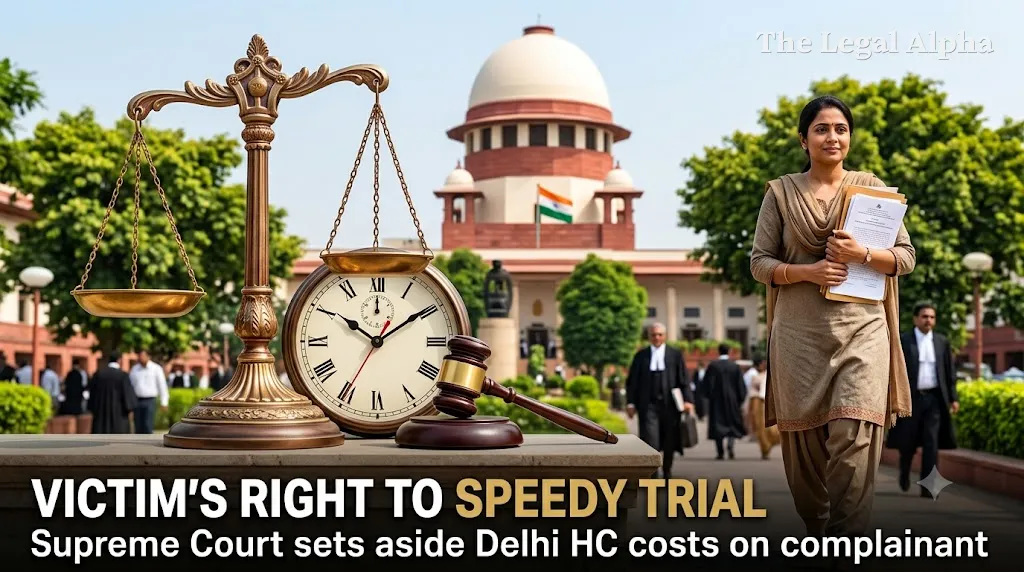
Victim Also Has Right to Seek Speedy Trial Like Accused: Supreme Court
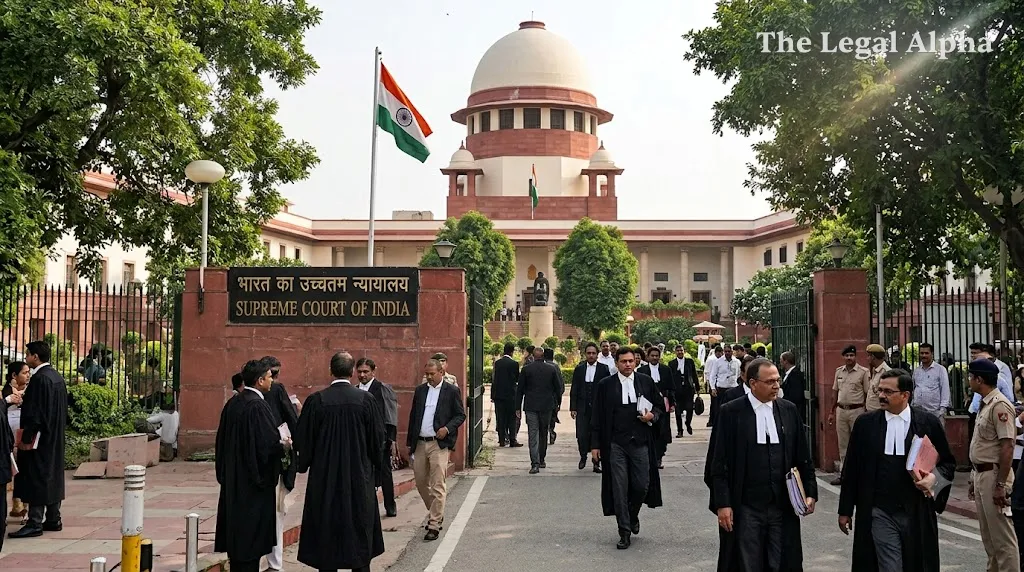
Court: Supreme Court of India
Bench: Justice Ujjal Bhuyan & Justice Atul S. Chandurkar
Case Citation: 2026 LiveLaw (SC) 1033
Impugned Order: Delhi High Court [CRL.M.C. 44/2026, 2026:DHC:61, Decided on 06.01.2026]
Date of Pronouncement: September 24, 2026 | Reported: October 08-09, 2026 (LiveLaw ID: 553834)
Subject: Article 21 & Section 482 CrPC / Section 528 BNSS | Victim's Right to Speedy Trial
The appellant, Renuka Jain, is the de facto complainant and victim in a criminal case registered pursuant to FIR No. 211/2017 at Police Station Farsh Bazar, Shahdara, Delhi, alleging offences under Section 420 (cheating) of the Indian Penal Code, 1860. The criminal proceedings remained mired in extensive delay before the trial court for nearly nine years. Despite charges being framed, the trial progressed at a snail’s pace: out of 22 cited prosecution witnesses (one of whom was later dropped), only the first witness (PW-1) had been produced and was still undergoing cross-examination, leaving 21 prosecution witnesses completely unexamined.
Distressed by the indefinite stalling of the trial, Renuka Jain approached the High Court of Delhi under Section 482 of the Code of Criminal Procedure, 1973 (CrPC) [CRL.M.C. 44/2026], seeking a straightforward direction to the trial court to conclude the proceedings expeditiously. Legal aid counsel was assigned to represent her through the Delhi High Court Legal Services Committee (DHCLSC).
On January 6, 2026, the Delhi High Court dismissed her petition at the threshold. Accepting the argument of the State prosecutor, the Single Judge held that in a State-prosecuted police case, the de facto complainant is 'merely a witness' with no locus standi, and that only the State or the accused can invoke the jurisdiction of the court to seek an expeditious trial. The High Court went a step further, castigating the victim's plea as 'completely frivolous and a drain on already overflowing dockets of the Court', dismissed it with punitive costs of ₹10,000/- imposed on the victim, and criticized the DHCLSC for providing legal aid without vetting the case's strength. Aggrieved by this rejection and punitive sanction, Renuka Jain moved the Supreme Court of India.
Legal Topic
Criminal Jurisprudence & Constitutional Rights – Article 21 of the Constitution of India (Fundamental Right to Speedy Trial and Fair Justice); Victimology & Locus Standi of Complainants; Section 482 CrPC (now Section 528, Bharatiya Nagarik Suraksha Sanhita, 2023 - Inherent Powers of High Courts); Role of the Victim in State Prosecutions; Legal Aid Protections under Legal Services Authorities Act, 1987; Expeditious Disposal of Criminal Trials.
Core Legal Issue
Whether the fundamental right to a speedy trial under Article 21 of the Constitution is the exclusive prerogative of the accused, or whether the victim of a crime also possesses independent locus standi to approach the High Court under Section 482 CrPC / Section 528 BNSS to seek expeditious disposal of a protracted criminal trial.
What Did the Court / Authority Decide?
A Division Bench of the Supreme Court of India, comprising Justice Ujjal Bhuyan and Justice Atul S. Chandurkar, allowed the appeal [Renuka Jain v. The State of NCT of Delhi & Ors., 2026 LiveLaw (SC) 1033], setting aside the Delhi High Court’s order dated January 6, 2026 in its entirety, quashing the ₹10,000/- costs imposed on the victim, and directing the trial court to conclude the criminal proceedings expeditiously within an outer limit of one year from September 24, 2026.
Justice Ujjal Bhuyan and Justice Atul S. Chandurkar held that the right to a speedy trial is not an exclusive privilege reserved solely for the accused, but is an integral facet of Article 21 equally available to the victim. The Bench delivered a strong rebuke to the High Court’s reasoning, observing: \"We are unable to agree with the view taken by the High Court castigating the victim for bringing a petition before the Court seeking a speedy trial as being completely frivolous and a drain on the overflowing dockets of the Court. It is based on a complete misreading of the legal and constitutional provisions and cannot be sustained.\" The Court emphasized that victims cannot be relegated to passive bystanders or mere witnesses in their own cause, as justice delayed denies closure and rehabilitation to the victim just as it causes prejudice to the accused. Reaffirming the principles laid down in Keshvendra Singh v. Shankar Singh (2026), the Supreme Court held that the victim has unassailable locus standi to petition constitutional courts for the timely conclusion of trials.
Key Legal Points
- Right to Speedy Trial Belongs Equally to Victims: The Supreme Court authoritatively held that the constitutional right to a speedy trial under Article 21 is not the exclusive prerogative of the accused. A victim of a crime has an equal, enforceable right to prompt justice.
- Victim Possesses Independent Locus Standi: The Bench ruled that a complainant/victim is not merely a prosecution witness or a detached spectator. The victim retains an independent legal standing to approach the High Court under Section 482 CrPC / Section 528 BNSS to ensure the criminal trial moves forward without unconscionable delay.
- Castigation and Penalization of Victim Struck Down: The Court firmly overturned the High Court’s characterization of the victim’s petition as 'frivolous' and a 'drain on court dockets', holding that penalizing a victim with ₹10,000/- costs for seeking timely justice was a grave misreading of constitutional and procedural law.
- Sanctity of Legal Aid Protection: The Supreme Court disapproved of the High Court's reprimand of the Delhi High Court Legal Services Committee, emphasizing that access to free legal aid for marginalized litigants is a constitutional imperative that cannot be chilled by punitive judicial strictures.
- Strict Time-Bound Direction for Trial Conclusion: Taking note that 21 prosecution witnesses remained to be examined after nearly nine years, the Supreme Court directed the trial court to complete the trial expeditiously within an outer timeline of one year.
Relevant Law
- Article 21, Constitution of India: Guarantees protection of life and personal liberty, within which the right to a speedy and fair trial is firmly entrenched as a fundamental right.
- Section 482, Code of Criminal Procedure, 1973 (Section 528, Bharatiya Nagarik Suraksha Sanhita, 2023): Preserves the inherent powers of the High Court to make such orders as may be necessary to prevent abuse of the process of any court or otherwise to secure the ends of justice.
- Section 2(wa), Code of Criminal Procedure, 1973 (Section 2(1)(y), Bharatiya Nagarik Suraksha Sanhita, 2023): Statutorily defines the 'victim' and recognizes their participatory rights in the criminal justice system.
- Keshvendra Singh v. Shankar Singh (2026): Supreme Court precedent recognizing that the right to a speedy trial applies with equal force to the victim of an offence.
- Mallikarjun Kodagali v. State of Karnataka (2019) 2 SCC 752: Landmark Supreme Court ruling expanding victimology and recognizing victims as core stakeholders who cannot be marginalized in criminal proceedings.
- Hussainara Khatoon (I) v. Home Secretary, State of Bihar (1980) 1 SCC 81: Locus classicus establishing that a speedy trial is an inalienable component of the fundamental right to life and liberty under Article 21.
Arguments of the Parties
- Contentions of the Appellant (Renuka Jain):
- Represented by Advocate-on-Record Ms. Fauzia Shakil, alongside Advocates Shivangi Nanda, Nazmeen Ahmed, Khalid Ali, and Aanand Kumar Vashistha, the appellant submitted that the trial had been pending since 2017 with only PW-1 being examined.
- Counsel argued that the victim has suffered immense mental and financial trauma for nine years and was fully entitled under Article 21 to pray for expeditious proceedings.
- It was contended that the High Court committed a manifest illegality by treating the victim as a stranger without locus standi and arbitrarily penalizing a legal aid recipient with ₹10,000/- costs.
- Contentions of the Respondents (State of NCT of Delhi & Ors.):
- Represented by Additional Solicitor General Mr. Davinder Pal Singh, alongside Advocates Akshat Aggarwal, Vidhi Gupta, Sanjay Tyagi, Ishaan Sharma, Disha Thakkar, and AORs Dr. N. Visakamurthy and Dr. Sushil Balwada, the State submitted the trial’s status.
- The State informed the Court that 22 prosecution witnesses were initially cited, of whom one had been dropped, leaving 21 witnesses, with PW-1 currently under cross-examination.
- The State submitted that heavy docket burdens and systemic procedural delays in the district judiciary were responsible for the pacing of the trial, but did not oppose a direction for expeditious conclusion.
Why Does It Matter?
For decades, the Indian criminal justice system operated under a rigid, state-centric paradigm where criminal prosecutions were viewed strictly as a bilateral contest between the Sovereign State and the Accused. In this traditional framework, the victim who suffered the actual harm was reduced to a voiceless witness, while the constitutional guarantee of a 'speedy trial' was conceptualized almost exclusively as a safeguard against the oppressive pre-trial detention of the accused. Consequently, when trials lingered for decades, victims had no institutional recourse and were often dismissed as busybodies by courts when seeking expeditious hearings.
The Supreme Court’s ruling in Renuka Jain represents a transformative milestone in Indian victimology and constitutional jurisprudence. By dismantling the notion that a speedy trial is the sole monopoly of the accused, Justices Ujjal Bhuyan and Atul S. Chandurkar firmly balance the scales of justice. The judgment establishes that victims have equal constitutional entitlement to closure, accountability, and the speedy administration of justice under Article 21. By striking down punitive costs imposed on a legal aid litigant, the Supreme Court sends an unmistakable signal to the High Courts and trial judiciary across India: seeking speedy justice is a fundamental right, never a 'frivolous drain' on the courts.
Legal Takeaway
The fundamental right to a speedy trial under Article 21 of the Constitution is not the exclusive prerogative of the accused; it is equally available to the victim of the offence. A de facto complainant/victim possesses independent locus standi to approach the High Court under Section 482 CrPC (now Section 528 BNSS) to seek the expeditious disposal of a criminal trial. High Courts cannot dismiss such petitions as frivolous or impose punitive costs on victims seeking timely justice.
Sources (Primary & Additional)
- Primary Judicial Order: Supreme Court of India, Renuka Jain v. The State of NCT of Delhi & Ors. [Decided on September 24, 2026 / Reported October 08-09, 2026], per Justice Ujjal Bhuyan and Justice Atul S. Chandurkar. LiveLaw SC Judgment Repository Citation: 2026 LiveLaw (SC) 1033.
- Authoritative Legal Reporting (LiveLaw): Yash Mittal, \"Victim Also Has Right To Seek Speedy Trial Like Accused: Supreme Court\" (Article ID: 553834, Published on October 08-09, 2026). LiveLaw Article.
- Constitutional & Criminal Law Intelligence (LawChakra): Editorial Desk, \"Victim Has Right To Seek Speedy Trial Like Accused: Supreme Court\" (Published on October 09, 2026). LawChakra Analysis.
- Impugned High Court Order Record: High Court of Delhi at New Delhi, Renuka Jain v. State (NCT of Delhi) & Ors. [CRL.M.C. 44/2026 & CRL.M.A. 126/2026, Neutral Citation: 2026:DHC:61, Decided on January 06, 2026]. Delhi High Court Repository / IndianKanoon.