Victim Also Has Right to Speedy Trial: Supreme Court Sets Aside Delhi HC Costs on Complainant
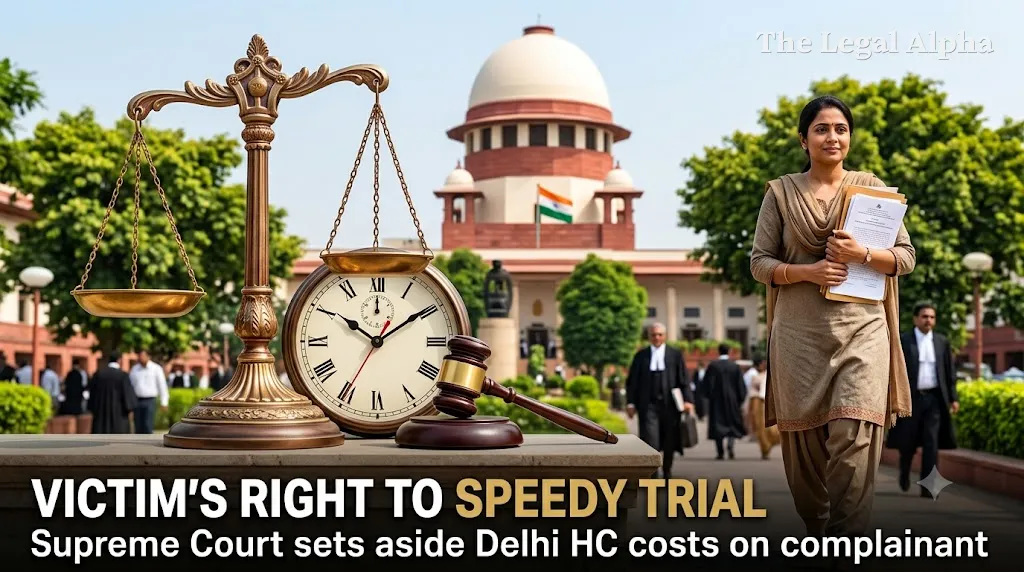
Court: Supreme Court of India
Bench: Justice Ujjal Bhuyan & Justice Atul S. Chandurkar
Date of Pronouncement: September 24, 2026 | Reported: October 09, 2026 (LiveLaw ID: 553834)
Subject: Article 21 & Section 482 CrPC / 528 BNSS | Victim's Right to Speedy Trial
Category
Judgements | Criminal Justice & Constitutional Law
What Happened?
The appellant, Renuka Jain, is a complainant and victim who instituted criminal proceedings concerning an alleged commercial cheating dispute against the accused persons in Delhi. Following the registration of the First Information Report (FIR) and subsequent investigation, the prosecution cited 22 witnesses in the chargesheet. However, the criminal proceedings languished in the trial court for years, lingering at the pre-charge and initial evidence stages.
Faced with mounting delays in securing justice, Renuka Jain approached the High Court of Delhi by filing a petition under Section 482 of the Code of Criminal Procedure, 1973 (CrPC) [CRL. M.C. 44/2026], seeking a direction to the trial court for expeditious disposal of the trial.
On January 6, 2026, the Delhi High Court (Single Judge Bench of Justice Girish Kathpalia) dismissed the petition. The High Court held that in a police report case, the victim has no independent locus standi to demand an expedited trial and is confined merely to the role of a prosecution witness. The High Court castigated the victim for approaching the court, describing the petition as 'completely frivolous and a drain on the overflowing dockets of the Court,' and slapped punitive costs of ₹10,000/- on the complainant.
Aggrieved by this dismissal, castigation, and imposition of costs, Renuka Jain appealed to the Supreme Court of India.
Legal Topic
Criminal Jurisprudence & Victims' Constitutional Rights – Article 21, Constitution of India (Fundamental Right to Speedy Trial); Section 482 CrPC / Section 528 Bharatiya Nagarik Suraksha Sanhita, 2023 (BNSS) (Inherent Powers of High Court); Locus Standi of Victims in Police-Instituted Cases; Section 2(wa) CrPC / Section 2(1)(y) BNSS (Definition and Statutory Rights of Victims); Judicial Restraint in Imposing Costs on Crime Victims.
Core Legal Issue
Whether a victim or de facto complainant in a police-instituted criminal case has the independent locus standi to approach the High Court under Section 482 CrPC / Section 528 BNSS seeking expeditious disposal of a criminal trial, or whether the constitutional right to a speedy trial under Article 21 is an exclusive prerogative of the accused.
What Did the Court / Authority Decide?
A Division Bench of the Supreme Court of India, comprising Justice Ujjal Bhuyan and Justice Atul S. Chandurkar, allowed the appeal [Renuka Jain v. The State of NCT of Delhi & Ors., Decided on September 24, 2026 / Reported October 09, 2026], set aside the Delhi High Court's order, quashed the ₹10,000/- costs imposed on the complainant, and issued time-bound directions to the trial court.
The Supreme Court firmly rejected the High Court’s reasoning, ruling that the right to a speedy trial under Article 21 is not an exclusive privilege reserved for the accused, but belongs equally to the victim of a crime. Justice Ujjal Bhuyan and Justice Atul S. Chandurkar observed: "We are unable to agree with the view taken by the High Court castigating the victim for bringing a petition before the Court seeking a speedy trial as being completely frivolous and a drain on the overflowing dockets of the Court. It is based on a complete misreading of the legal and constitutional provisions and cannot be sustained." The Bench emphasized that modern criminal jurisprudence recognizes the victim as an active participant entitled to fair and timely justice. Noting that 21 prosecution witnesses remained to be examined and PW-1 was undergoing cross-examination, the Supreme Court directed the trial court to conclude the proceedings expeditiously within an outer limit of one year from September 24, 2026.
Key Legal Points
- Speedy Trial Belongs Equally to Victims: The Supreme Court unequivocally established that the constitutional guarantee of a speedy trial under Article 21 is not the exclusive prerogative of the accused; victims of crime possess an equal stake and right to timely justice.
- Independent Locus Standi under Inherent Powers: The Bench held that a victim or de facto complainant has undeniable locus standi to invoke the High Court’s inherent powers under Section 482 CrPC (now Section 528 BNSS) to seek directions for expeditious trial in police-instituted cases.
- Castigation and Penal Costs Quashed: The Supreme Court condemned the High Court’s characterization of a victim’s plea for timely justice as 'frivolous' or a 'drain on court dockets,' setting aside the ₹10,000/- penalty as legally and constitutionally untenable.
- Evolution of Victimology in Indian Criminal Law: The Court reaffirmed that recent procedural amendments have elevated victims from passive spectators or mere witnesses into rights-bearing stakeholders with recognized procedural entitlements throughout criminal proceedings.
- One-Year Outer Limit Mandated: Considering that 21 prosecution witnesses remained to be examined, the Supreme Court directed the trial court to conclude the trial within a strict outer timeline of one year.
Relevant Law
- Article 21, Constitution of India: Guarantees protection of life and personal liberty, which encompasses the fundamental right to a fair and speedy trial for both accused and victims.
- Section 482, Code of Criminal Procedure, 1973 (now Section 528, Bharatiya Nagarik Suraksha Sanhita, 2023): Inherent powers of the High Court to make such orders as may be necessary to prevent abuse of the process of any court or otherwise to secure the ends of justice.
- Section 2(wa), CrPC (now Section 2(1)(y), BNSS, 2023): Defines 'victim' as a person who has suffered any loss or injury caused by reason of the act or omission for which the accused has been charged.
- Hussainara Khatoon v. Home Secretary, State of Bihar (1980) 1 SCC 81: Landmark ruling recognizing the right to a speedy trial as an integral part of fundamental rights under Article 21.
- Mallikarjun Kodagali v. State of Karnataka (2019) 2 SCC 752: Apex Court benchmark judgment affirming that the criminal justice system must give a voice to victims and recognizing their independent participatory rights.
Arguments of the Parties
- Contentions of the Appellant (Renuka Jain):
- Represented by Advocate-on-Record Ms. Fauzia Shakil, the appellant submitted that as the direct victim of the alleged offence, she had suffered severe prejudice due to protracted trial delays extending over several years.
- Counsel argued that the right to speedy justice under Article 21 is bilateral and applies equally to victims seeking closure and accountability.
- It was submitted that the High Court committed serious constitutional error by labelling a victim's plea for timely trial as 'frivolous' and penalizing her with costs.
- Contentions of the Respondents (State of NCT of Delhi & Accused):
- Represented by Additional Solicitor General Mr. Davinder Pal Singh, the State submitted that in police report cases, the carriage of proceedings rests primarily with the Public Prosecutor.
- Counsel indicated that 22 witnesses were cited, one was dropped, and examination of PW-1 was in progress.
- While explaining procedural steps before the trial court, the respondents submitted that institutional dockets in subordinate courts face heavy backlogs, and individual directions for expedited trials should be issued sparingly.
Why Does It Matter?
For decades, traditional criminal jurisprudence treated crime exclusively as a wrong against the Sovereign State, reducing the actual victim to a mere bystander or evidentiary witness. Consequently, constitutional guarantees of speedy trial under Article 21 were viewed almost exclusively through the lens of the accused’s right against prolonged pre-trial incarceration, while victims endured endless trial delays, repeated adjournments, witness intimidation, and lack of closure.
The Supreme Court’s judgment in Renuka Jain represents a vital milestone in Indian victimology and procedural justice. By holding that a victim’s plea for speedy trial is not a 'drain on judicial dockets' but a legitimate constitutional assertion, Justices Ujjal Bhuyan and Atul S. Chandurkar firmly dismantle the notion that speedy justice is a one-sided privilege. The decision empowers millions of crime victims across India to hold subordinate courts and prosecuting agencies accountable to strict timelines, preventing trials from turning into endless ordeals of attrition.
Legal Takeaway
The right to a speedy trial under Article 21 of the Constitution of India is not the exclusive prerogative of the accused, but extends equally to the victim of a crime. A victim has independent locus standi to approach the High Court under Section 482 of the CrPC (or Section 528 of the BNSS) to seek directions for expeditious trial. Subordinate and constitutional courts cannot castigate a victim's petition for speedy justice as frivolous or impose costs for seeking timely disposal.
Sources (Primary & Additional)
- Primary Judicial Order: Supreme Court of India, Renuka Jain v. The State of NCT of Delhi & Ors. [Decided on September 24, 2026], per Justice Ujjal Bhuyan and Justice Atul S. Chandurkar. Supreme Court of India Judgment Repository / LiveLaw Archive.
- Authoritative Legal Reporting (LiveLaw): Yash Mittal, \"Victim Also Has Right To Seek Speedy Trial Like Accused: Supreme Court\" (Article ID: 553834, Published on October 09, 2026). LiveLaw Article.
- Impugned High Court Judgment Record: High Court of Delhi, Renuka Jain v. State (NCT of Delhi) [CRL. M.C. 44/2026, Decided on January 06, 2026, per Justice Girish Kathpalia]. SupremeToday Legal Intelligence.