Delhi Metro Curbs: Supreme Court Moved in Contempt Over Continued Station Closures
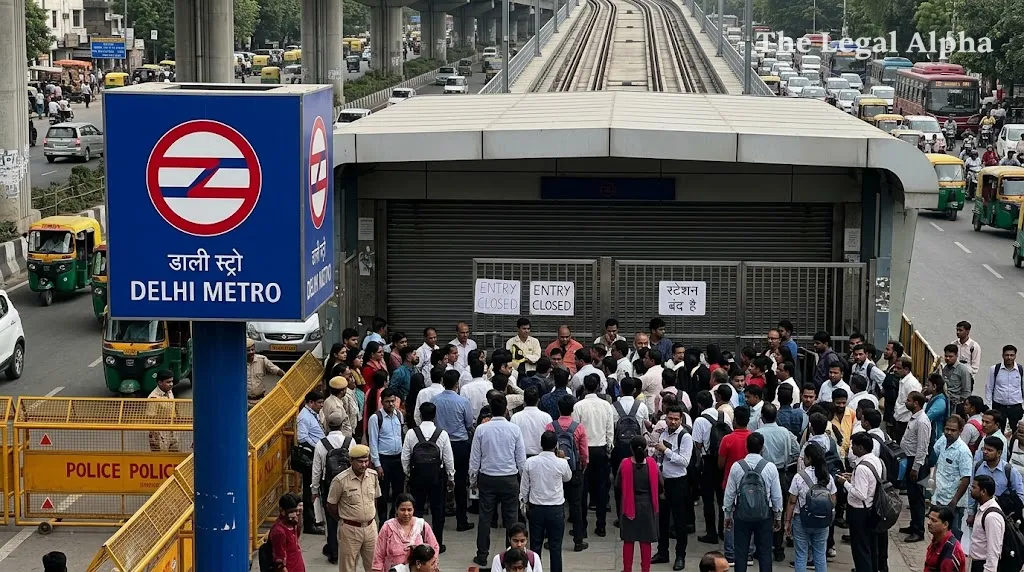
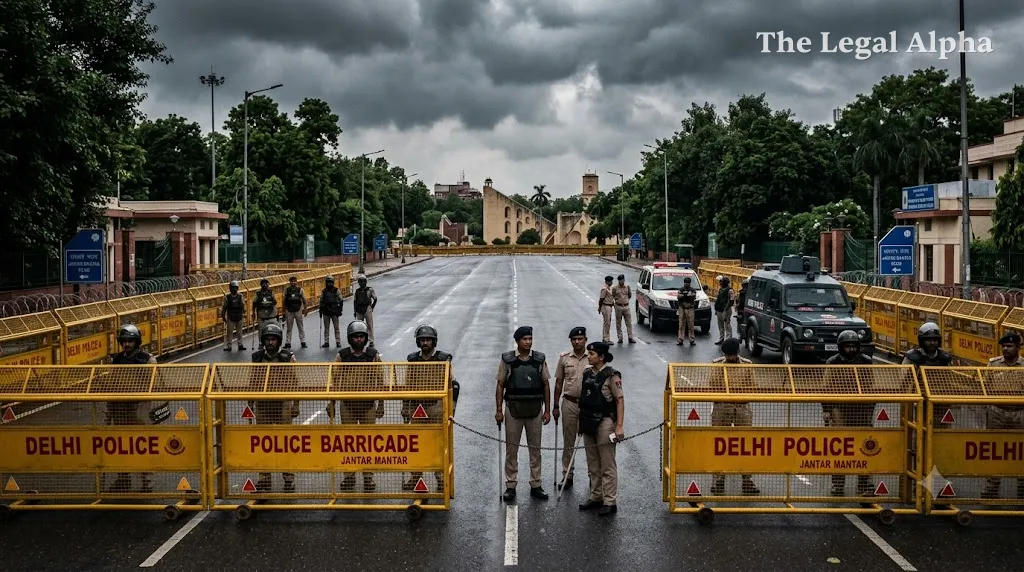
A contempt petition has been moved before the Supreme Court of India against administrative and transport authorities for allegedly defying judicial directions on public mobility across the National Capital Region. Just a day after the top court explicitly ruled that authorities must not impose blanket prohibitions on train and metro operations in the capital, the Delhi Metro Rail Corporation (DMRC) announced extensive entry and exit curbs across dozens of transit stations ahead of planned public demonstrations. The petitioner, advocate Shailendra Mani Tripathi, approached the apex court alleging that continuing widespread closures—scaled from an initial 57 stations to 45—amounts to deliberate non-compliance with the court’s order to maintain regulated, proportional transit access for ordinary commuters.
Legal Topic
Area of Law: Constitutional Law & Civil Procedure
Sub-topic: Contempt of Courts / Proportionality in Public Order Curbs
Core Legal Issue
The dispute concerns whether executive authorities and state transit utilities committed wilful disobedience of a binding Supreme Court directive by maintaining blanket operational shutdowns of rapid transit stations, under the guise of public security, despite explicit instructions to adopt a regulated, non-prohibitive approach.
At its foundation, the issue addresses the enforceable limits of executive discretion under public order powers—specifically Section 163 of the Bharatiya Nagarik Suraksha Sanhita, 2023 (BNSS)—when such measures disproportionately paralyze public transit infrastructure and infringe upon citizens' freedom of movement.
What Did the Court / Authority Decide?
On October 9, a Supreme Court bench headed by the Chief Justice of India made it clear that authorities cannot enforce a complete ban on metro movement and incoming rail services to manage planned demonstrations in the capital. The court instructed the Union Government and police authorities to distinguish between "complete prohibition" and "regulation," ordering that transit services run in a regulated manner without causing hardship to daily commuters, alongside wide advance publicity of any necessary travel advisories.
Following these directions, the DMRC issued notifications keeping gates closed at 45 stations between the night of October 9 and the evening of October 10. The freshly filed contempt petition seeks urgent judicial intervention to revoke these blanket restrictions, enforce strict compliance with the court's earlier order, and hold the responsible authorities accountable for wilful defiance. The contempt plea is currently pending formal listing and consideration.
Key Legal Points
-
Proportionality over Absolute Prohibition: The court emphasized that preventive law-enforcement measures must adhere to the doctrine of proportionality, holding that broad-spectrum shutdowns cannot be used when targeted regulation suffices.
-
Wilful Disobedience under Contempt Jurisdiction: The contempt petition centers on the principle that failure to recalibrate executive orders following explicit judicial instructions constitutes deliberate disobedience.
-
Preservation of Everyday Commuter Rights: Mass transit disruptions cannot be deployed as standard preventive policing instruments if they substantially impede the general public's fundamental liberty of movement.
-
State Obligation of Adequate Notice: Administrative transit curbs must be transparently communicated to the public in advance through wide publicity to prevent commuter strandedness and confusion.
Relevant Law
-
Contempt of Courts Act, 1971 (Section 2(b) & Section 12): Civil contempt concerning wilful disobedience of a court order, direction, or writ.
-
Constitution of India (Articles 19(1)(d), 21, and 129): Freedom of movement, personal liberty, and the Supreme Court’s inherent power as a court of record to punish contempt.
-
Bharatiya Nagarik Suraksha Sanhita, 2023 (Section 163): Preventive orders issued by executive magistrates in urgent cases of nuisance or apprehended danger.
Arguments of the Parties
Petitioner / Applicant: The petitioner argued that the administration deliberately bypassed the Supreme Court's mandate by maintaining mass gate closures across 45 major metro stations instead of operating a regulated transit schedule. He submitted photographic and video material from operational stations to illustrate commuter distress, contending that visiting sensitive areas such as Jantar Mantar revealed no ground-level unrest that could justify shutting down public transport across large swathes of the city.
State / Transport Authorities: While a formal response to the contempt plea is awaited, authorities previously contended before the apex court that transit curbs and train adjustments were essential preventive actions to safeguard law and order and manage the large influx of demonstrators converging on sensitive government zones without prior administrative permission.
Why Does It Matter?
This development brings sharp scrutiny to how preventive law enforcement intersects with civic infrastructure in India's metropolitan centres. Transit shutoffs and preventative road blockades have increasingly served as routine administrative mechanisms to manage impending protests. By testing these executive decisions through contempt jurisdiction, the matter reinforces that administrative convenience cannot override constitutional rights to mobility, nor can executive agencies nominally modify restriction counts while leaving the substantive effect of a blanket ban in place. A definitive ruling will provide essential guidance on the procedural boundaries public utilities must observe when balancing policing demands with commuter rights.
Legal Takeaway
Executive agencies cannot dilute binding judicial directives by marginally altering the scope of a blanket restriction while preserving its prohibitive effect. Where a constitutional court orders regulated access over absolute prohibition, persistent widespread closures expose administrative authorities to civil contempt for failing the test of proportionality.
Sources
Primary Source: Supreme Court of India, Proceedings and Oral Directions in Petitions Concerning Public Order Curbs in the National Capital (Delivered on October 9, 2026).
Additional Sources: Filings in Contempt Petition, Shailendra Mani Tripathi v. Union of India & Ors., Supreme Court of India (Filed October 10, 2026); Public Advisories and Service Announcements, Delhi Metro Rail Corporation (DMRC).