Delhi High Court Quashes Retrospective Dues Clawback, Orders DU to Refund Over Rs 25 Lakh to Retired Academic
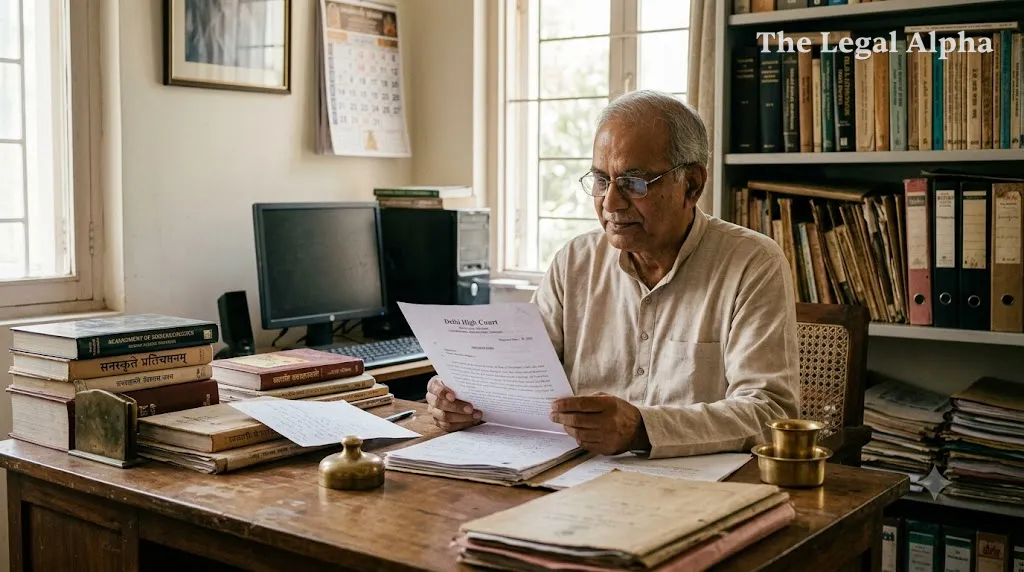
The Delhi High Court set aside an administrative recovery action initiated by Delhi University and Swami Shraddhanand College against a retired Sanskrit lecturer. The institutions had slashed over Rs 25.75 lakh from his retirement corpus—drastically lowering his gross terminal dues from Rs 33.04 lakh to barely Rs 5.29 lakh. The deduction stemmed from notional pay increments granted during a study leave between 1983 and 1986, which the university unilaterally revoked 25 years later on the grounds that he had failed to finish his PhD thesis.
The academic rejoined his teaching post in September 1986 and discharged his duties continuously for another quarter of a century before his superannuation in 2011. The High Court held that the retrospective recovery had no foundation in governing statutory rules and directed both the university and the college to restore his pay, recompute all pensionary benefits, and refund the deducted sums with interest.
Legal Topic
Area of Law: Service Law / Constitutional Law
Sub-topic: Post-Retirement Recovery / Pensionary Rights and Natural Justice
Core Legal Issue
Can a public university administratively withdraw career increments and recover substantial funds from an employee’s terminal benefits decades after a study leave period concluded, relying on a bond condition that directly conflicts with governing statutory study leave regulations and the constitutional safeguards protecting pensionary dues?
What Did the Court Decide?
The Delhi High Court ruled squarely in favor of the retired lecturer, declaring the entire clawback illegal and without authority of law.
-
Quashing Recovery Orders: The court set aside the university Pension Cell’s re-fixation orders, which had withheld Rs 11.40 lakh from salary and Rs 14.35 lakh from his provident fund.
-
Rejection of Bond Clause: It ruled that Clause 2 of the study leave bond executed by the academic—to the extent it prescribed recovery for non-completion of studies—contradicted the operative Study Leave Rules, 1979, and was unenforceable.
-
Directions for Refund and Recalculation: The court directed Delhi University and Swami Shraddhanand College to restore his original pay structure as drawn at the date of superannuation, re-calculate his pension, leave encashment, and commuted pension, and release all arrears dating back to December 1, 2011, along with 6% simple interest.
Key Legal Points
-
Protection of Pension under Article 300A: Pension, gratuity, and provident funds constitute legitimate property rights; an employee cannot be deprived of them by executive or administrative discretion without explicit authority of law.
-
Inapplicability of Unilateral Bond Clauses: A boilerplate contractual clause in a surety bond cannot override or expand liability beyond what is provided in statutory regulations. The 1979 Study Leave Rules omit thesis non-completion as an actionable ground for salary and increment forfeiture.
-
Application of the Rafiq Masih Threshold: The court reiterated that recoveries of alleged excess payments from retired personnel, payments disbursed over five years prior to the demand, or actions causing severe iniquity and hardship are strictly impermissible under Supreme Court jurisprudence.
-
Absence of Disciplinary Foundation: Recovery from post-retirement dues cannot be carried out absent proven judicial conviction, formal departmental proceedings, or specific statutory findings of grave misconduct.
Relevant Law
-
Article 300A of the Constitution of India (Right to property, extending constitutional safeguards against unlawful deprivation of pensionary benefits).
-
Delhi University Study Leave Rules, 1979 (Rule vi governing leave, allowances, increments, and obligations).
-
Clause 14, Appendix 'A' to Statute 28-A of Delhi University Act/Statutes (Stipulating conditions and safeguards for withholding pensionary benefits).
-
State of Punjab & Others v. Rafiq Masih (White Washer) (2015) 4 SCC 334 (Supreme Court precedent setting forth scenarios where monetary recovery by employers is impermissible).
Arguments of the Parties
The Petitioner: Counsel for the retired academic contended that the lecturer had complied with all governing terms upon returning from leave, serving the university for over 25 continuous years after his study leave ended in 1986. It was submitted that under the amended 1979 Rules, the mere non-completion of research work did not invite financial recovery. Furthermore, petitioner’s counsel argued that taking away roughly 84% of his retirement corpus without any finding of misconduct or institutional misrepresentation was harsh, punitive, and violative of established Supreme Court precedents.
The Respondents (Delhi University & College): The university and college administrators maintained that the petitioner had executed an undertaking/bond in September 1983 prior to proceeding on leave. They submitted that under the terms of this undertaking, the award of notional increments during leave was conditional upon the completion of his PhD degree. Since the scholar had never submitted his thesis, the university claimed that increments paid across those three years were irregular, justifying their withdrawal and adjustment prior to releasing net pensionary benefits.
Why Does It Matter?
This decision offers substantial protection to long-serving public-sector academics and employees confronted with bureaucratic clawbacks decades after leave permissions expire. It confirms that universities cannot revive stale, forgotten administrative conditions at the eve of an employee’s superannuation to dismantle their retiral security.
The ruling reinforces the primacy of parent service rules over arbitrary employer bonds, ensuring that institutions cannot invoke archaic conditional undertakings that conflict with their own updated statutory guidelines.
Legal Takeaway
Administrative employers cannot withhold or recover retirement benefits over technical non-compliances that occurred decades earlier, especially where governing service rules provide no statutory basis for recovery. Pensionary corpus is constitutionally protected under Article 300A, and equitable protections against post-retirement clawbacks firmly shield employees who acted without deceit.
Sources
-
Primary Source: High Court of Delhi, W.P.(C) 630/2012 & W.P.(C) 6964/2012, Judgment pronounced on October 8, 2026.
-
Additional Sources: Delhi University Study Leave Rules (1979); Supreme Court of India in State of Punjab v. Rafiq Masih (White Washer) (2015); Indian Express Legal Bureau (October 9, 2026).