U.S. Labor Department Freezes Permanent Labor Certifications for Major Tech and IT Outsourcing Giants
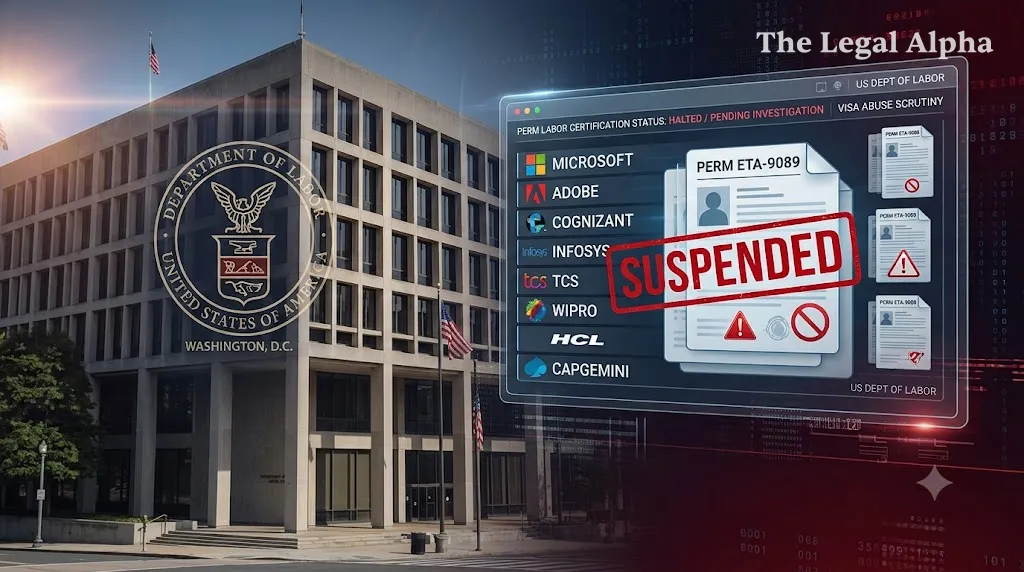
The United States Department of Labor has halted the processing and submission of permanent employment certifications for eight prominent technology and outsourcing firms, including Microsoft, Adobe, Cognizant, Infosys, Tata Consultancy Services, Wipro, HCL Technologies, and Capgemini. U.S. labor officials announced that the agency will refuse new applications and indefinitely suspend pending filings tied to these companies amid ongoing federal inquiries into alleged labor certification fraud, American worker displacement, and wage suppression. The move represents an aggressive regulatory intervention directly targeting the primary administrative gateway used by multinational technology companies to sponsor foreign personnel for permanent residency.
Legal Topic
-
Area of Law: Immigration & Nationality Law / Administrative Law
-
Sub-topic: Permanent Labor Certification (PERM) / Employer Compliance & Regulatory Audits
Core Legal Issue
The central administrative question is whether the Department of Labor has established adequate statutory and regulatory grounds under federal labor certification rules to impose an indefinite, blanket suspension on PERM processing for specific corporate entities prior to formal adjudication or final findings of statutory fraud.
At issue is whether active investigations alone justify freezing both prospective filings and pre-existing, pending labor certification applications under Title 20 of the Code of Federal Regulations, or whether such across-the-board freezes exceed the agency’s delegated authority by circumventing individualized case audits and established administrative review procedures.
What Did the Authority Decide?
The Department of Labor ordered an immediate, indefinite operational freeze on all permanent labor certification applications involving the eight named companies:
-
The agency will not accept any new Form ETA-9089 applications filed by or on behalf of the designated employers.
-
Processing has been suspended across all pending PERM applications tied to these firms while investigations remain active.
-
The agency cited ongoing multi-agency federal probes into recruitment compliance, potential visa abuse, and domestic worker displacement.
-
No formal administrative debarment order has been finalized; the current measure functions as an administrative hold pending investigative conclusions.
Key Legal Points
-
Pre-Adjudication Administrative Freezes: Imposing blanket processing suspensions during active investigations shifts regulatory oversight from post-filing supervised recruitment audits to systemic pre-approval halts.
-
Evidentiary Threshold for Sanctions: While federal rules grant the agency authority to audit or debar employers for fraudulent representations or willful failure to test the U.S. labor market, indefinite freezes without completed evidentiary determinations may invite procedural challenges under the Administrative Procedure Act.
-
Separation of Individual Claims: The suspension treats all pending company certifications collectively, affecting individual foreign national workers whose applications were filed well before the launch of current enforcement actions.
-
Non-Debarment Status: Because the agency has not issued formal debarment determinations, the suspension operates as an extraordinary discretionary exercise of the Secretary’s administrative docket-management powers.
Relevant Law
-
Immigration and Nationality Act (INA), 8 U.S.C. § 1182(a)(5)(A): Mandates that foreign workers seeking permanent employment cannot be admitted unless the Secretary of Labor certifies that there are insufficient willing, qualified, and available domestic workers, and that their employment will not adversely affect domestic wages and working conditions.
-
20 C.F.R. Part 656: Governs the PERM labor certification process, employer recruitment requirements, audit procedures, and grounds for invalidation or suspension.
-
20 C.F.R. § 656.31 & § 656.32: Sets out regulatory mechanisms for addressing fraud, misrepresentation, and debarment from the permanent labor certification program.
-
Administrative Procedure Act (APA), 5 U.S.C. § 706: Prohibits agency actions, findings, and conclusions found to be arbitrary, capricious, an abuse of discretion, or in excess of statutory jurisdiction.
Arguments of the Parties
Regulatory Authority
The Department of Labor contended that the suspension is necessary to preserve the integrity of the domestic labor market and prevent ongoing abuses of the permanent residency pipeline. Administration officials submitted that companies engaging in significant domestic workforce reductions while simultaneously certifying shortages of qualified domestic personnel run counter to the statutory purpose of the Immigration and Nationality Act. The agency argued that federal regulators hold inherent supervisory authority to pause processing when substantiated allegations of systemic recruitment irregularities and wage undercut are under active investigation.
Affected Employers
While formal litigation has not concluded, industry representatives and affected employers maintain that administrative programs must be executed in accordance with established regulatory rules rather than broad executive directives. Companies argue that an agency cannot penalize pending, lawful filings or bar employers from statutory certification programs absent formal administrative findings of non-compliance or completion of statutory debarment proceedings. Corporate counsels assert that the blanket freeze violates procedural due process and arbitrarily disrupts legitimate employment relationships without individualized reviews.
Why Does It Matter?
This development marks a substantial shift in how federal regulators enforce labor certification mandates against corporate employers. PERM approval is an indispensable statutory prerequisite for the vast majority of employment-based immigrant visas under the EB-2 and EB-3 preference categories. By freezing the front end of this process, the Department of Labor has effectively shut off the primary path to lawful permanent residency for thousands of specialized professionals currently maintaining status under temporary visas like the H-1B.
Beyond the immediate disruption for foreign national staff, the action creates acute compliance and talent-retention hurdles for multinational enterprises relying on international technical personnel. If the agency's authority to freeze processing during ongoing probes withstands administrative review, it provides a blueprint for federal regulators to deploy procedural holds as de facto sanctions prior to concluding formal administrative hearings.
Legal Takeaway
The Department of Labor's freeze on PERM applications underscores that statutory labor market testing is subject to direct administrative intervention whenever federal agencies allege displacement or systemic recruitment flaws. Employers must maintain rigorous, audit-proof recruitment documentation and anticipate heightened scrutiny when filing permanent certifications alongside broader domestic workforce restructurings.
Sources
Primary Source:
-
U.S. Department of Labor, Office of Foreign Labor Certification, Official Statements and Administrative Directives on PERM Suspension (Keith Sonderling, Secretary of Labor).
Additional Sources:
-
Title 20, Code of Federal Regulations, Part 656 (Labor Certification Process for Permanent Employment of Aliens in the United States).
-
Immigration and Nationality Act (INA), 8 U.S.C. § 1182(a)(5)(A).
-
Administrative Procedure Act (APA), 5 U.S.C. § 706.