Supreme Court Examines Accessibility Barriers in Mandatory LPG Aadhaar Authentication for Persons with Disabilities
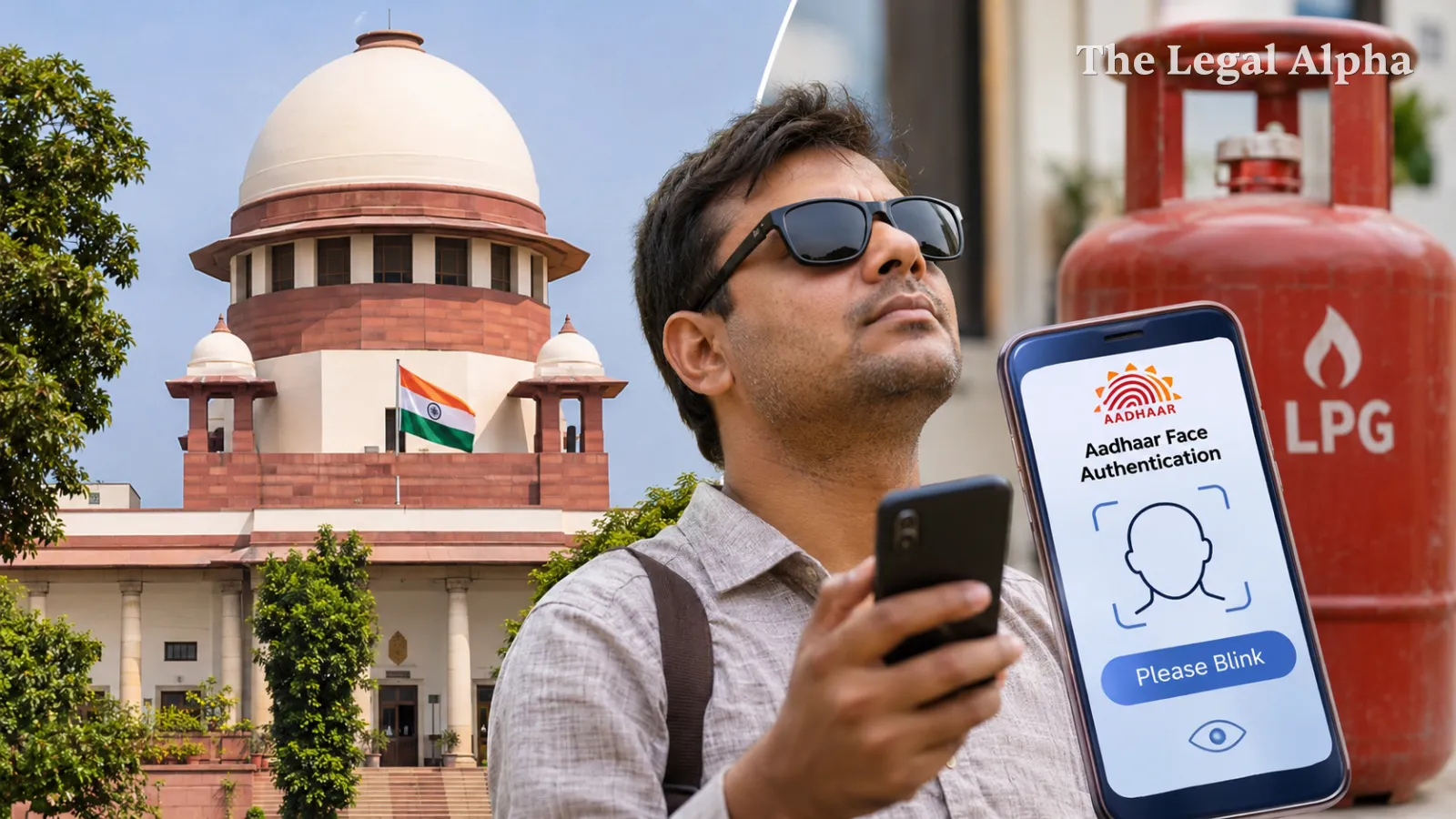
The Supreme Court of India has sought responses from the Centre and other respondents on a petition challenging accessibility barriers in the mandatory Biometric Aadhaar Authentication (BAA) process for domestic LPG consumers.
The petition has been filed by Amar Jain, a disability rights lawyer who is completely blind. He has highlighted how the face-authentication process, which requires consumers to position their faces before a mobile camera and respond to visual instructions such as blinking, creates serious difficulties for persons with blindness, low vision and facial disfigurement.
The challenge concerns the LPG authentication requirement introduced from October 1, 2026, for consumers seeking subsidised domestic LPG refills. The petitioner argues that people who cannot independently complete the prescribed authentication process risk losing access to subsidised LPG and potentially the standard 14.2 kg domestic cylinder.
The Supreme Court has issued notice to the Centre and other respondents, seeking their responses by December 16, 2026.
Area of Law: Constitutional Law and Disability Rights
Sub-topic: Right to Equality, Accessibility, Reasonable Accommodation and Aadhaar-Based Authentication
The central legal question is whether the government can make biometric Aadhaar authentication a condition for accessing subsidised domestic LPG without ensuring that persons with disabilities have an independently usable alternative.
The petition raises concerns about whether a digital verification system that depends on visual instructions and facial movements can satisfy the constitutional guarantees of equality, dignity and personal liberty when it excludes individuals who cannot perform those actions because of their disabilities.
It also questions whether withdrawing access to the standard domestic LPG cylinder and applicable subsidy, without providing an accessible alternative, amounts to an unreasonable restriction on essential public services.
The Supreme Court has issued notice to the Union Government and other respondents, asking them to respond to the accessibility concerns raised in the petition by December 16, 2026.
The petitioner has sought interim protection to ensure that persons with disabilities who cannot complete biometric Aadhaar authentication are not denied the standard 14.2 kg domestic LPG cylinder, regulated retail price or applicable subsidy until an accessible authentication mechanism becomes operational.
However, these are reliefs requested by the petitioner and should not be confused with directions already granted by the Court.
The petition also seeks a declaration-based exemption for eligible persons with disabilities, supported by a Unique Disability ID (UDID) card or disability certificate.
The matter remains pending before the Supreme Court. No final decision on the validity of the challenged authentication requirement has been reported.
- Accessibility of digital authentication: Authentication procedures must account for the needs of persons with blindness, low vision and facial disfigurement.
- Right to equality: A uniform verification procedure may create unequal consequences when persons with disabilities cannot independently complete it.
- Reasonable accommodation: Government systems should provide suitable alternatives to ensure that disability does not become a barrier to accessing essential services.
- Continuity of LPG supply: The petitioner seeks protection against the withdrawal of standard domestic LPG supply and applicable subsidies solely because of disability-related authentication difficulties.
- Human intervention and alternative verification: The petition proposes accessible authentication options, human review of failed attempts and dedicated assistance for affected consumers.
Constitution of India
-
Article 14: Guarantees equality before the law and equal protection of the laws.
-
Article 21: Protects life and personal liberty, including the constitutional interests of dignity and autonomy.
Rights of Persons with Disabilities Act, 2016
-
Section 3: Provides for equality and non-discrimination.
-
Section 2(y): Defines reasonable accommodation.
-
Section 40: Deals with accessibility standards.
Aadhaar Act, 2016
The statutory framework governing Aadhaar authentication is relevant to the challenge concerning mandatory biometric verification and the availability of alternative authentication arrangements.
Relevant Supreme Court Precedent
In Pragya Prasun & Anr. v. Union of India & Ors., 2025 INSC 599, decided on April 30, 2025, the Supreme Court issued directions to make digital KYC procedures more accessible to persons with disabilities.
The Court recognised digital access as an intrinsic component of the right to life and personal liberty under Article 21 and directed authorities to provide alternatives to conventional eye-blinking-based liveness verification.
Petitioner – Amar Jain
The petitioner argues that the prescribed LPG authentication system is inaccessible to persons with visual disabilities because all available verification channels depend on face authentication.
His counsel submitted that the IndianOil ONE, HelloBPCL and HP PAY applications require consumers to position their faces before a camera and respond to visual instructions without adequate audio guidance or screen-reader-compatible feedback.
The petitioner further argues that persons who cannot complete authentication because of their disabilities should not lose access to standard domestic LPG cylinders or applicable subsidies.
He has sought alternative authentication methods, protection through disability certificates or UDID cards, human review of failed verification and dedicated assistance facilities.
Respondents – Union Government and Other Authorities
The Supreme Court has sought responses from the respondents. Their detailed counterarguments or formal positions in the present proceedings are not established by the available report.
The case raises an important question about the relationship between digital governance and the rights of persons with disabilities.
Digital authentication systems are increasingly used to regulate access to government benefits and essential services. However, when these systems depend exclusively on visual actions or facial movements, they can unintentionally exclude individuals who cannot perform those actions.
The outcome could have implications beyond LPG consumers, particularly for the design of Aadhaar-based verification systems and other digital public services.
The Supreme Court's earlier judgment in Pragya Prasun had already emphasised the need for accessible digital KYC procedures. The present petition brings a similar concern into the context of an essential household service.
It also highlights the importance of reasonable accommodation. Preventing fraudulent connections and ensuring proper subsidy distribution may be legitimate government objectives, but authentication procedures must also account for people who cannot comply because of disabilities.
Digital verification requirements should not become barriers preventing persons with disabilities from accessing essential public services and government benefits. The Supreme Court's consideration of this petition could further clarify how constitutional equality and reasonable accommodation apply to mandatory Aadhaar-based authentication systems.
Primary Sources:
-
Supreme Court judgment in Pragya Prasun & Anr. v. Union of India & Ors., 2025 INSC 599, dated April 30, 2025.
-
Ministry of Petroleum and Natural Gas, Press Information Bureau release dated September 19, 2026, concerning mandatory Biometric Aadhaar Authentication for subsidised domestic LPG refills.
Additional Sources:
- Reporting on the Supreme Court proceedings and petition by Amar Jain.