Skydance Completes $110 Billion Warner Bros Acquisition Under Strict Five-Year Antitrust Consent Decree
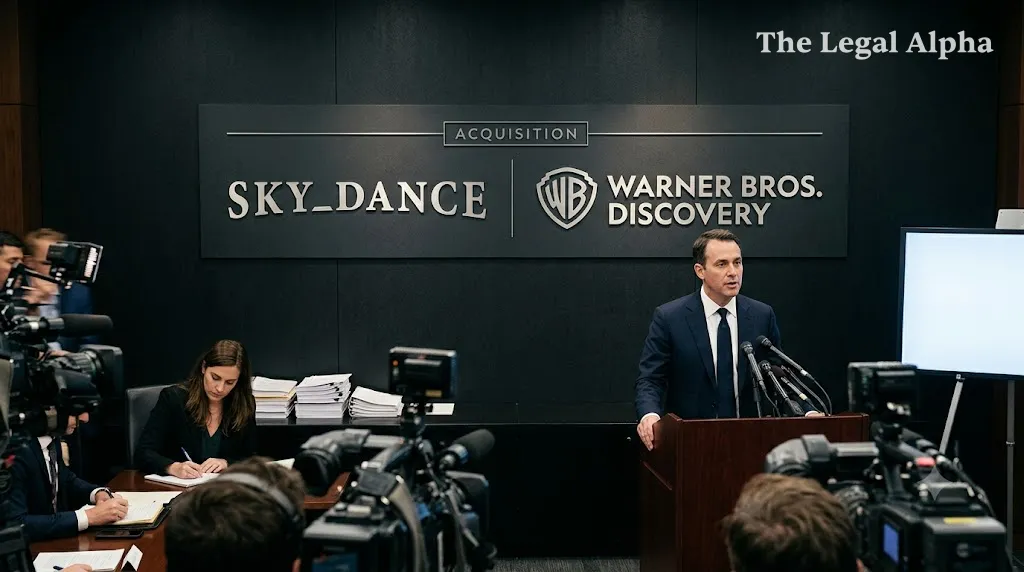
Paramount Skydance has formally concluded its $110 billion mega-takeover of Warner Bros Discovery, consummating one of the largest corporate consolidations in entertainment history. Following the completion of the transaction on October 6, 2026, the merged entity has been restructured as Skydance Corporation, with its Class B common stock transitioning to the New York Stock Exchange under the ticker symbol "SKYD".
The deal brings storied film studios, linear broadcast networks, cable channels, and direct-to-consumer streaming assets—including CBS, CNN, HBO Max, and Paramount+—under single corporate ownership led by David Ellison. The closing was made possible after the parties secured clearance from the U.S. Department of Justice and settled contentious legal challenges brought by a coalition of state attorneys general and entertainment industry labor unions.
Legal Topic
-
Area of Law: Antitrust & Competition Law / Corporate Mergers & Acquisitions
-
Sub-topic: Horizontal Merger Enforcement / Behavioral Remedies & Consent Decrees
Core Legal Issue
The central legal issue was whether the horizontal consolidation of two legacy Hollywood conglomerates substantially lessened competition in theatrical film distribution, pay-television carriage negotiations, and digital subscription video-on-demand services.
Antitrust regulators and state law enforcement agencies examined whether the combined entity would possess excessive market power over theatrical exhibition windows, unfairly leverage must-carry power across cable networks, or reduce content investment and labor opportunities within the domestic production market.
What Did the Court / Authority Decide?
The U.S. Department of Justice Antitrust Division opted not to challenge the transaction in court after determining the consolidation would not unlawfully impede broader consumer competition against dominant digital tech platforms. However, to overcome objections and legal challenges from state attorneys general and Hollywood union representatives, the merging parties entered into a binding five-year consent decree establishing extensive structural and behavioral commitments:
-
Theatrical Release Quotas: The company is legally bound to release at least 30 theatrical films annually for the first two years, rising to at least 32 films annually across the following three years. Failure to meet these slate minimums triggers a $30 million per-film penalty and potential forced divestiture of assets such as Miramax.
-
Windowing Guarantees: Skydance must maintain traditional theatrical exclusivity windows of at least 45 days before digital or home release, and 90 days before subscription video-on-demand deployment.
-
Separation of Cable Carriage Talks: To prevent coercive bundling, the decree mandates that cable network carriage negotiations for Paramount and Warner Bros networks remain strictly segregated, barring cross-portfolio leverage under threat of mandatory divestitures of select cable properties.
-
Domestic Production Commitments: The company committed to investing $1.5 billion in U.S. domestic film and television production over five years.
-
Editorial Governance: The agreement requires an independent news editorial independence board to monitor CBS News and CNN to safeguard established journalistic standards.
Key Legal Points
-
Reliance on Behavioral Remedies: The resolution illustrates a notable shift back toward complex behavioral enforcement mechanisms—such as release quotas and negotiation firewalls—rather than requiring substantial asset divestitures before closing.
-
Strict Conditional Penalties: Unlike standard corporate pledges, the slate requirements operate under enforceable financial penalties ($30 million per missed release) and mandatory clawbacks, with penalty proceeds designated for industry labor and pension funds.
-
Regulatory Recognition of Market Realities: Federal antitrust authorities treated the transaction as a defensive counterweight by legacy media firms responding to asymmetric disruption from mega-cap streaming platforms.
-
Separation of Media Assets vs. Unified Corporate Ticker: While operational firewalls and distinct studio identities are legally maintained to avoid regulatory friction, the financial underlying interests are fully unified under Skydance Corporation.
Relevant Law
-
Section 7 of the Clayton Act (15 U.S.C. § 18): Governing horizontal mergers that may substantially lessen competition or tend to create a monopoly.
-
Section 1 and Section 2 of the Sherman Act (15 U.S.C. §§ 1, 2): Concerning restraints of trade and monopolization risks.
-
Federal Trade Commission Act § 5 (15 U.S.C. § 45): Addressing unfair methods of competition.
-
State Antitrust Statutes: Invoked by state attorneys general concerning local labor markets and cultural economic impact.
Arguments of the Parties
Merging Entities (Paramount Skydance & Warner Bros Discovery)
The parties maintained that the merger was essential to survive structural shifts in global media, pointing to massive content spending by big-tech players like Netflix, Apple, and Amazon. Counsel argued that legacy studios lack the scale to independently sustain high capital expenditures, theatrical commitments, and streaming infrastructure without operational consolidation.
Regulatory Enforcers & Labor Opponents
State regulators and industry union groups argued that combining two major Hollywood production houses threatened independent cinema, risked suppressing wages, and placed theatrical exhibitors at an unfair disadvantage. Critics also expressed concern that consolidated control over broadcast and cable distribution would force cable providers and consumers to absorb higher costs through anti-competitive bundling.
Why Does It Matter?
The completion of this merger sets a critical precedent for antitrust enforcement in mature, disrupted industries. By agreeing to a comprehensive consent decree, Skydance and Warner Bros have demonstrated that mega-mergers facing intense horizontal scrutiny can still close if parties accept rigorous, legally binding operational oversight.
For the corporate and media bar, this framework establishes a detailed blueprint for how behavioral covenants—such as minimum output guarantees, fixed distribution windows, and independent governance boards—can be leveraged to resolve multi-jurisdictional enforcement hurdles without dismantling the target's core studio assets.
Legal Takeaway
Large-scale horizontal acquisitions can withstand regulatory resistance when merging parties are willing to enter binding, court-enforceable consent decrees that mandate output floors, enforce structural negotiation firewalls, and impose stiff economic penalties for non-compliance.
Sources
Primary Source:
-
U.S. Department of Justice & State Attorneys General Consent Decree and Regulatory Settlements Re: Paramount Skydance / Warner Bros. Discovery Acquisition (2026).
-
U.S. Securities and Exchange Commission Form 8-K filings, Skydance Corporation (October 2026).
Additional Sources:
-
Reuters, Financial and Legal Reportage on Paramount-Warner Bros. Merger Closing, October 6, 2026.
-
New York Stock Exchange / Nasdaq Corporate Actions Notification, Listing of Skydance Corporation (SKYD), October 2026.