Qualcomm and Arm Clash in Delaware Over Chip Licensing: Billions in Royalty Payments at Stake as Contract Trial Opens
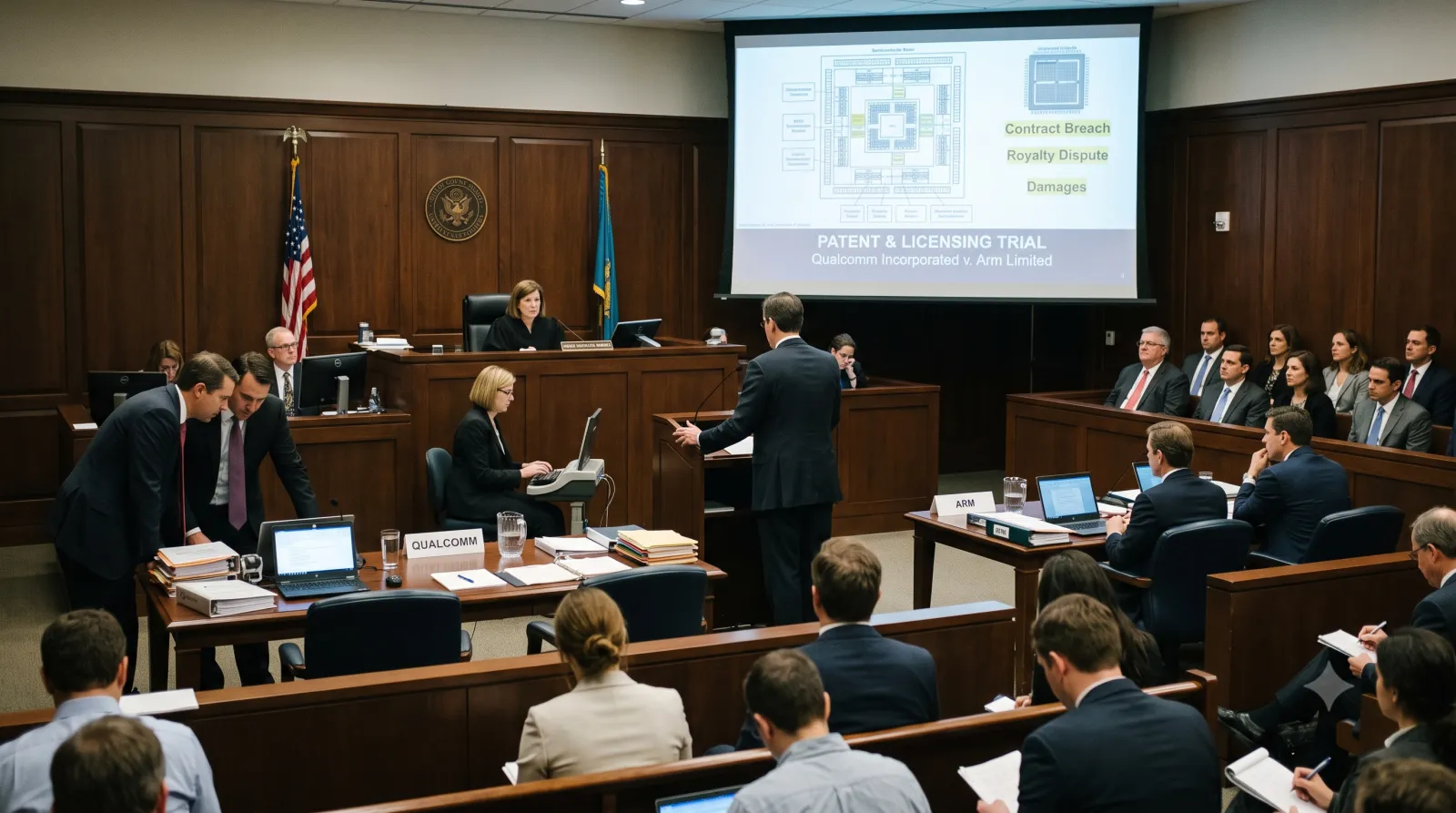
A major courtroom showdown between two semiconductor giants opened this week in Delaware federal court. Qualcomm has brought its long-time technology architecture provider, Arm Holdings, before a federal jury, claiming that Arm breached their core commercial and architectural licensing agreements. According to Qualcomm, Arm contractually withheld essential chip-testing software tools and leaked a license-termination notice to the media, an action Qualcomm alleges damaged sensitive partnership negotiations with Meta Platforms.
As a primary remedy under the contract, Qualcomm is seeking permission to halt royalty payments to Arm for up to five years—a sanction that could deprive Arm of billions of dollars. Arm denies any wrongdoing, arguing that Qualcomm suffered no measurable financial injury and that the alleged damage to prospective deals is purely speculative. The dispute marks an escalation in a high-stakes commercial relationship that has grown increasingly contentious in recent years.
Legal Topic
Area of Law: Commercial Litigation & Intellectual Property Licensing
Sub-topic: Breach of Contract, Enforceability of Contractual Remedies, and Consequential Damages
Core Legal Issue
The trial centers on whether Arm’s alleged failure to deliver technical development tools and its public disclosure of a termination threat constitute an actionable breach of contract, and whether Qualcomm can enforce a contractual clause allowing it to suspend royalty payments for up to five years as a remedy.
The court must also determine whether lost prospective business opportunities can support a claim for consequential damages without proof of concrete, non-speculative injury, and whether Arm failed to fulfill an implied or express obligation to negotiate licensing terms for its next-generation architecture in good faith.
What Did the Court / Authority Decide?
The matter is currently at trial, and no final decision on liability or damages has been rendered. On Monday, October 5, 2026, U.S. District Judge Maryellen Noreika commenced a five-day jury trial to hear evidence on Qualcomm's breach of contract claims and alleged business injuries.
While the jury weighs the factual issues, Judge Noreika is actively considering whether to strike down the specific contract term that permits Qualcomm to halt royalty payments for up to five years. If the court invalidates that remedy, Qualcomm will be restricted to seeking standard monetary damages. In addition, Judge Noreika is set to preside over a separate bench trial to determine whether Arm breached its contractual duty to negotiate in good faith regarding Qualcomm's access to the next generation of Arm architecture, ahead of the current agreement's expiration in 2033.
Key Legal Points
-
Enforceability of Royalty-Withholding Remedies: The court is evaluating whether an agreed contractual mechanism permitting a five-year royalty suspension functions as a legitimate remedy or an unenforceable penalty clause under governing contract law.
-
Standard of Proof for Lost Business Opportunities: Under established commercial contract principles, consequential damages arising from disrupted third-party discussions require demonstrable proximate causation rather than speculative projections.
-
Bifurcated Bench and Jury Determinations: The proceedings distinguish factual claims of breach and monetary harm, which are placed before the jury, from equitable claims concerning good-faith negotiation obligations, which are reserved for judicial determination.
-
Evolving Duties in Direct Competitor-Licensor Relationships: The litigation illustrates the heightened contractual friction that arises when an upstream intellectual property licensor begins designing hardware in direct competition with its key licensees.
Relevant Law
-
Delaware Uniform Commercial Code & Common Law of Contracts: Governing material breach, standards of causation for consequential damages, and the enforceability of agreed remedies.
-
Restatement (Second) of Contracts § 356: Providing the legal framework for distinguishing enforceable liquidated remedies from punitive clauses that courts refuse to enforce.
-
Implied Covenant of Good Faith and Fair Dealing: Requiring contracting parties not to intentionally frustrate the core benefits or reasonable expectations contemplated by the licensing contract.
-
Federal Rules of Civil Procedure (Rules 39 & 50): Regulating the division of issues between jury verdicts and bench determinations, as well as judicial review of contractual terms as a matter of law.
Arguments of the Parties
Plaintiff: Qualcomm
Qualcomm argued that Arm violated clear contractual obligations by withholding critical chip-testing tools that Qualcomm was contractually entitled to receive. Qualcomm submitted that Arm aggravated the breach by deliberately making public a 2024 license-termination notice, which cast uncertainty over Qualcomm’s technical stability and directly harmed high-level negotiations for a chip supply agreement with Meta Platforms. Based on these breaches, Qualcomm asserted that it is entitled to compensatory relief and the enforcement of the contract’s remedy clause allowing a royalty payment freeze for up to five years.
Defendant: Arm Holdings
Arm contended that it did not breach the licensing agreement and that Qualcomm suffered no actionable injury whatsoever. Arm submitted that Qualcomm’s claims regarding lost or damaged negotiations with Meta are purely speculative and cannot satisfy the legal standard for recoverable damages. Arm also countered that Qualcomm cannot seek damages for disclosures to the press, asserting that Qualcomm itself previously shared non-public details of regulatory antitrust inquiries into Arm. Furthermore, Arm argued that Qualcomm's request for a five-year royalty suspension represents an impermissible and unenforceable contractual penalty.
Why Does It Matter?
The trial holds substantial financial and operational significance for the global semiconductor industry. Qualcomm accounts for roughly 9% of Arm's total revenue, meaning that an adverse verdict permitting a multi-year royalty freeze would deliver a severe commercial blow to Arm and its majority owner, SoftBank Group.
Beyond the immediate financial exposure, the litigation reflects growing structural friction in the technology sector. For decades, Arm functioned purely as an architecture designer and licensor, but its recent shift toward producing its own chips has turned it into a direct market rival of its largest licensees. A judicial ruling clarifying whether licensors can be subjected to sweeping royalty freezes for technical breaches—or whether such terms will be struck down as punitive—will set a major precedent for how future intellectual property and technology licensing agreements are structured.
Legal Takeaway
Contract clauses that allow an aggrieved party to suspend substantial royalty payments are vulnerable to judicial invalidation if a court determines they operate as punitive measures rather than proportionate remedies. Additionally, asserting damages for disrupted commercial discussions requires concrete proof of non-speculative injury, ensuring that general reputational friction alone cannot support a major damages award.
Sources
Primary Source:
-
Qualcomm Inc. v. Arm Ltd. / Arm Ltd. v. Qualcomm Inc., Memorandum Decisions and Trial Proceedings, U.S. District Court for the District of Delaware (Civ. No. 22-1146-MN and related dockets before U.S. District Judge Maryellen Noreika).
Additional Sources:
-
Quarterly and Annual Disclosures (Form 10-K and Form 20-F) filed with the U.S. Securities and Exchange Commission by Qualcomm Inc. and Arm Holdings plc.
-
U.S. District Court for the District of Delaware Trial Proceedings and Transcripts, October 5–6, 2026.