Kerala High Court Directs Devaswom Board to Keep Sabarimala Prasad Supplies Free of Conflicting Markings and Align Tenders with Temple Customs
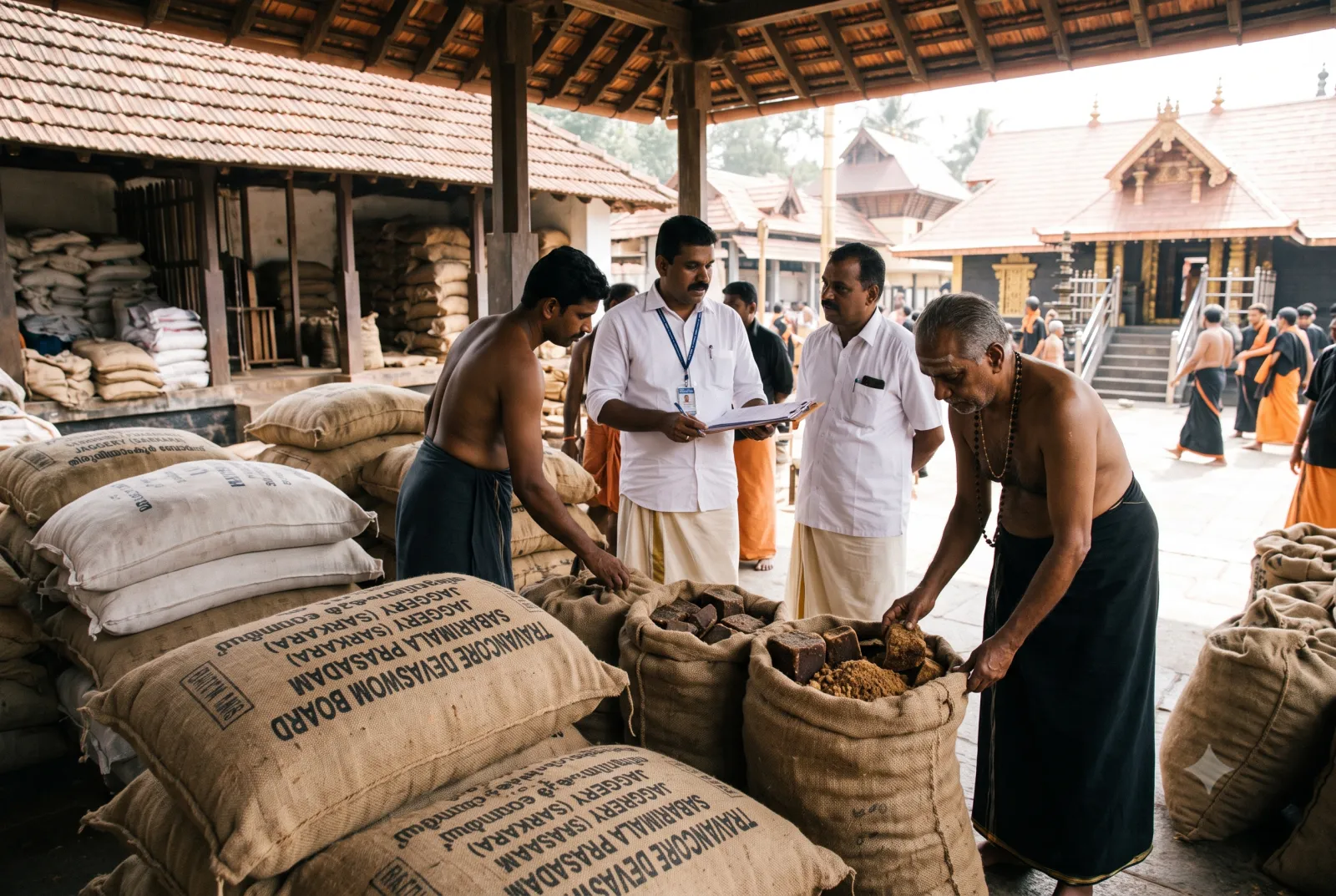
The Kerala High Court has disposed of a five-year-old dispute concerning the procurement of Halal-certified jaggery for preparing sacred offerings at the Sabarimala Lord Ayyappa Temple. A Division Bench comprising Justice Raja Vijayaraghavan V and Justice K.V. Jayakumar directed the Travancore Devaswom Board to exercise greater vigilance in future procurements and ensure that raw materials supplied for temple rituals do not carry markings or declarations capable of creating apprehension or perceived conflict with temple customs.
The matter originated during the 2021 pilgrimage season when a devotee challenged the supply of jaggery packets bearing Halal certification labels, questioning both ritual purity and food safety. While official laboratory tests confirmed that the jaggery met all statutory food safety standards, the Court concluded the proceedings by directing the Board to embed strict faith-sensitive and quality conditions into its future electronic tender documents.
Legal Topic
Area of Law: Religious Endowments and Administrative Law
Sub-topic: Temple Administration and Public Procurement Conditions
Core Legal Issue
The central issue before the Court was whether a statutory temple management board must regulate the packaging and labeling of raw materials procured through public tenders to prevent apparent conflicts with temple traditions, even when the goods fully satisfy statutory food safety standards.
Specifically, the Court had to address whether commercial export markings—such as Halal certification printed on packaging intended for West Asian markets—warranted judicial intervention in temple administration, and how the Devaswom Board should structure future supply contracts to respect customary practices.
What Did the Court Decide?
The High Court disposed of the writ petition without penalizing the administration or invalidating the procurement, noting that the jaggery supplied had met all safety parameters and that the Devaswom Board had undertaken to act with greater diligence in the future.
The Bench observed that the Travancore Devaswom Board ought to have exercised greater care to prevent the supply of materials bearing symbols, markings, or declarations that could give rise to an apprehension of conflict with the religious customs and practices followed at the temple.
To prevent recurrence, the Court issued specific prospective directions:
-
The Travancore Devaswom Board must exercise due care and caution in all future procurement exercises.
-
The Board must incorporate necessary conditions in its e-tender documents to mandate that all materials procured for Nivedyam and Prasadam conform strictly to prescribed quality standards as well as the religious customs and requirements of Sabarimala Temple.
Key Legal Points
-
Administrative Vigilance in Sacred Procurements: Governing bodies of religious institutions have an administrative responsibility to ensure that ritual ingredients do not display external symbols or certifications that may raise reasonable apprehensions of conflict with the institution's customary practices.
-
Customary Stipulations in Public Tenders: Statutory temple boards are entitled and required to introduce specific tender clauses obligating commercial suppliers to honor temple traditions and appropriate packaging norms alongside standard quality criteria.
-
Labeling Versus Food Safety Standards: The presence of an export certification label does not constitute a violation of the Food Safety and Standards Act, 2006, provided the consumable item passes chemical, biological, and statutory safety analyses.
-
Prospective Guidance over Punitive Relief: Where a public authority provides a formal undertaking to rectify procurement gaps and past stocks complied with safety benchmarks, writ courts may resolve administrative controversies by framing prospective operational safeguards.
Relevant Law
-
The Travancore-Cochin Hindu Religious Institutions Act, 1950: Governs the administrative duties, temple property management, and customary maintenance obligations of the Travancore Devaswom Board.
-
The Food Safety and Standards Act, 2006 (and 2011 Regulations): Prescribes statutory safety, purity, testing, and packaging standards for food items meant for human consumption.
-
Article 226 of the Constitution of India: High Court writ jurisdiction invoked to review the administrative actions and tendering processes of statutory authorities.
Arguments of the Parties
Petitioner
The petitioner, a devotee of Lord Ayyappa, argued that Halal certification signifies compliance with the rituals and tenets of another faith, rendering the sweetener inconsistent with the satwik and ritually pure standards historically required for Lord Ayyappa’s offerings. The petitioner submitted that using such ingredients infringed long-standing temple rituals and alleged that substandard or deteriorated jaggery posed health risks to pilgrims, demanding confiscation and regulatory action.
Respondent
The Travancore Devaswom Board submitted that the supply contract had been transparently awarded to the lowest eligible bidder through an open e-tender process. The Board explained that the supplier routinely exported food products to Middle Eastern nations where Halal markings are mandatory, which was the sole reason the packaging carried the label. The Board and the Food Safety Department submitted laboratory test reports proving that every batch delivered was fresh and fully compliant with statutory food safety parameters. The Board confirmed that earlier deteriorated stocks from prior seasons had been auctioned off strictly for non-human industrial use, and it undertook to exercise greater care in future tenders.
Why Does It Matter?
This ruling addresses a sensitive intersection between commercial public procurement and religious traditions. State-supervised temple boards manage massive supply chains to prepare offerings for millions of pilgrims annually. While government procurement typically focuses on competitive pricing and statutory standards, this judgment clarifies that administrators of religious institutions must also consider customary and ritual sensibilities.
For commercial vendors, the judgment highlights that fulfilling institutional supply contracts with religious bodies requires attention to packaging and presentation. Suppliers can no longer assume that stock packaged for foreign export can be delivered under temple contracts without screening for sensitive markings. By requiring the Devaswom Board to embed explicit packaging and tradition-compliance clauses directly into e-tender contracts, the Court established a clear contractual safeguard to prevent public controversies before goods reach temple gates.
Legal Takeaway
Statutory temple boards must actively protect institutional customs by inserting explicit requirements into public tender documents to bar conflicting symbols or markings on ritual supplies. At the same time, food items certified as safe by statutory food safety authorities cannot be deemed legally defective merely because their packaging carries a standard commercial export label.
Sources
Primary Source:
Judgment of the High Court of Kerala in S.J.R. Kumar v. The Travancore Devaswom Board & Ors., WP(C) No. 25645 of 2021 (Neutral Citation: 2026:KER:75371), delivered on September 29, 2026 by Justice Raja Vijayaraghavan V and Justice K.V. Jayakumar.
Additional Sources:
Reports of the Sabarimala Special Commissioner; submissions of the Food Safety Officer and Government Analyst's Laboratory; tender records of the Travancore Devaswom Board.