Federal Court Halts Administration’s Multi-Million-Dollar Fines Against Undocumented Immigrants
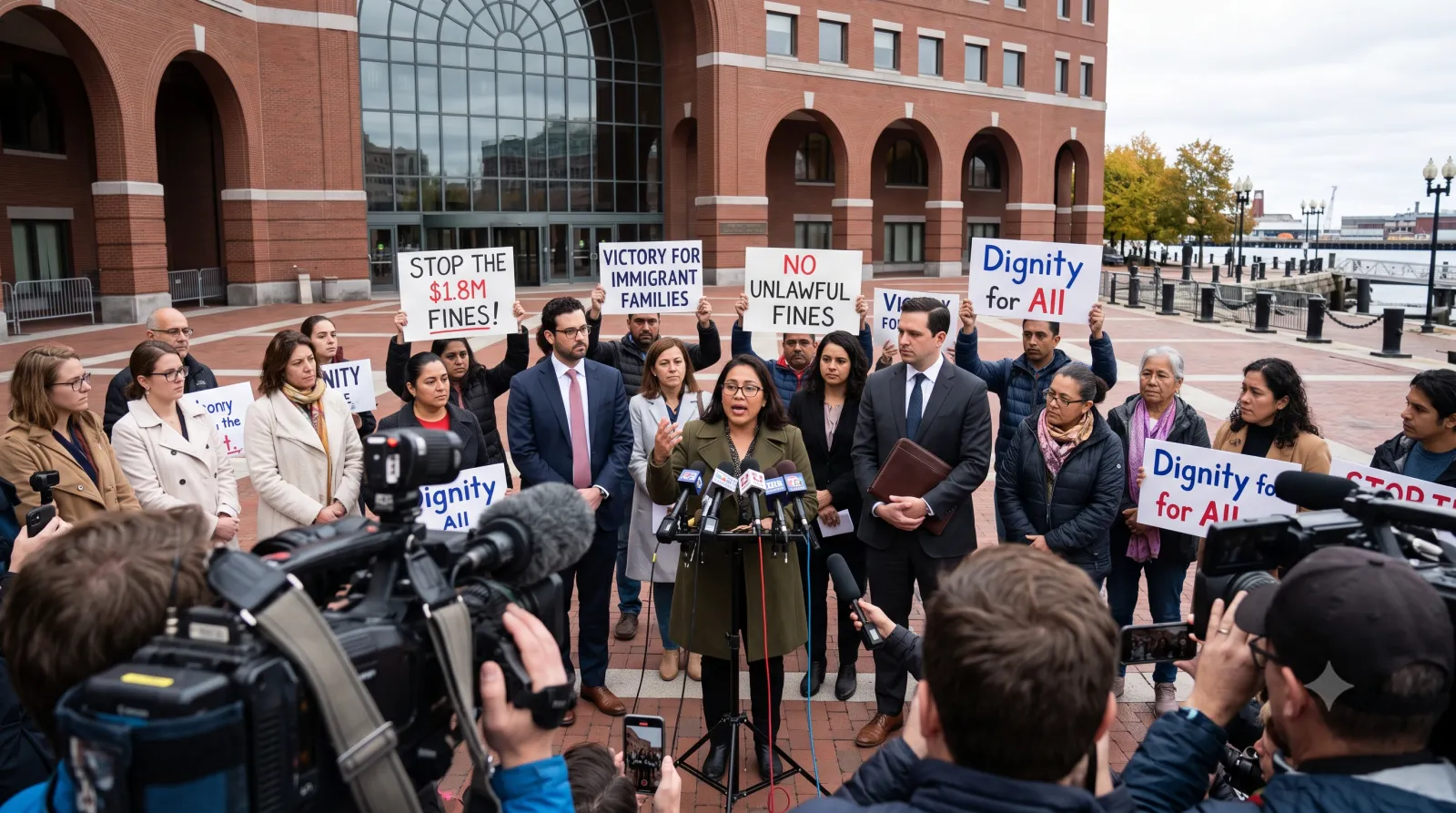
A federal judge in Boston has blocked the federal government from levying massive civil monetary penalties—reaching up to $1.8 million per person—against immigrants who remain in the United States following final deportation orders. The ruling, issued on October 5, 2026, by the U.S. District Court for the District of Massachusetts, halts an aggressive administrative enforcement campaign that had already generated more than 103,000 fine notices totaling approximately $84 billion. Immigrant plaintiffs and advocacy organizations challenged the initiative as procedurally defective and unlawfully punitive.
Legal Topic
Area of Law: Immigration Law & Federal Administrative Law
Sub-topic: Civil Monetary Penalties / Administrative Procedure Act Compliance / Removal Enforcement
Core Legal Issue
The primary legal question before the court was whether federal immigration authorities may impose daily statutory penalties—accruing retroactively up to $1.8 million—using standardized, boilerplate forms without making an individualized finding of willful noncompliance.
The court also had to determine whether the Department of Homeland Security (DHS) and the Department of Justice (DOJ) violated the Administrative Procedure Act (APA) by eliminating statutory notice periods and curtailing appeal rights through internal policy adjustments without first providing the public with notice and an opportunity to comment.
What Did the Court / Authority Decide?
Senior U.S. District Judge George A. O'Toole Jr. ruled in favor of the plaintiffs, granting an injunction that stops the federal government from enforcing or assessing the contested fines under the streamlined policy.
The court held that the penalty system violated the APA on two distinct grounds. First, the administration failed to comply with mandatory notice-and-comment rulemaking when it altered the fine assessment structure in July 2025. Second, U.S. Immigration and Customs Enforcement (ICE) acted unlawfully by issuing boilerplate penalty notices that lacked specific factual allegations demonstrating that an individual’s failure to depart was "willful" or "voluntary."
Judge O'Toole stressed that the plaintiffs already lived in economically precarious circumstances, and enforcing exorbitant financial penalties would drive them into immediate insolvency. While this ruling halts fine collections and the streamlined process under review, broader substantive claims in the class-action litigation remain pending.
Key Legal Points
-
Procedural Rulemaking Mandates: Substantive changes to administrative enforcement frameworks—such as shortening challenge windows and eliminating standard notice periods—require notice-and-comment rulemaking under 5 U.S.C. § 553.
-
Evidentiary Threshold for Willfulness: Statutory penalties triggered by a noncitizen’s failure to depart require specific, individualized proof of voluntary defiance rather than mechanized, boilerplate allegations.
-
Irreparable Harm via Insolvency: The threat of severe, life-altering administrative fines against low-income individuals constitutes irreparable economic harm sufficient to justify preliminary injunctive relief.
-
Limits on Agency Discretion: Administrative convenience cannot override statutory protections or procedural due process in the assessment of civil monetary sanctions.
Relevant Law
-
Administrative Procedure Act (APA), 5 U.S.C. § 553: Establishes mandatory notice-and-comment procedures for federal agency rulemaking.
-
Administrative Procedure Act (APA), 5 U.S.C. § 706(2)(A): Authorizes courts to set aside agency actions that are arbitrary, capricious, an abuse of discretion, or contrary to law.
-
Immigration and Nationality Act (INA) § 274D, 8 U.S.C. § 1324d: Authorizes civil monetary penalties against noncitizens subject to a final order of removal who willfully fail or refuse to depart the country.
-
Federal Civil Penalties Inflation Adjustment Act: The statutory mechanism through which the baseline immigration daily non-departure penalties were adjusted up to $998 per day.
Arguments of the Parties
Plaintiffs (Affected Immigrants and Immigrant Legal Resource Center)
The plaintiffs argued that DHS and ICE overstepped their statutory authority by weaponizing civil monetary penalties as an instrument of financial intimidation. They submitted that ICE routinely issued boilerplate notices that failed to evaluate personal circumstances, health conditions, or legal barriers that prevented voluntary departure. Furthermore, the plaintiffs contended that the agencies violated the APA by drastically shortening response times and stripping away procedural safeguards without conducting formal public rulemaking.
Defendants (Department of Homeland Security and Department of Justice)
The government argued that the daily fines are explicitly sanctioned by Congress under the Immigration and Nationality Act to encourage compliance with final removal orders. Officials contended that the procedural modifications adopted in July 2025 were internal administrative measures designed to streamline enforcement, curb systemic delays, and manage case backlogs. The administration asserted that agencies hold broad operational discretion to enforce existing statutory remedies without submitting routine enforcement guidelines to public comment.
Why Does It Matter?
The decision places a significant judicial restraint on executive attempts to repurpose civil monetary penalties into a mass deportation enforcement mechanism. By pausing a framework that produced $84 billion in assessed penalties across more than 103,000 individuals, the ruling shields vulnerable immigrant households from immediate financial insolvency.
Beyond immigration enforcement, the ruling reinforces fundamental administrative law doctrines. It serves as a reminder to federal regulators that changing substantive enforcement mechanisms requires adherence to formal APA rulemaking procedures. Furthermore, it affirms that where a statute requires proof of a specific mental state—such as willful noncompliance—an administrative agency cannot rely on automated boilerplate forms to meet its legal burden.
Legal Takeaway
Federal agencies cannot skip notice-and-comment rulemaking to streamline punitive systems, nor can they rely on automated boilerplate forms to fine individuals. Whenever a statute requires a showing of willful noncompliance, the government must support penalties with individualized, case-specific evidence.
Sources
Primary Source:
-
Memorandum and Order, U.S. District Court for the District of Massachusetts (Judge George A. O'Toole Jr., issued October 5, 2026).
Additional Sources:
-
Immigration and Nationality Act, 8 U.S.C. § 1324d (Civil Penalties for Failure to Depart).
-
Administrative Procedure Act, 5 U.S.C. §§ 553 & 706.
-
Filings and case materials from the Immigrant Legal Resource Center (ILRC).