Pastoral Care Behind Glass: Catholic Archdiocese Sues ICE and Missouri Jail Over Denied Sacraments to Immigrant Detainees
The Roman Catholic Archdiocese of St. Louis filed a federal civil rights lawsuit against federal immigration authorities and local jail officials, alleging that immigration detainees held in eastern Missouri are being unconstitutionally denied in-person access to priests and the Catholic sacraments.
Filed on October 5, 2026, in the U.S. District Court for the Eastern District of Missouri, the lawsuit challenges strict visitation rules enforced at the Ste. Genevieve County Detention Center. The county facility houses approximately 150 civil immigration detainees under a contract with U.S. Immigration and Customs Enforcement (ICE).
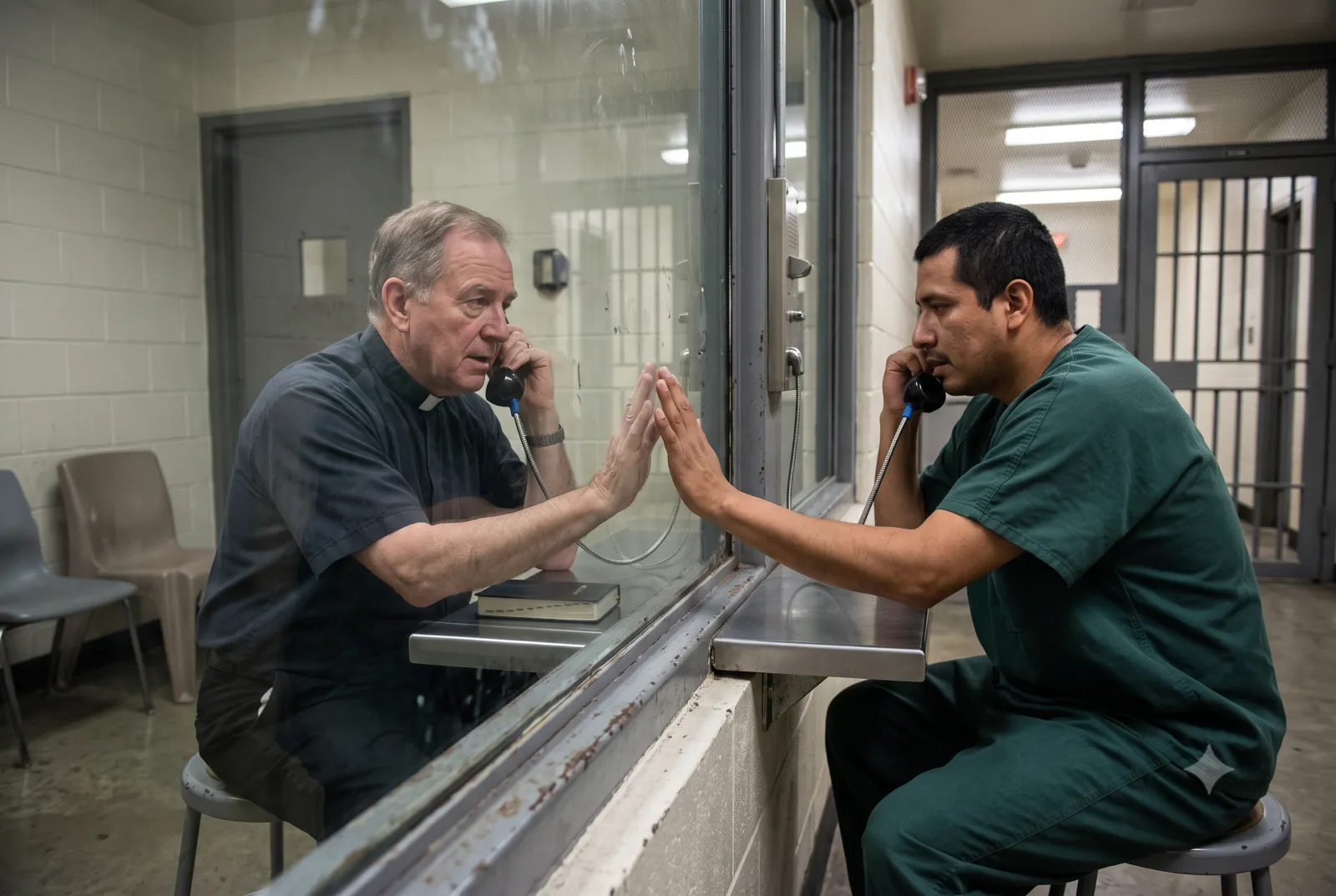
According to the complaint, detention authorities limit clergy visits to a single four-hour window on Monday mornings and refuse to permit private, contact visits. Instead, priests are required to communicate with detainees through a security glass divider using jail intercom telephones. The archdiocese contends that these constraints create an absolute bar to core Catholic rites—including the Sacrament of Reconciliation (Confession), the distribution of the Holy Eucharist (Communion), and the Anointing of the Sick—which require physical presence and strict spiritual confidentiality.
Legal Topic
Area of Law: Constitutional Law & Civil Rights
Sub-topic: Religious Freedom & Institutional Detainee Rights
Core Legal Issue
The case centers on whether blanket jail visitation policies that restrict clergy to non-contact, intercom-mediated visits impose a substantial, unjustified burden on the religious exercise of civil immigration detainees and their ministers.
Under federal religious freedom statutes and the U.S. Constitution, detention authorities may not substantially burden religious practices without demonstrating that the restriction serves a compelling governmental interest and constitutes the least restrictive means of achieving that interest. The primary legal question before the court is whether security considerations justify barring clergy from contact rooms when the same facility routinely provides private, in-person access to attorneys and foreign consular representatives.
What Did the Court / Authority Decide?
The litigation is in its initial stages, and the federal district court has not yet ruled on the underlying merits of the lawsuit.
Alongside the substantive complaint, the plaintiffs filed an emergency motion for a preliminary injunction. That motion asks the court to immediately enjoin jail officials from enforcing the no-contact rule and mandate temporary procedures that grant clergy access comparable to legal visits while the broader constitutional challenge proceeds. The named defendants have been served and will be required to submit responsive pleadings and show cause why interim injunctive relief should not be ordered.
Key Legal Points
-
Substantial Burden on Sacraments: The plaintiffs assert that the jail's physical and technical barriers make the administration of Catholic sacraments impossible under canon law, which forbids hearing confessions over electronic recording lines and requires consecrated hands to distribute Holy Communion.
-
Disparate Access Standards: The lawsuit challenges the facility’s differential treatment of visitors, arguing that if security protocols safely permit unmonitored, contact meetings for defense counsel and consular officials, denying equivalent access to ordained clergy fails the "least restrictive means" test.
-
Delegated Federal Duties: While the detention facility is operated by a county sheriff's department, it holds federal immigration detainees under an Intergovernmental Service Agreement; the suit highlights ICE's legal obligation to ensure its contracted facilities adhere to federal religious accommodation mandates.
-
Emerging National Jurisprudence: The Missouri filing follows successful preliminary injunctions obtained by clergy earlier this year against ICE processing centers in Minnesota and Illinois, signaling growing judicial scrutiny over sacramental access in administrative detention.
Relevant Law
-
The First Amendment to the United States Constitution (Free Exercise Clause): Guarantees the right to exercise religious beliefs free from arbitrary government prohibition.
-
The Religious Freedom Restoration Act of 1993 (RFRA), 42 U.S.C. § 2000bb et seq.: Prohibits federal agencies and their contractors from placing substantial burdens on religious exercise unless justified by a compelling governmental interest implemented through the least restrictive means.
-
The Religious Land Use and Institutionalized Persons Act of 2000 (RLUIPA), 42 U.S.C. § 2000cc et seq.: Extends heightened strict-scrutiny protections against religious burdens to state and local institutional facilities receiving federal funds.
-
Civil Rights Act of 1871, 42 U.S.C. § 1983: Provides a federal cause of action against state and local officials acting under color of state law for constitutional and statutory deprivations.
-
ICE Performance-Based National Detention Standards (PBNDS): Federal administrative standards requiring detention centers to permit pastoral visits of reasonable duration with appropriate privacy protections.
Arguments of the Parties
Plaintiffs (Archdiocese of St. Louis, Archbishop Mitchell T. Rozanski, and Clergy) The archdiocese argues that ministering to prisoners is a fundamental scriptural mandate and that the facility's policy creates a functional prohibition on the sacraments. Priests cannot administer Confession over jail phone lines because electronic interception compromises the inviolable Seal of Confession, which carries the penalty of excommunication under church law.
Additionally, the archdiocese rejected the jail's alternative suggestion—that clergy place consecrated hosts into containers for guards to pass through slots—as doctrinally impermissible and sacrilegious. The plaintiffs submit that because the facility already maintains safe, private consultation rooms for attorneys and foreign consular officials, extending those same protocols to clergy presents zero incremental security risk.
Defendants (Ste. Genevieve County Officials and Federal Authorities) While formal legal responses have not yet been filed, detention officials and law enforcement operators historically rely on broad correctional discretion to maintain facility safety, prevent contraband introduction, and control inmate movement. Jail administrators generally contend that uniform non-contact visiting rules are neutral, non-discriminatory security measures applied evenly across non-attorney visitors, and that telephone-and-glass partitions provide reasonable opportunities for general spiritual counseling without breaching correctional security envelopes.
Why Does It Matter?
This lawsuit highlights a persistent point of friction in the U.S. immigration system: the legal gap between federal detention guidelines and everyday operational policies inside county-level facilities. ICE relies heavily on intergovernmental agreements with rural county jails to house civil detainees. Although ICE's official national standards instruct facilities to accommodate religious ministry, local sheriffs often enforce their own rigid security regimes designed for criminal detention.
If the federal court grants the preliminary injunction, the ruling will reinforce a growing judicial consensus that institutional administrators cannot treat pastoral visits as discretionary privileges secondary to legal visits. A decision in favor of the archdiocese would establish clear authority in the Eighth Circuit, providing a compliance blueprint for immigration advocates and faith groups across the country seeking equal access to civil detention facilities.
Legal Takeaway
Correctional institutions cannot invoke generalized security concerns to justify policies that effectively ban sacramental rites when less restrictive accommodations—such as using existing attorney-client rooms—are already available. Under federal religious protection statutes, denying confidential, in-person access to clergy must meet strict scrutiny, a burden that blanket non-contact visiting rules struggle to survive.
Sources
Primary Source:
-
Archbishop Mitchell T. Rozanski et al. v. Sheriff Gary Stolzer et al., Docket No. 1:26-cv-00224, filed October 5, 2026, in the U.S. District Court for the Eastern District of Missouri.
-
U.S. Immigration and Customs Enforcement, Performance-Based National Detention Standards (PBNDS), Religious Practices Provisions.
Additional Sources:
-
Reuters: Legal reporting on the St. Louis Archdiocese federal civil rights complaint, October 5, 2026.
-
The St. Louis Review: Official publication of the Archdiocese of St. Louis, coverage of detention center ministry litigation, October 5, 2026.