High Court Directs Prince Harry and Co-Claimants to Pay £9.54 Million Interim Legal Costs on Stricter Indemnity Basis
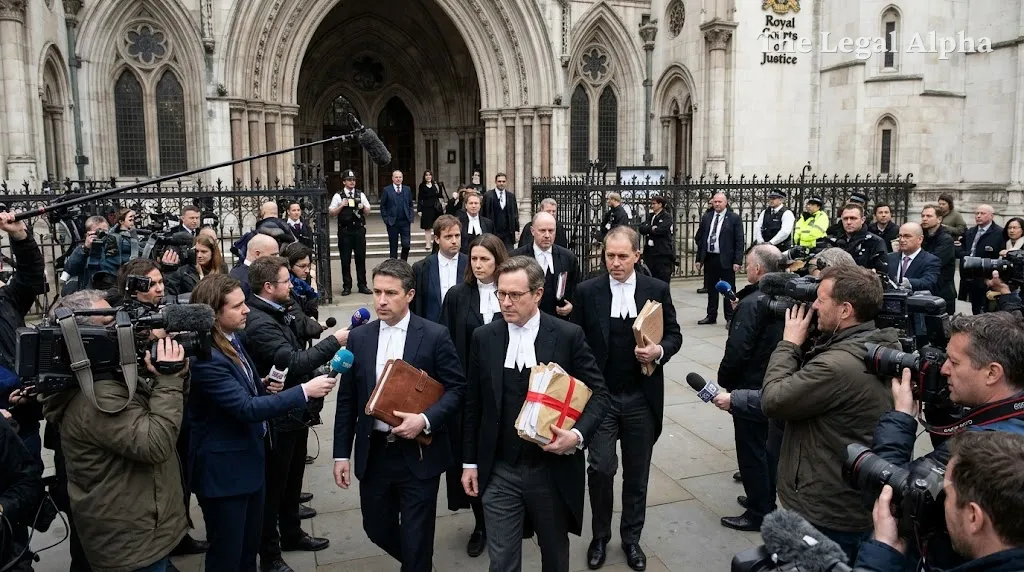
The High Court of England and Wales ordered Prince Harry (The Duke of Sussex) alongside six other prominent figures—including Sir Elton John, Baroness Doreen Lawrence, and Elizabeth Hurley—to make an immediate interim payment of £9.54 million (roughly $13 million) toward the legal defense costs of Associated Newspapers Limited, the publisher of the Daily Mail and The Mail on Sunday.
The costs determination followed the dismissal of the group’s high-profile privacy lawsuit, in which the claimants accused the media group of widespread unlawful information gathering, including phone tapping, voicemail interception, and deceptive private investigations. Following an extensive trial, the court concluded that the claimants failed to prove their allegations regarding the specific articles in issue. Because the court deemed the procedural conduct of the claimants’ case “unreasonable to a high degree,” it ordered costs to be assessed on an indemnity basis rather than the routine standard basis.
Legal Topic
-
Area of Law: Civil Litigation / Media Law
-
Sub-topic: Costs Assessment / Indemnity Basis / Interim Payments on Account
Core Legal Issue
The primary legal inquiry focused on whether the claimants’ procedural conduct and the manner in which their claims were framed and sustained took the case outside the ordinary realm of civil litigation, justifying an order for costs on the indemnity basis under the Civil Procedure Rules (CPR). A related question was determining the appropriate sum to be paid on account pending a detailed costs assessment, and whether the court has jurisdiction to cap costs assessed on an indemnity basis.
Under English civil procedure, the standard basis applies the test of proportionality and resolves doubts in favor of the paying party. By contrast, indemnity costs remove the proportionality hurdle, placing the evidentiary burden on the paying party to demonstrate that costs were unreasonably incurred or unreasonable in quantum.
What Did the Court Decide?
-
Dismissal Confirmed: Justice Matthew Nicklin reiterated the underlying dismissal of all substantive claims, noting a failure of proof connecting unlawful tactics directly to the disputed publications.
-
Indemnity Costs Awarded: The court held that the bulk of the publisher’s recoverable costs should be assessed on the indemnity basis due to the unparticularized, fluid, and speculative nature of several serious allegations that were abandoned late in proceedings.
-
Interim Quantum: The claimants were ordered to pay £9.54 million on account of costs, rather than the total £34.5 million bill advanced by Associated Newspapers. The judge declined to place a preliminary cap on the final bill but highlighted that the overall claim appeared exceptionally high.
-
No Finding of Dishonesty: Justice Nicklin explicitly clarified that the claimants themselves acted without dishonesty and had genuine concerns regarding their privacy.
-
Pending Steps: The total enforceable sum will be determined via a formal detailed assessment by a dedicated costs judge if the parties cannot reach an agreement. The claimants retain the right to seek permission to appeal against both the trial judgment and the consequential costs order.
Key Legal Points
-
Threshold for Indemnity Costs: An award of costs on the indemnity basis does not follow simply from losing a case; it requires conduct or circumstances taking the litigation out of the norm, characterized by high unreasonableness in how claims are advanced or withdrawn.
-
Proportionality Shield Removed: While costs claimed on an indemnity basis must still be reasonably incurred and reasonable in amount, they are not constrained by proportionality, shifting the benefit of the doubt to the receiving party.
-
Interim Payments on Account: Under CPR 44.2(8), courts routinely order a substantial percentage of the reasonably expected recoverable costs to be paid upfront to prevent successful defendants from being kept out of pocket during drawn-out assessment proceedings.
-
Duty of Evidential Precision: Generic allegations of industrial-scale newsroom wrongdoing cannot substitute for article-specific proof showing that unlawful methods yielded the exact publication complained of.
Relevant Law
-
Civil Procedure Rules (CPR) Rule 44.2: Governs the court's general discretion as to costs, including the conduct of parties and whether to make an interim payment on account.
-
Civil Procedure Rules (CPR) Rule 44.3: Establishes the distinction between the standard basis and the indemnity basis of costs assessment.
-
Judicial Precedents: Excelsior Commercial Products Ltd v Salisbury Hammer Aspden & Johnson and Three Rivers District Council v Bank of England, defining "out of the norm" conduct and unreasonableness warranting indemnity costs.
Arguments of the Parties
Claimants (Prince Harry and Co-Claimants) The claimants submitted that their pursuit of the litigation was grounded in well-founded, genuine concerns over media intrusion and that the proceedings did not warrant the punitive threshold of indemnity costs. Their counsel argued that interim payments should be substantially lower—proposing a figure closer to £11 million ($11 million equivalent)—and requested limits or scrutiny on Associated Newspapers' total expenditure, which they described as grossly inflated.
Defendant (Associated Newspapers Limited) Associated Newspapers argued that defending the multifaceted and sprawling action cost roughly £34.5 million, asserting that the claimants advanced sweeping claims of criminal wrongdoing without foundational evidence. The publisher contended that late abandonments of claims and significant shifts in the claimants' pleadings placed unfair burdens on the defense, justifying full recovery on an indemnity basis.
Why Does It Matter?
The decision delivers a cautionary precedent for claimants bringing group litigation or historic privacy claims against major media entities. For years, claimants relied on generalized findings from statutory inquiries or previous civil findings against competitor titles to establish circumstantial propensity. This ruling underscores that propensity arguments cannot bypass strict evidentiary proof.
Additionally, the imposition of indemnity costs creates significant litigation risk for third-party funders, After-the-Event (ATE) insurers, and claimants alike. With media publishers demonstrating a willingness to spend tens of millions of pounds to defend editorial sourcing, prospective claimants must weigh whether their after-the-event coverage will adequately protect them if a case unravels and indemnity costs strip away standard proportionality caps.
Legal Takeaway
Unsuccessful claimants cannot rely on broad systemic misconduct to prove individual claims; failing to substantiate specific allegations risks triggering indemnity costs that strip away proportionality protections. Litigants must rigorously evaluate evidence before trial or face substantial interim cost orders.
Sources
-
Primary Source: High Court of England and Wales (King's Bench Division), Various Claimants v Associated Newspapers Limited, Costs Judgment of Mr Justice Nicklin ([2026] EWHC 1637 (KB) and consequential costs ruling).
-
Additional Sources: Civil Procedure Rules (CPR) Parts 44; Legal proceedings coverage via LawCommentary, Griffin Law, and Courthouse News Service.