Supreme Court Enforces Bhakra-Beas Hydro Entitlement: Punjab and Haryana Directed to Transfer 11,973 Million Units of Power Arrears to Himachal Pradesh
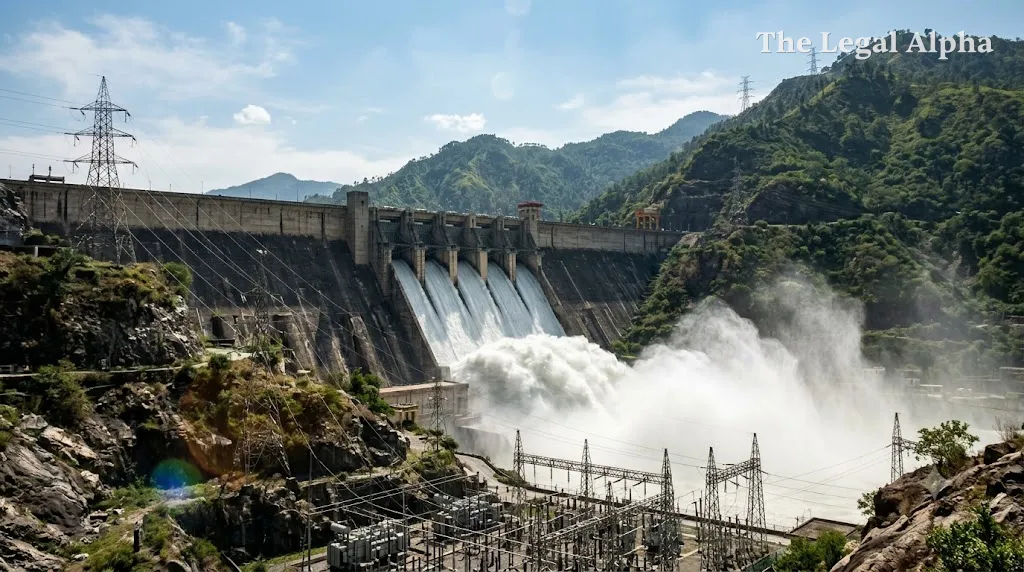
The Supreme Court of India has concluded a protracted interstate dispute over electricity arrears stemming from the reorganization of Punjab in 1966. A three-judge bench led by Chief Justice Surya Kant and Justices Joymalya Bagchi and V. Mohana approved a cashless settlement mechanism prepared by the Union Government. Under the binding order, Punjab and Haryana must deliver 11,973 million units (MU) of electricity in kind to Himachal Pradesh spread across 20 consecutive lean seasons.
The ruling brings operational finality to a 2011 decree that had recognized Himachal Pradesh’s legal share in the power generated by the Bhakra-Nangal and Beas hydroelectric projects but remained unexecuted for over a decade due to financial and logistical disagreements among the states.
Legal Topic
Area of Law: Constitutional & Interstate Energy Law
Sub-topic: Reorganisation of States / Execution of Decrees / Inter-State River Valley Projects
Core Legal Issue
The controversy centered on the execution of a Supreme Court decree under Article 131 of the Constitution concerning the apportionment of assets, liabilities, and energy rights under Part VIII of the Punjab Reorganisation Act, 1966.
While Himachal Pradesh’s substantive 7.19 percent entitlement had been confirmed in 2011, the participating states remained deadlocked on the mechanism of discharge: whether the accumulated historical arrears should be settled in cash or in energy units, the appropriate amortization period, and how historical capital expenditure incurred during project construction should be offset against past liabilities.
What Did the Court / Authority Decide?
The bench adopted the Union Government’s framework and issued definitive operational directions:
-
Total Energy Liability: The gross arrears owed to Himachal Pradesh were assessed at 13,066 MU by the Central Electricity Authority. Factoring in an adjustment of ₹420 crore representing Himachal's historical share of project capital costs, the net liability to be delivered was fixed at 11,973 MU.
-
Delivery Schedule: Punjab and Haryana must transmit this electricity at an average rate of 653 MU annually across 20 consecutive winter/lean seasons (October to March), when Himachal Pradesh faces peak power deficits.
-
Inter Se Apportionment: Between the contributing states, the liability will be shared in the ratio of 58:42 for the Bhakra-Nangal Project and 60:40 for the Beas Projects.
-
Cashless Model: Himachal Pradesh is exempted from making cash refunds for past construction expenditure, with the debt adjusted directly against power deliveries.
Key Legal Points
-
Enforceability of Interstate Decrees: The judgment affirms that long-pending decrees arising under original interstate suits must be brought to execution through pragmatic settlement frameworks when financial restitution risks destabilizing state exchequers.
-
Rejection of Unilateral Delays: The bench rejected Punjab’s plea seeking a 30-year phased timeline, holding that prolonged non-satisfaction of an interstate decree undermines the finality of apex court adjudications.
-
Reconciliation of Capital Debt and Statutory Benefits: The formula reconciled statutory entitlements under state reorganisation legislation with equitable principles of capital cost-sharing in shared public infrastructure.
Relevant Law
-
Constitution of India: Article 131 (Original jurisdiction of the Supreme Court in interstate disputes) and Article 142 (Power to enforce decrees and pass orders to ensure complete justice).
-
Punjab Reorganisation Act, 1966: Sections 78, 79, and 80 (Governance, rights, and apportionment of assets/liabilities concerning the Bhakra-Nangal and Beas Projects managed by the Bhakra Beas Management Board).
-
Supreme Court Precedent: State of Himachal Pradesh v. Union of India & Ors. (2011), which settled Himachal Pradesh’s 7.19 percent entitlement from the respective dates of commercial operation.
Arguments of the Parties
Petitioner (State of Himachal Pradesh)
Senior Advocate Kapil Sibal, appearing for Himachal Pradesh, submitted that the state had been deprived of its lawful power entitlement for decades despite securing a binding decree in 2011. The state urged an expedited settlement within a 10-year window to alleviate severe energy deficits during winter months, emphasizing that execution should not be indefinitely delayed by debtor states.
Respondents (States of Punjab and Haryana)
The State of Punjab resisted an upfront monetary payout or a condensed delivery timeline, citing acute stress on the state exchequer and grid operations. It proposed stretching any delivery over 30 years to minimize domestic tariff shocks.
Attorney General R. Venkataramani, representing the Union, submitted an independent compromise note proposing a 20-year lean-season delivery and the capital cost offset of ₹420 crore to balance fiscal viability with decree execution. Haryana largely acquiesced to the structured central formulation.
Why Does It Matter?
The resolution provides a viable judicial blueprint for resolving long-standing federal disputes involving legacy assets, inter-basin transfers, and regional river valley boards.
By replacing cash liabilities with units of seasonal energy, the court avoided triggering fiscal distress for the distributing states while ensuring the recipient state secures tangible power supply when its hydroelectric generation drops in winter. It establishes a precedent that execution proceedings in interstate water and power disputes can be reconciled through structured in-kind restitution balanced against capital infrastructure liabilities.
Legal Takeaway
A binding decree under Article 131 cannot be stalled indefinitely by disagreements over monetary computation. In complex interstate asset allocations, the Supreme Court can invoke its equitable powers to enforce in-kind, staggered restitution models that honor statutory rights without destabilizing public utilities.
Sources
Primary Source:
-
State of Himachal Pradesh v. Union of India and Others, Original Suit execution proceedings, order dated November 6, 2026 (Supreme Court of India, Bench comprising Chief Justice Surya Kant, Justice Joymalya Bagchi, and Justice V. Mohana).
Additional Sources:
-
Report of the Central Electricity Authority on Energy Apportionment under the Punjab Reorganisation Act, 1966.
-
Settlement Notes and Allocation Formulations presented by Attorney General for India R. Venkataramani.