DOJ Personnel Exits Stall Investigation into Alleged Coordinated Plot Against Trump
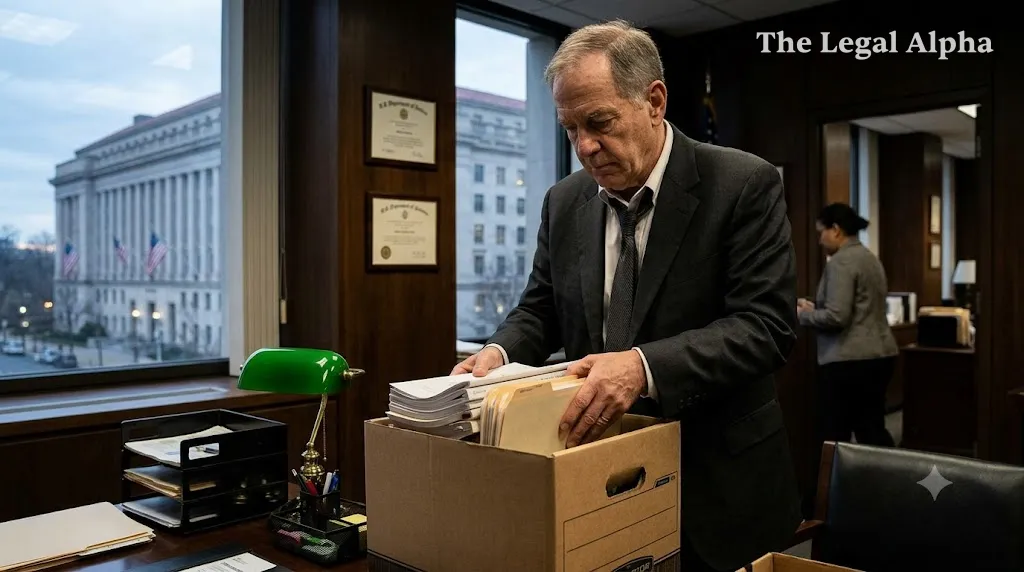
The U.S. Department of Justice’s inquiry into an alleged broad conspiracy by former federal officials against Donald Trump has faced severe internal fractures following consecutive resignations of senior prosecutors leading the effort. Lead prosecutor Joseph diGenova stepped down from the Florida-based inquiry without returning any indictments, publicly citing the absence of prosecutable evidence necessary to support criminal charges. Weeks later, attorney Kurt Olsen also withdrew from the team amid disagreements over supervisory direction from Washington. The resignations highlight sharp institutional tension between political demands for swift prosecution and the rigorous evidentiary thresholds required under federal criminal standards.
Legal Topic
-
Area of Law: Criminal Law / Legal Ethics & Professional Responsibility
-
Sub-topic: Prosecutorial Discretion, Grand Jury Practice, and Probable Cause Standards
Core Legal Issue
The fundamental legal question centers on the limits of prosecutorial discretion and ethical duties under federal standards of criminal justice: specifically, whether government attorneys may initiate or sustain criminal charges under federal conspiracy statutes when the investigative record lacks sufficient, admissible evidence demonstrating probable cause and a reasonable likelihood of conviction at trial.
Federal prosecutors are legally and ethically prohibited from presenting an indictment to a grand jury if they cannot substantiate every element of the underlying offense with competent evidence. When political directives collide with an absence of admissible proof, prosecutors face an affirmative ethical obligation to decline prosecution or withdraw from the matter rather than pursue baseless proceedings.
What Did the Court / Authority Decide?
No court has rendered a final determination because the Justice Department has not filed a formal indictment or charging instrument.
Procedurally, the inquiry remains active at the Department of Justice, where remaining career personnel and investigative agents continue handling outstanding subpoenas and reviewing agency files. However, the supervisory authority has been left in administrative transition following the back-to-back departures of diGenova and Olsen. The department has not announced formal replacements or indicated whether the underlying investigation will be narrowed, transferred, or formally closed.
Key Legal Points
-
Strict Probable Cause Threshold: Under the Justice Manual and constitutional due process, a federal prosecutor may only seek an indictment if they believe the admissible evidence will establish guilt beyond a reasonable doubt before an unbiased jury.
-
Ethical Rules on Frivolous Prosecution: Model Rule of Professional Conduct 3.8 and state bar ethics rules prohibit a prosecutor from initiating or maintaining a criminal charge that is not supported by probable cause.
-
Complex Burden in Conspiracy Inquiries: Establishing a criminal conspiracy under federal law requires clear proof of an actual agreement between two or more persons to commit an unlawful act, not merely shared political antipathy, separate institutional decisions, or official misconduct.
-
Independence of the Prosecutorial Function: The resignations highlight the traditional institutional divide between executive policy preferences and the independent evidentiary standards governing the Department of Justice.
Relevant Law
-
18 U.S.C. § 371: General federal conspiracy statute (conspiracy to commit offense or to defraud the United States).
-
Justice Manual (Title 9-27.220): Principles of Federal Prosecution governing grounds for initiating or declining criminal prosecution.
-
ABA Model Rules of Professional Conduct, Rule 3.8: Special Responsibilities of a Prosecutor (refraining from prosecuting charges unsupported by probable cause).
-
U.S. Constitution, Fifth Amendment: Grand Jury Clause requiring indictment based on probable cause before felony prosecution.
-
Federal Rule of Criminal Procedure 7: Indictment and Information requirements.
Arguments of the Parties
Investigation Proponents and Administration Position
Advocates for the inquiry contend that intelligence and law enforcement officials engaged in coordinated, unlawful efforts to investigate political figures unfairly, justifying an exhaustive grand jury probe to determine whether inter-agency coordination crossed into statutory conspiracy or unlawful deprivation of rights. From this perspective, the Justice Department retains broad authority to review past administrative and investigative actions for potential corruption or procedural abuse.
Investigated Officials and Department Practitioners
Legal counsel representing former officials and institutional practitioners submit that the inquiry lacks predication and constitutes a politicized attempt to penalize lawful government duties. They maintain that standard inter-agency communications and national security investigations do not meet the legal threshold of an illicit conspiracy, and that prosecuting career civil servants without concrete evidence of a statutory violation breaches both federal regulations and ethical norms.
Why Does It Matter?
This development reinforces the essential role of professional conduct rules as a safeguard against the weaponization of the criminal process. For the legal system, high-profile prosecutor resignations over insufficient evidence reinforce the principle that grand jury power cannot be exercised purely to satisfy public or executive expectations.
The friction also provides critical guidance to defense attorneys representing institutional targets: when political narratives lack evidentiary support, early scrutiny of predication and grand jury compliance can stall flawed investigations before an indictment is ever returned. Ultimately, it reaffirms that federal criminal liability requires rigorous, admissible proof of statutory wrongdoing regardless of how aggressively an investigation is pursued.
Legal Takeaway
A prosecutor’s primary duty is to ensure justice, not simply to secure convictions; pursuing an indictment without competent evidence violates both federal prosecutorial standards and bar ethics. When the record fails to support probable cause, the law requires prosecutors to decline charges or withdraw, ensuring the justice system remains tethered to evidence rather than external influence.
Sources
Primary Source:
-
U.S. Department of Justice, Justice Manual, Title 9, Principles of Federal Prosecution (§§ 9-27.200–9-27.220).
-
American Bar Association, Model Rules of Professional Conduct, Rule 3.8 (Special Responsibilities of a Prosecutor).
Additional Sources:
-
Reporting and investigative records on Department of Justice personnel changes and Florida grand jury proceedings (Associated Press, NBC News, PBS NewsHour).