Wiretapping at OpenAI: Federal Authorities Charge Engineer Over Covert Listening Device in Executive Boardroom
Federal law enforcement authorities arrested an OpenAI software engineer following the discovery of a concealed electronic recording device inside an executive conference room at the company's San Francisco headquarters. The defendant, Abdulrahman Alfozan, a 35-year-old Saudi national and permanent resident in the United States, was taken into custody by the Federal Bureau of Investigation.
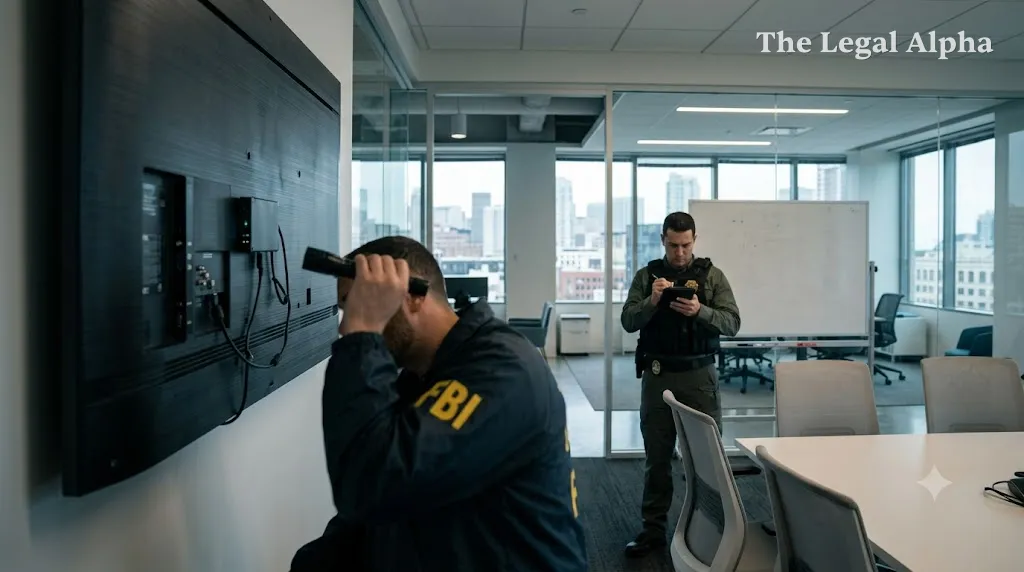
According to the federal criminal complaint, security personnel discovered an encrypted recording apparatus wrapped in paper and plugged into a television port inside a restricted room used by senior leadership to debate proprietary models, technical architecture, and core business strategy. Internal review—bolstered by surveillance footage and digital audit trails—placed Alfozan repeatedly outside the unauthorized room, culminating in footage showing him checking behind the screen. A secondary recording apparatus was subsequently recovered from an unattended bag belonging to the defendant. OpenAI immediately terminated his employment and referred the investigation to federal authorities.
Legal Topic
Area of Law: Federal Criminal Law / White-Collar Crime
Sub-topic: Unlawful Interception of Oral Communications / Corporate Insider Threats
Core Legal Issue
The fundamental legal question centers on whether an enterprise employee incurs criminal liability under federal anti-wiretapping statutes by deploying surreptitious recording hardware in private workplace facilities without consent.
Specifically, the court must address whether prosecutors can prove beyond a reasonable doubt that the defendant intentionally intercepted, or endeavored to intercept, oral communications in an environment where company participants maintained an objectively reasonable expectation of privacy under federal law.
What Did the Court / Authority Decide?
The United States Attorney’s Office for the Northern District of California initiated proceedings by filing a formal criminal complaint charging the defendant with unlawful interception of oral communications.
Following his arrest, the defendant made an initial appearance before a federal magistrate judge in San Francisco. The court ordered the defendant to remain in temporary federal custody pending a formal detention hearing scheduled for October 19. No formal verdict or evidentiary judgment has been entered; the matter remains at the pre-indictment complaint stage where statutory presumptions of innocence fully apply.
Key Legal Points
-
Application of the Federal Wiretap Act to Physical Eavesdropping: Federal interception laws govern physical bugs and concealed audio hardware within private office rooms just as stringently as network wiretaps and telephonic intercepts.
-
Evidentiary Threshold of "Endeavoring" to Intercept: The statute criminalizes not merely the successful exfiltration of decrypted audio data, but the overt attempt or deployment of machinery intended to capture private spoken exchanges.
-
Forensic and Surveillance Corroboration: The criminal complaint establishes probable cause through convergent digital footprints, including internal workspace calendar queries, perimeter physical access logs, camera footage, and localized hardware telemetry.
-
Distinction Between Wiretap and Trade Secret Charges: While public interest centers around proprietary artificial intelligence trade secrets, the initial federal charging instrument focuses strictly on Title III wiretapping violations rather than the Economic Espionage Act.
Relevant Law
-
18 U.S.C. § 2511(1)(b): Prohibits intentionally using or endeavoring to use any electronic, mechanical, or other device to intercept any oral communication when such device is affixed to or transmits a signal through commercial or interstate infrastructure.
-
18 U.S.C. § 2511(4)(a): Sets forth the statutory penalty structure, imposing up to five years of imprisonment, statutory monetary fines, and supervised release upon conviction.
-
Title III of the Omnibus Crime Control and Safe Streets Act of 1968: The overarching statutory framework governing communications interception and expectations of non-public oral privacy.
Arguments of the Parties
Petitioner / The United States
The Department of Justice contends that the defendant deliberately placed an unauthorized, continuous audio recording mechanism behind an executive display to covertly capture confidential board-level and engineering discussions. Prosecutors assert that internal system query logs, physical movement near the room without legitimate business necessity, and forensic matching with equipment found in his personal bag establish clear intent to intercept protected conversations.
Respondent / The Accused
Under federal criminal procedure, the defendant maintains a constitutional presumption of innocence. Through standard defense posture in preliminary proceedings, the defense puts the government to its strict burden of proof, requiring federal prosecutors to establish each element—including direct connection to the physical planting of the device, active functionality, and criminal intent—beyond a reasonable doubt without relying on circumstantial inference.
Why Does It Matter?
This prosecution illustrates the rising legal vulnerability frontier technology companies face from inside access vectors. While corporate risk modeling predominantly allocates resources to perimeter cybersecurity and remote network intrusions, physical premises monitoring remains an equally vulnerable attack surface.
Legally, the case highlights the strategic flexibility of 18 U.S.C. § 2511 as a rapid frontline charging vehicle. Proving trade secret theft or economic espionage often demands an extensive forensic showing of data exfiltration and economic valuation. By contrast, wiretap statutes allow federal prosecutors to intervene and detain a suspect swiftly based on the mere installation and attempt to intercept private workplace conversations.
Legal Takeaway
Installing surreptitious listening hardware in an unauthorized corporate space constitutes a completed federal offense under the Wiretap Act regardless of whether confidential recordings were ever retrieved or decoded. For high-stakes technology enterprises, legal risk management requires harmonizing physical executive room access restrictions with real-time auditability to withstand insider compromises.
Sources
Primary Source:
-
United States of America v. Abdulrahman Alfozan, Criminal Complaint, United States District Court for the Northern District of California (Docketed October 2026); U.S. Department of Justice Press Release.
Additional Sources:
-
Official Statement of the United States Attorney's Office, Northern District of California.
-
Associated Press Legal and National Security Reporting on Federal Warrant and Arraignment Filings.