Supreme Court Declines Immigration Double Jeopardy Appeal, Prompting Sotomayor and Gorsuch Warning
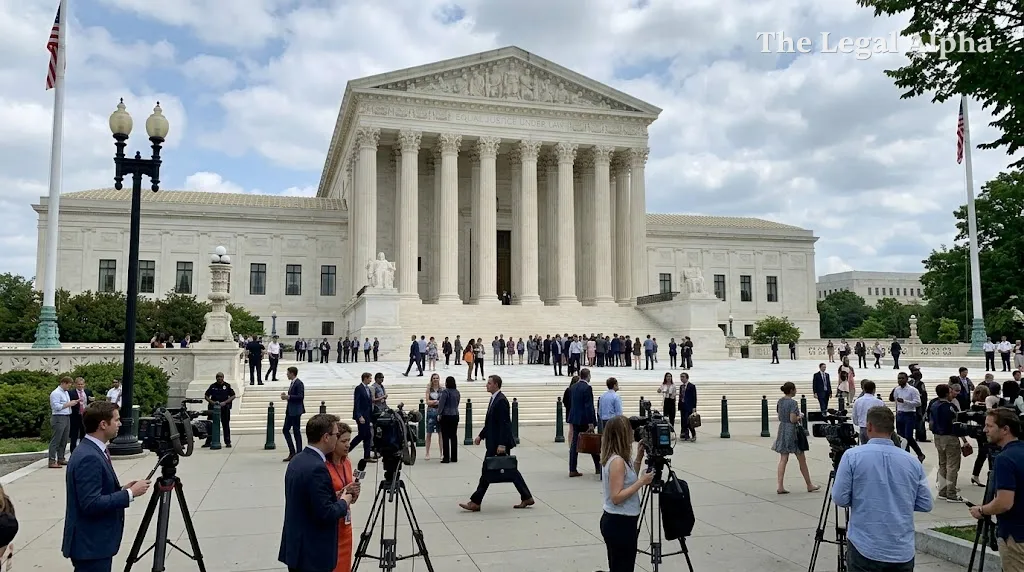
The Supreme Court of the United States refused to hear an appeal brought by Jesus Herrera-Salazar, an undocumented immigrant prosecuted twice for essentially unbroken unauthorized presence in the country. While the Court formally denied the petition for certiorari, Justice Sonia Sotomayor, joined by Justice Neil Gorsuch, penned an unusual joint statement calling out the lower courts for sanctioning a "constitutional absurdity" under the Fifth Amendment's Double Jeopardy Clause.
Herrera-Salazar was originally convicted in 2020 under federal law for being illegally "found in" the United States following a prior removal. After serving his prison sentence, federal prosecutors charged him again in 2024 under the exact same statute, treating his ongoing, uninterrupted presence as a fresh violation simply because he was located a second time. Although the procedural posture prevented the Supreme Court from taking the case, the justices used the denial to send a direct message to federal trial and appellate courts across the country.
Legal Topic
-
Area of Law: Constitutional Law / Criminal Law
-
Sub-topic: Double Jeopardy / Federal Immigration Offenses
Core Legal Issue
The core legal question centers on the Fifth Amendment’s Double Jeopardy Clause and continuous offenses: Can the federal government repeatedly charge and convict an individual under 8 U.S.C. § 1326 for being "found in" the United States when their unlawful presence was continuous and they never actually left or reentered the country between prosecutions?
The matter addresses whether unlawful presence constitutes a single, continuing status crime that cannot be carved into separate prosecutions using arbitrary discovery dates, or whether authorities can continually re-prosecute noncitizens so long as they remain on domestic soil.
What Did the Court / Authority Decide?
The Supreme Court formally denied Herrera-Salazar's petition for a writ of certiorari, leaving his secondary conviction and sentence undisturbed.
In a separate statement respecting the denial, Justice Sotomayor—joined by Justice Gorsuch—cautioned that the prosecution’s theory put the defendant in an inescapable legal trap: whether he remained in the district or attempted to leave the country to comply, he would be committing an offense. While procedural hurdles made this specific petition unsuited for full review, Sotomayor and Gorsuch instructed lower courts faced with future recurring prosecutions to give the Double Jeopardy Clause its full constitutional force rather than allowing serial convictions for uninterrupted conduct.
Key Legal Points
-
Prohibition Against Successive Prosecutions for Ongoing Conduct: When criminal conduct is continuous and unbroken by departure and subsequent reentry, standard double jeopardy doctrine bars the government from slicing a single offense into multiple criminal cases based merely on separate discovery dates.
-
The "Catch-22" Status Dilemma: Sotomayor observed that the government's statutory reading produces an untenable paradox: an individual released from custody after an initial conviction becomes instantly liable for a new criminal violation the moment they step outside the prison gates.
-
Cross-Ideological Warning: The joint statement by Sotomayor and Gorsuch signals shared concern among both liberal and conservative originalist jurists regarding federal overreach and the erosion of foundational Fifth Amendment protections.
Relevant Law
-
U.S. Constitution, Fifth Amendment: Double Jeopardy Clause ("...nor shall any person be subject for the same offence to be twice put in jeopardy of life or limb...").
-
8 U.S.C. § 1326: Reentry of removed aliens (criminalizing entering, attempting to enter, or being at any time "found in" the United States following deportation or removal).
Arguments of the Parties
Petitioner (Herrera-Salazar) Herrera-Salazar argued that his second prosecution violated the Double Jeopardy Clause because he never exited the United States following his initial conviction. His defense contended that being "found in" the country is a continuing offense; once jeopardy attached and he was punished for that presence, prosecutors could not recharge him for the identical unlawful presence simply because additional time had passed.
Respondent (United States) The federal government maintained that each instance in which immigration authorities discover an undocumented individual on domestic soil constitutes a separate, actionable violation of 8 U.S.C. § 1326. The government argued that because the petitioner remained unlawfully within the country on a subsequent date, authorities were entitled to bring a distinct indictment based on the later discovery.
Why Does It Matter?
The decision underscores a lingering vulnerability for noncitizens subject to criminal immigration enforcement. If federal prosecutors can repeatedly indict individuals for uninterrupted presence, immigration detention and sentence completion offer no finality against criminal jeopardy.
While the certiorari denial leaves this prosecutory tactic technically viable in certain jurisdictions, the pointed statement from two influential justices across the court's ideological spectrum serves as a roadmap for defense counsel. Federal public defenders and appellate practitioners now have clear high-court rhetoric to challenge repetitive § 1326 indictments, placing pressure on federal district and circuit judges to dismiss serial charges before they reach the high court.
Legal Takeaway
Uninterrupted unlawful presence cannot constitutionally be sliced into serial crimes without offending basic double jeopardy principles. While the Supreme Court declined to disturb the judgment in this instance due to procedural barriers, lower courts have received explicit guidance to curb repeated prosecutions for identical, ongoing conduct.
Sources
Primary Source:
-
Herrera-Salazar v. United States, 607 U.S. ___ (2026) (Statement of Sotomayor, J., joined by Gorsuch, J., respecting the denial of certiorari).
Additional Sources:
-
Supreme Court of the United States Order List, October Term 2026.
-
8 U.S.C. § 1326 (Reentry of removed aliens).