US Court Seeks Delhi Courts’ Assistance to Serve Summons on Ajit Doval in Pannun Lawsuit
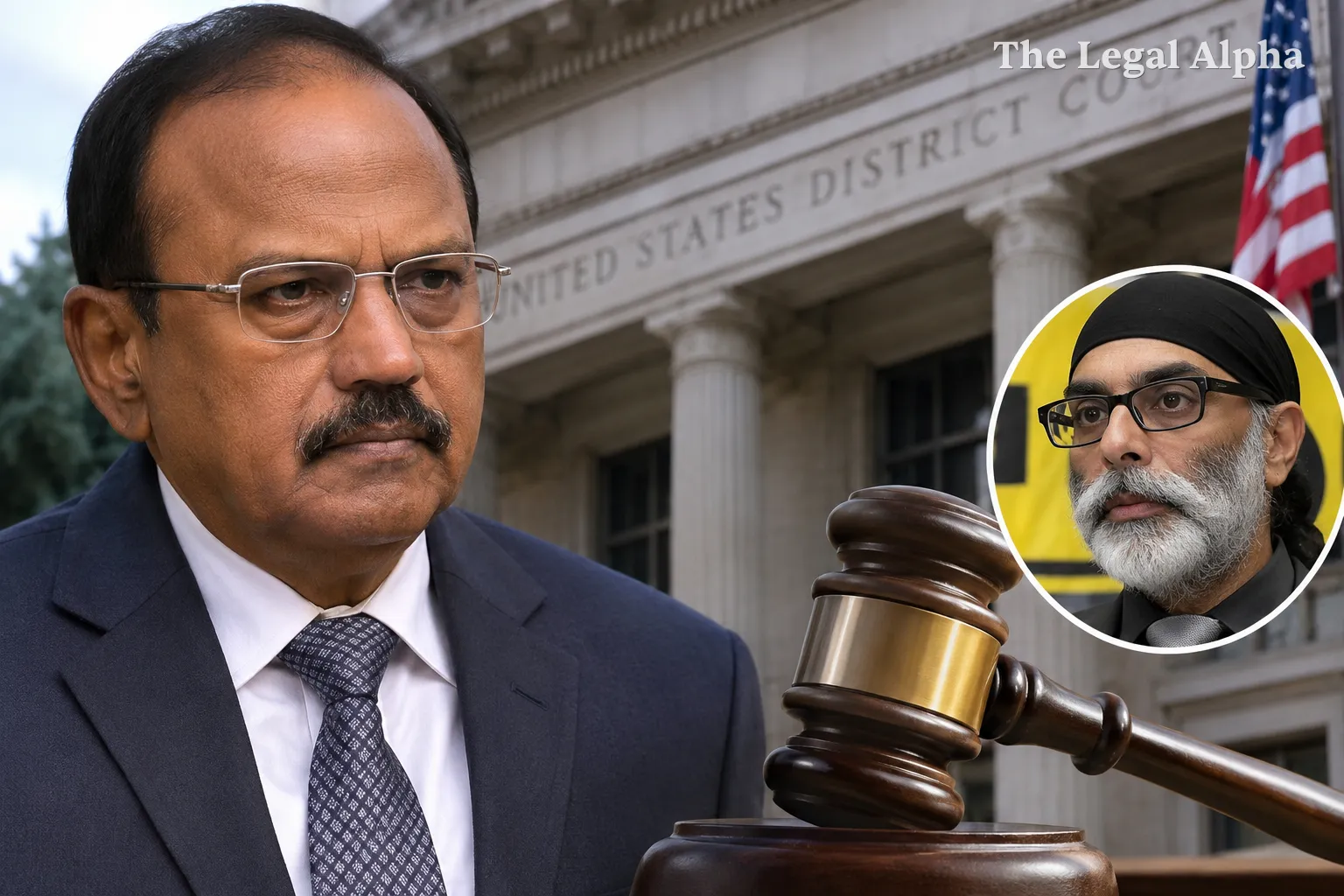
The United States District Court for the Southern District of New York has sought assistance from three district courts in Delhi to serve legal summons on India's National Security Advisor Ajit Doval and former Research and Analysis Wing (RAW) chief Samant Goel.
The development comes in a civil lawsuit filed by Gurpatwant Singh Pannun, who has alleged that Indian officials were involved in a conspiracy to assassinate him in the United States. The allegations remain part of pending civil proceedings and have not been established as judicial findings.
US District Judge Katherine Polk Failla has directed the US court's clerk to forward the relevant judicial documents to the Patiala House, Dwarka and Tis Hazari district courts for assistance in serving the summons.
Legal Topic
Area of Law: International Law and Civil Procedure
Sub-topic: Cross-Border Service of Judicial Process
Core Legal Issue
The central legal question concerns whether summons issued by a foreign court can be served on individuals in India through Indian district courts when the ordinary procedure for international service has been unsuccessful.
The matter also involves the application of the Hague Convention on the Service Abroad of Judicial and Extrajudicial Documents and the provisions of India's Code of Civil Procedure, 1908, governing the transmission and service of foreign summons.
What Did the US Court Decide?
The Southern District of New York authorised an alternative method of serving summons on Doval and Goel through the Indian court system after earlier attempts through the conventional channel under the Hague Convention were unsuccessful.
The court formally requested assistance from the relevant Delhi district courts under Article 19 of the Hague Convention and Section 29(c) read with Order V, Rule 21 of the Indian Code of Civil Procedure.
The receiving courts have been requested to facilitate service of the judicial documents and provide a written record of the proceedings undertaken.
Importantly, the order concerns the procedure for serving summons. It does not determine the truth of Pannun's allegations or establish the liability of the named defendants.
Key Legal Points
-
Alternative service permitted: The US court authorised service through Indian district courts after the earlier method of service proved unsuccessful.
-
Hague Convention: Article 19 provides a basis for alternative methods of service where the Convention's ordinary procedures do not prevent such service.
-
Indian procedural law: Section 29(c) and Order V, Rule 21 of the Code of Civil Procedure, 1908, are relevant to the transmission and service of foreign summons.
-
Judicial assistance: The Delhi courts have been requested to facilitate delivery of the documents and report the steps taken.
-
No determination on merits: Permission to serve summons does not amount to a finding that the allegations against the defendants are true.
Relevant Law
Hague Convention on the Service Abroad of Judicial and Extrajudicial Documents
Article 19 addresses situations where a receiving state's law permits alternative methods of transmitting documents originating abroad.
Code of Civil Procedure, 1908
-
Section 29(c): Deals with the transmission of summonses issued by specified foreign courts for service in India.
-
Order V, Rule 21: Provides the procedural framework for the service of summons received from foreign courts.
Federal Rules of Civil Procedure, United States
Rule 4(f) concerns service of process on individuals in foreign countries and provides the procedural framework for authorised methods of international service.
Arguments of the Parties
Plaintiff – Gurpatwant Singh Pannun
Pannun sought permission to serve Doval and Goel through an alternative judicial route. He submitted that previous attempts to serve the defendants through established channels had not succeeded.
Defendants – Ajit Doval and Samant Goel
The available reporting does not establish a detailed response from Doval or Goel specifically opposing the alternative-service request. Their alleged involvement in the conspiracy remains a matter of the underlying civil litigation.
Why Does It Matter?
The development highlights the procedural challenges involved when courts in one country seek to serve legal documents on individuals located in another jurisdiction.
It also demonstrates how international conventions and domestic procedural laws can work together to facilitate cross-border judicial cooperation.
For Indian courts, the matter raises questions about the handling of foreign judicial documents and the procedures applicable when assistance is requested by an overseas court.
However, the order should not be interpreted as an acceptance of the allegations or as a decision on the merits of the lawsuit. Its immediate significance is limited to facilitating the service of legal documents.
Legal Takeaway
The US court's decision illustrates that unsuccessful conventional attempts at international service do not necessarily prevent a plaintiff from seeking an alternative legally recognised procedure. The authorisation of service through Indian courts is a procedural development and does not establish the allegations made in the underlying civil lawsuit.
Sources
Primary Source: US District Court Order – Pannun v. The Government of India et al., Case No. 1:24-cv-07021-KPF.
Additional Sources: