New York Appeals Court Holds Insurer Liable for Bar Owner’s Independent Legal Defence Despite Assault Exclusion
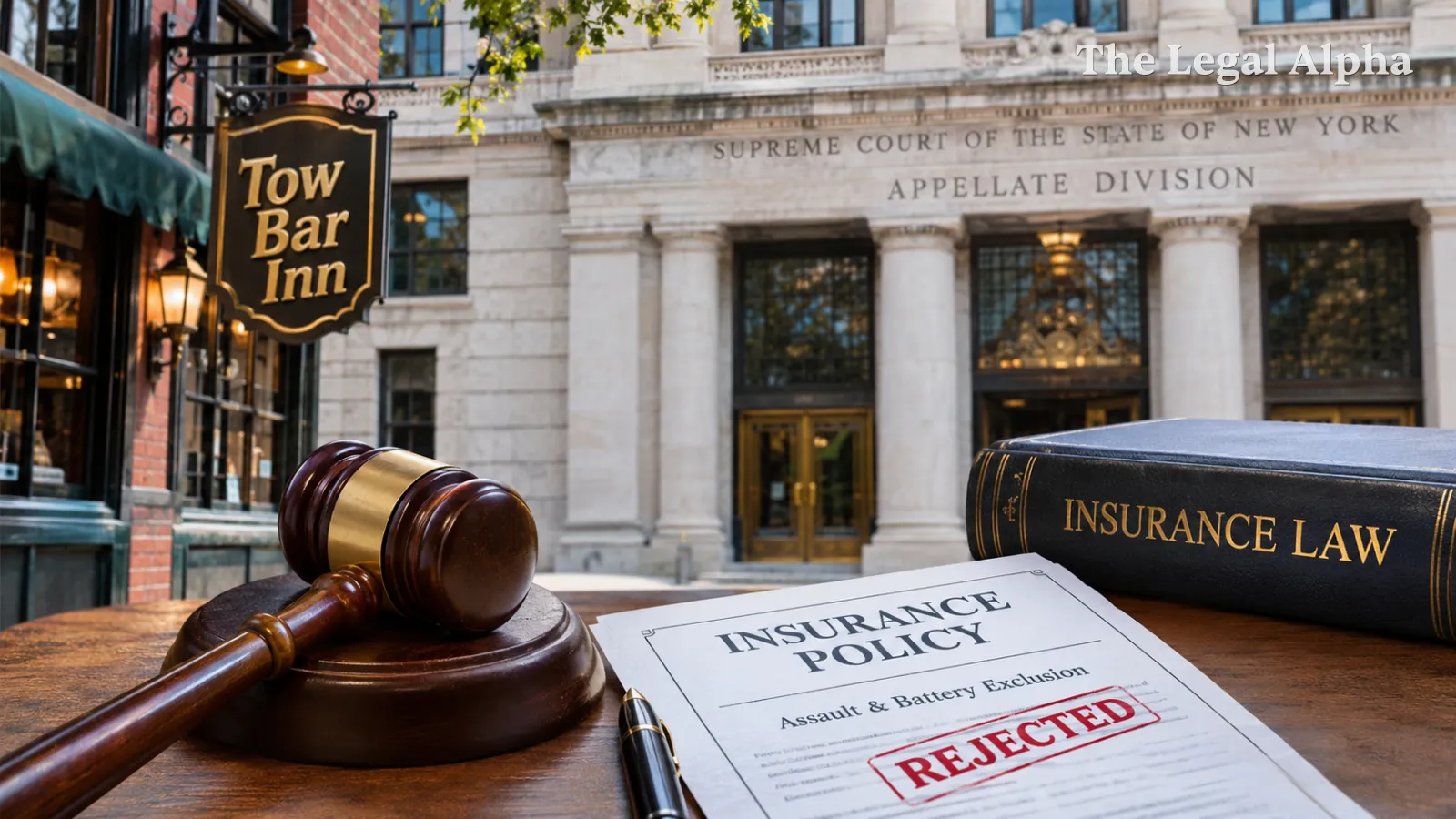
The Appellate Division, Fourth Department of the New York Supreme Court has ruled that Utica First Insurance Company must pay the legal expenses of Ratava LLC, which operates the Tow Bar Inn, after rejecting the insurer’s reliance on an assault and battery exclusion in its commercial insurance policy.
In Ratava, LLC v. Utica First Insurance Company (2026 NY Slip Op 06923), decided on November 20, 2026, the court considered whether an insurer could refuse to defend a business against a personal injury lawsuit by relying on its own investigation when the underlying complaint contained only negligence allegations.
The dispute arose after a patron sued the bar, alleging injuries caused by the establishment's negligence and failure to properly maintain its premises. Although the complaint did not mention an altercation, Utica First denied coverage under its policy's Assault & Battery Exclusion.
The appellate court found that the insurer remained obligated to defend the business and pay the reasonable legal fees of an independent lawyer chosen by the bar owner.
Legal Topic
Area of Law: Insurance Law
Sub-topic: Duty to Defend / Interpretation of Insurance Policy Exclusions / Insurer's Obligation to Pay Legal Fees
Core Legal Issue
The central question was whether an insurance company could avoid its contractual duty to defend an insured business by relying on its own investigation suggesting that the injuries resulted from an assault, when the underlying personal injury complaint alleged only negligence.
The court also examined whether the insurer could insist on further discovery before its duty to defend was determined and whether the insured business was entitled to independent legal representation at the insurer's expense because of a conflict of interest.
What Did the Court Decide?
The Appellate Division, Fourth Department, modified the lower court's order and granted Ratava LLC partial summary judgment.
It declared that Utica First Insurance Company was obligated to defend the bar in the underlying personal injury lawsuit. The court further held that Ratava could retain an attorney of its own choice and that the insurer must pay the reasonable and necessary legal fees of that lawyer, together with related ancillary costs.
The appellate court rejected the insurer's argument that further discovery was necessary to determine its duty to defend. It clarified that this obligation had to be assessed by examining the allegations within the four corners of the underlying complaint.
The remaining challenge raised by the bar owner was rejected, while the lower court's order was otherwise affirmed as modified.
The ruling concerns the insurer's duty to provide a defence. It does not determine the ultimate liability of the bar in the underlying personal injury lawsuit or conclusively establish its entitlement to indemnification.
Key Legal Points
-
Broad Duty to Defend: An insurer's obligation to defend is wider than its obligation to indemnify. It arises whenever the allegations in the underlying complaint suggest a reasonable possibility of coverage.
-
Policy Exclusions Must Be Established: An insurer relying on an exclusion must demonstrate that the allegations fall entirely within that exclusion and leave no reasonable possibility of coverage.
-
Four-Corners Rule: The duty to defend is determined by examining the allegations contained in the underlying complaint rather than relying on an insurer's separate investigation.
-
Independent Legal Representation: Where the insurer's interests conflict with those of the insured, the insured may retain an attorney of its choice at the insurer's expense.
-
Discovery Cannot Delay the Coverage Determination: Further discovery was not relevant to deciding the duty to defend in this case because the court could resolve that question from the underlying complaint itself.
Relevant Law
The appellate court relied on established New York insurance law principles, including:
Frontier Insulation Contractors v. Merchants Mutual Insurance Co., 91 NY2d 169 (1997): Established that an insurer's duty to defend arises whenever the allegations in the underlying complaint potentially give rise to a covered claim. It also addresses the burden an insurer must satisfy to rely on a policy exclusion.
Automobile Insurance Co. of Hartford v. Cook, 7 NY3d 131 (2006): Recognised that an insurer's duty to defend is exceedingly broad and applies where the complaint suggests a reasonable possibility of coverage.
Continental Casualty Co. v. Rapid-American Corp., 80 NY2d 640 (1993): Addressed the principles governing an insurer's obligations and the interpretation of insurance coverage.
Public Service Mutual Insurance Co. v. Goldfarb, 53 NY2d 392 (1981): Supports an insured's entitlement to independent counsel at the insurer's expense where the insurer's interests conflict with those of the insured.
Georgetown Capital Group, Inc. v. Everest National Insurance Co., 104 AD3d 1150 (4th Dept 2013): Applied the principles governing an insurer's reliance on policy exclusions to deny a defence.
Arguments of the Parties
Ratava LLC (Bar Owner)
Ratava argued that the insurer was required to defend it because the underlying personal injury complaint alleged negligence and premises liability rather than assault or battery.
It maintained that the allegations potentially fell within the commercial insurance policy's coverage and that the insurer could not avoid its obligations by relying on findings from its own investigation.
The business also sought the right to obtain partial summary judgment without waiting for further discovery.
Utica First Insurance Company (Insurer)
Utica First relied on the Assault & Battery Exclusion contained in its Businessowners Policy.
The insurer maintained that its investigation indicated that the patron's injuries arose from an altercation on the bar's premises. It also argued that additional discovery was necessary before the court could determine whether it had a duty to defend the business.
The appellate court rejected the insurer's position on the duty to defend, finding that its arguments did not establish that the underlying allegations fell entirely within the policy exclusion.
Why Does It Matter?
The ruling reinforces an important distinction in insurance law: an insurer's duty to defend is not necessarily determined by what its investigation suggests happened, but by whether the allegations in the underlying complaint potentially fall within the policy's coverage.
For businesses such as bars, restaurants and other commercial establishments, this distinction can have significant financial consequences. A personal injury claim may involve allegations of negligence even where an insurer suspects that an assault or other excluded event contributed to the injuries.
The decision also provides important protection against premature denial of legal defence. Insurers cannot automatically rely on their own investigative conclusions to avoid defending an insured when the complaint itself raises potentially covered claims.
Another significant aspect concerns independent legal representation. Where an insurer's interests conflict with those of its policyholder, the insured may be entitled to choose its own lawyer, with reasonable and necessary legal fees paid by the insurer.
However, the ruling should not be understood as eliminating assault and battery exclusions from insurance policies. Such exclusions may still apply where the allegations and applicable policy language establish that the claim falls entirely within their scope.
Legal Takeaway
The New York appellate ruling confirms that an insurer cannot avoid its duty to defend merely by relying on its own investigation when the underlying complaint contains potentially covered negligence claims. Where a conflict of interest exists, the insured may also be entitled to independent counsel at the insurer's expense. The decision highlights the importance of examining the actual allegations and policy language before denying insurance protection.
Sources
Primary Source:
Ratava, LLC v. Utica First Insurance Company, 2026 NY Slip Op 06923, Appellate Division, Fourth Department, decided November 20, 2026.
Additional Sources:
New York insurance law precedents cited in the appellate court's judgment, including Frontier Insulation Contractors v. Merchants Mutual Insurance Co. and Public Service Mutual Insurance Co. v. Goldfarb.