Unsubstantiated Claims of VPN and Encrypted App Contact Cannot Justify Preventive Detention: J&K High Court
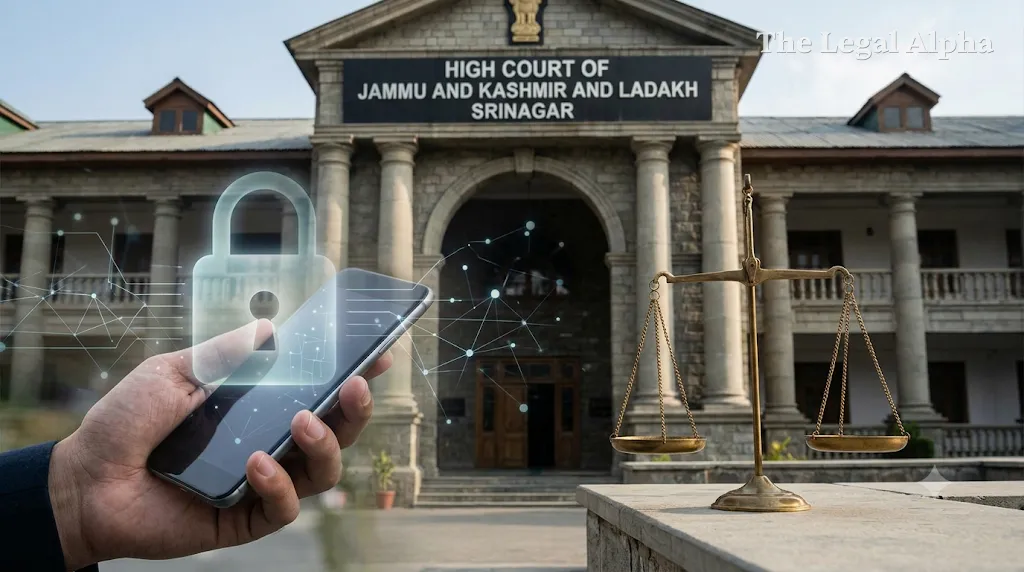
The High Court of Jammu & Kashmir and Ladakh has set aside a preventive detention order issued against a Pulwama resident, ruling that vague allegations of using a Virtual Private Network (VPN) and an encrypted messaging application to communicate with terrorist handlers cannot independently sustain detention without concrete supporting evidence.
Justice Wasim Sadiq Nargal allowed a habeas corpus petition filed by Ajaz Ahmad Seh, a 27-year-old driver from Sehpora in Pulwama district, challenging his detention under the Jammu and Kashmir Public Safety Act, 1978 (PSA). The District Magistrate of Pulwama had passed the detention order on July 28, 2025, following which Seh was lodged in District Jail, Udhampur. The ruling is significant because it draws a clear boundary against detaining individuals based on broad technological assertions—such as encrypted app or VPN usage—when authorities fail to provide specific dates, communication logs, or verifiable details of unlawful conduct.
Legal Topic
Area of Law: Constitutional Law / Preventive Detention
Sub-topic: Personal Liberty and Statutory Safeguards under the J&K Public Safety Act, 1978
Core Legal Issue
The central question before the High Court was whether a detaining authority can validly curtail an individual's personal liberty under preventive detention laws based on generalized allegations of using a VPN and an encrypted application to contact terrorist handlers, without specifying the dates, contents, or concrete acts of assistance.
Additionally, the Court examined whether a District Magistrate discharges their statutory duty by substantially reproducing a police dossier without demonstrating independent application of mind, and whether preventive detention can be invoked when ordinary criminal law mechanisms are available to address the alleged offences.
What Did the Court / Authority Decide?
In a judgment pronounced on October 30, 2026, Justice Wasim Sadiq Nargal quashed Detention Order No. 34/DMP/PSA/2025 and allowed Seh's habeas corpus petition. The Court directed the authorities to release Seh forthwith, provided his custody was not required in connection with any other criminal case or lawful order.
The Court held that while allegations involving links to terrorist organizations are undoubtedly serious, preventive detention is an extraordinary invasion of personal liberty that cannot be used as a substitute for standard criminal prosecution. Justice Nargal observed that the grounds of detention failed to disclose when the alleged communications occurred, what information was exchanged, or what specific logistical acts the petitioner performed. Furthermore, the Court found that the District Magistrate had mechanically adopted the narrative in the police dossier rather than arriving at an independent subjective satisfaction.
Key Legal Points
-
Specificity in Detention Grounds: General assertions that a detainee used a VPN or an encrypted messaging platform to contact suspected terrorists cannot, by themselves, justify preventive detention unless backed by specific particulars and cogent supporting material.
-
Right to Effective Representation: Vague and unparticularized grounds deprive a detainee of the constitutional ability to make a meaningful representation against their detention, violating procedural fairness.
-
Independent Application of Mind: A detaining authority cannot act as a rubber stamp by copying a police dossier verbatim; the record must reflect an independent evaluation of the evidence before curtailing personal liberty.
-
Preventive vs. Punitive Action: Preventive detention is meant to stop future threats to state security, not to bypass ordinary criminal trials for past alleged offences where standard investigative and bail procedures apply.
Relevant Law
-
Article 21 and Article 22(5) of the Constitution of India: Guarantee the right to personal liberty and mandate that a person detained under preventive laws be communicated clear, intelligible grounds to make an effective representation.
-
Article 226 of the Constitution of India: Empowers High Courts to issue writs, including habeas corpus, to review the legality of executive detention orders.
-
Jammu and Kashmir Public Safety Act, 1978: The preventive detention statute under which the impugned detention order was issued.
-
Sections 126 and 170 of the Bharatiya Nagarik Suraksha Sanhita, 2023 (BNSS): Provisions governing security for keeping the peace and preventive arrest, under which the petitioner had previously executed bonds.
-
Precedents Cited: Khudiram Das v. State of West Bengal (1975), Vijay Narain Singh v. State of Bihar (1984), and Rekha v. State of Tamil Nadu (2011), reaffirming that preventive detention laws must be strictly construed and sparingly exercised.
Arguments of the Parties
Petitioner
Counsel for Ajaz Ahmad Seh contended that the detention order was passed mechanically based on an undated police report without independent scrutiny by the District Magistrate. The petitioner argued that the grounds of detention were completely vague, lacking dates, times, or concrete evidence regarding the alleged communications or support to militants. It was also submitted that the petitioner was denied an effective opportunity to be heard before the Advisory Board and that preventive detention was improperly invoked despite him already being bound down under the BNSS.
Respondent
The Union Territory administration defended the detention order, submitting that preventive detention is a precautionary measure aimed at preventing activities prejudicial to state security rather than punishing past acts. Counsel for the authorities argued that the District Magistrate had properly examined the police dossier—which alleged that Seh acted as an Over Ground Worker (OGW), communicated with a designated terrorist handler via an encrypted app over a VPN, and passed information on security force movements—before arriving at a valid subjective satisfaction.
Why Does It Matter?
As digital privacy tools like VPNs and end-to-end encrypted messaging applications become widespread, law enforcement agencies increasingly cite their usage in intelligence dossiers. This ruling establishes an important evidentiary safeguard: the mere use of privacy-enhancing technology, even alongside serious allegations of cross-border contact, does not lower the constitutional threshold required to detain a citizen without trial.
For district magistrates and executive authorities, the judgment serves as a strict reminder that national security concerns do not dilute statutory procedure. Detention orders that rely on copy-pasted police narratives or fail to supply verifiable facts remain vulnerable to judicial quashing, reinforcing accountability in executive decision-making.
Legal Takeaway
Serious allegations involving national security or the use of encrypted technology do not exempt authorities from constitutional due process. Preventive detention orders must be backed by specific, verifiable facts and reflect independent scrutiny by the detaining authority, rather than vague claims or recycled police dossiers.
Sources
Primary Source:
Judgment of the High Court of Jammu & Kashmir and Ladakh at Srinagar in Ajaz Ahmad Seh v. Union Territory of Jammu and Kashmir & Anr. (HCP No. 279/2025, decided on October 30, 2026, by Justice Wasim Sadiq Nargal).
Additional Sources:
Court cause list and public order records of the High Court of Jammu & Kashmir and Ladakh; legal reporting by LiveLaw and Bar & Bench.