Election Commission Orders Special Summary Revision in Karnataka With Strict Safeguards Against Arbitrary Voter Deletions
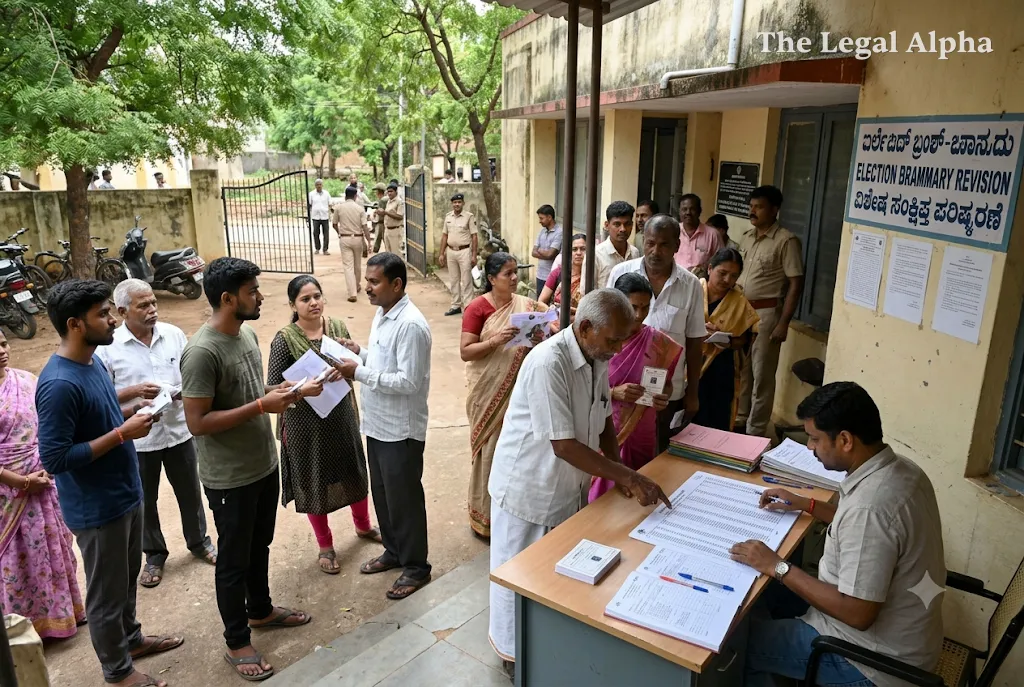
The Election Commission of India (ECI) has directed the launch of a Special Summary Revision (SSR) of electoral rolls in Karnataka, fixing January 1, 2027, as the qualifying date. The directive comes weeks after the conclusion of a Special Intensive Revision (SIR) in the state—an exhaustive door-to-door enumeration exercise that ended on October 27, 2026, and resulted in the removal of over 99.32 lakh names from Karnataka's voter list, reducing the registered electorate from roughly 5.54 crore to 4.55 crore.
Following widespread political debate and concerns from civil society groups over large-scale exclusions during the intensive enumeration, the ECI issued a structured schedule and stringent verification protocols on November 16, 2026. Under the new schedule, integrated draft electoral rolls will be published on December 1, 2026, citizens may file claims and objections until December 31, 2026, and the final electoral rolls will be released on January 20, 2027.
Legal Topic
Area of Law: Constitutional Law / Election Law
Sub-topic: Electoral Roll Revision, Universal Adult Suffrage, and Procedural Safeguards Against Disenfranchisement
Core Legal Issue
The central legal question addressed by the Election Commission's directive is how to balance the constitutional mandate of maintaining accurate, error-free electoral rolls against the statutory duty to protect eligible citizens from arbitrary disenfranchisement. Specifically, following a de novo enumeration (SIR) that triggered mass deletions, the ECI had to establish binding procedural checks to prevent bulk or unverified objections (via Form 7) while providing an accessible mechanism for left-out voters and newly eligible youth to secure enrolment.
What Did the Court / Authority Decide?
The Election Commission of India ordered a targeted Special Summary Revision across Karnataka and laid down mandatory procedural safeguards governing both voter inclusion and deletion:
-
Timeline and Enrolment Drive: Integrated draft rolls will be published on December 1, 2026, followed by a one-month window (December 1 to December 31, 2026) for filing claims (Form 6 for inclusion, Form 8 for corrections) and objections (Form 7 for deletion). The final roll will be published on January 20, 2027. Citizens turning 18 on or before January 1, 2027, as well as eligible voters left out during the previous SIR, are eligible to apply.
-
Mandatory Personal Verification by EROs: Electoral Registration Officers (EROs) must personally cross-verify deletion cases whenever proposed deletions exceed 2% of the total electors in a polling station, or whenever a single individual files objections in more than five cases.
-
Reasoned Orders and Right to Hearing: For every proposed deletion, the ERO must afford the affected voter an opportunity to be heard, pass a reasoned order, and upload that order onto the ECINET portal.
-
Limits on Bulk Objections and Aadhaar Rules: The ECI reiterated caps on individual Form 7 filings to curb bulk deletion attempts, mandated field verification by Booth Level Officers (BLOs) for duplicate entries, and clarified that no enrolment application may be rejected—nor any existing voter deleted—for failing to furnish an Aadhaar number.
-
Freeze on Official Transfers: To ensure administrative continuity, officials deployed for the SSR cannot be transferred between December 1, 2026, and January 20, 2027, without prior ECI approval.
Key Legal Points
-
Distinction Between SIR and SSR: Unlike a Special Intensive Revision, which discards existing rolls for a fresh house-to-house enumeration, a Special Summary Revision presumes the existing roll is valid and updates it through citizen-initiated claims and objections.
-
Natural Justice in Electoral Deletions: By requiring EROs to conduct personal verifications, grant hearings, and record reasoned orders on ECINET before striking off names, the ECI has operationalized principles of natural justice and administrative accountability.
-
Burden of Proof on the State: Under established election law, once a citizen is enrolled or seeks legitimate inclusion, the administrative burden to prove ineligibility lies with the election machinery rather than placing an onerous evidentiary hurdle on vulnerable or migrant voters.
-
Protection Against Bulk Manipulation: Capping individual Form 7 objections and triggering automatic ERO scrutiny at the 2% polling station threshold directly targets organized attempts to purge targeted voter demographics.
-
Voluntary Nature of Aadhaar Linkage: Reaffirming that non-submission of Aadhaar cannot be grounds for rejection or deletion aligns electoral administration with statutory privacy protections and Supreme Court jurisprudence.
Relevant Law
-
Article 324 and Article 326 of the Constitution of India: Article 324 vests the superintendence, direction, and control of elections and electoral roll preparation in the ECI, while Article 326 guarantees universal adult suffrage to every citizen aged 18 and above who is not otherwise disqualified.
-
Representation of the People Act, 1950 (Sections 16, 19, 21, 22, and 23): Governs disqualifications for registration, conditions of registration (age and ordinary residence), preparation and revision of rolls, correction of entries, and inclusion of names.
-
Registration of Electors Rules, 1960 (Rules 13, 14, 21A, and 25): Prescribes the statutory forms (Forms 6, 7, and 8), inquiry procedures for claims and objections, mandatory notice and hearing before deletion of names, and the framework for summary versus intensive revisions.
-
Lal Babu Hussein v. Electoral Registration Officer (1995) 3 SCC 100: Supreme Court precedent establishing that Electoral Registration Officers cannot arbitrarily delete existing voters without giving proper notice, a fair opportunity to be heard, and following strict procedural safeguards.
Arguments of the Parties
Because this development stems from an administrative directive by the Election Commission rather than an adversarial court judgment, the positions reflect the public discourse between political/civil society stakeholders and the election authority:
-
Political Parties and Civil Society Groups: Critics and opposition parties contended that the recently concluded Special Intensive Revision disproportionately removed over 99 lakh voters—alleging targeted deletions in specific constituencies and improper bulk filing of Form 7 applications without proper notice to affected citizens.
-
Election Commission of India: The ECI maintained that intensive revisions are necessary to purge deceased, permanently shifted, and duplicate entries from the rolls, while initiating the Special Summary Revision with strict verification thresholds to ensure that no eligible citizen is left out and no wrongful deletions occur.
Why Does It Matter?
The ECI's directive carries significant legal and practical consequences beyond routine administrative scheduling. In recent revision cycles, civil rights groups and litigants have raised alarms—including before the Supreme Court—that aggressive roll cleanups risk disenfranchising daily-wage workers, tenants, seasonal migrants, and minority communities who may be temporarily absent during door-to-door surveys.
By mandating that EROs upload reasoned deletion orders onto ECINET and personally audit any polling station experiencing more than 2% deletions, the ECI has created a transparent, auditable digital trail. For voters, political parties, and legal practitioners, this requirement provides concrete documentary records that can be challenged through statutory appeals under Section 24 of the Representation of the People Act, 1950, or via judicial review if procedural lapses persist.
Legal Takeaway
Eligible voters in Karnataka who were omitted during the recent intensive revision—or who turn 18 by January 1, 2027—have a strict one-month window between December 1 and December 31, 2026, to inspect the draft rolls and file Form 6 for inclusion. Crucially, election officials cannot delete any name from the voter list without granting the individual a hearing, passing a written reasoned order, and uploading it online, nor can they reject an application for lack of an Aadhaar card.
Sources
Primary Source:
-
Election Commission of India (ECI), Instructions and Schedule for Special Summary Revision (SSR) of Electoral Rolls with reference to 01.01.2027 as the qualifying date (November 2026).
Additional Sources:
-
The Times of India, "EC orders SSR in Karnataka, 'left out' voters in focus" (November 17, 2026).
-
The New Indian Express, "Start Special Summary Revision: ECI to states" (November 17, 2026).
-
Representation of the People Act, 1950, and Registration of Electors Rules, 1960.