Supreme Court Strikes Down UP Pension Laws, Protects Retirement Benefits of Regularised Employees
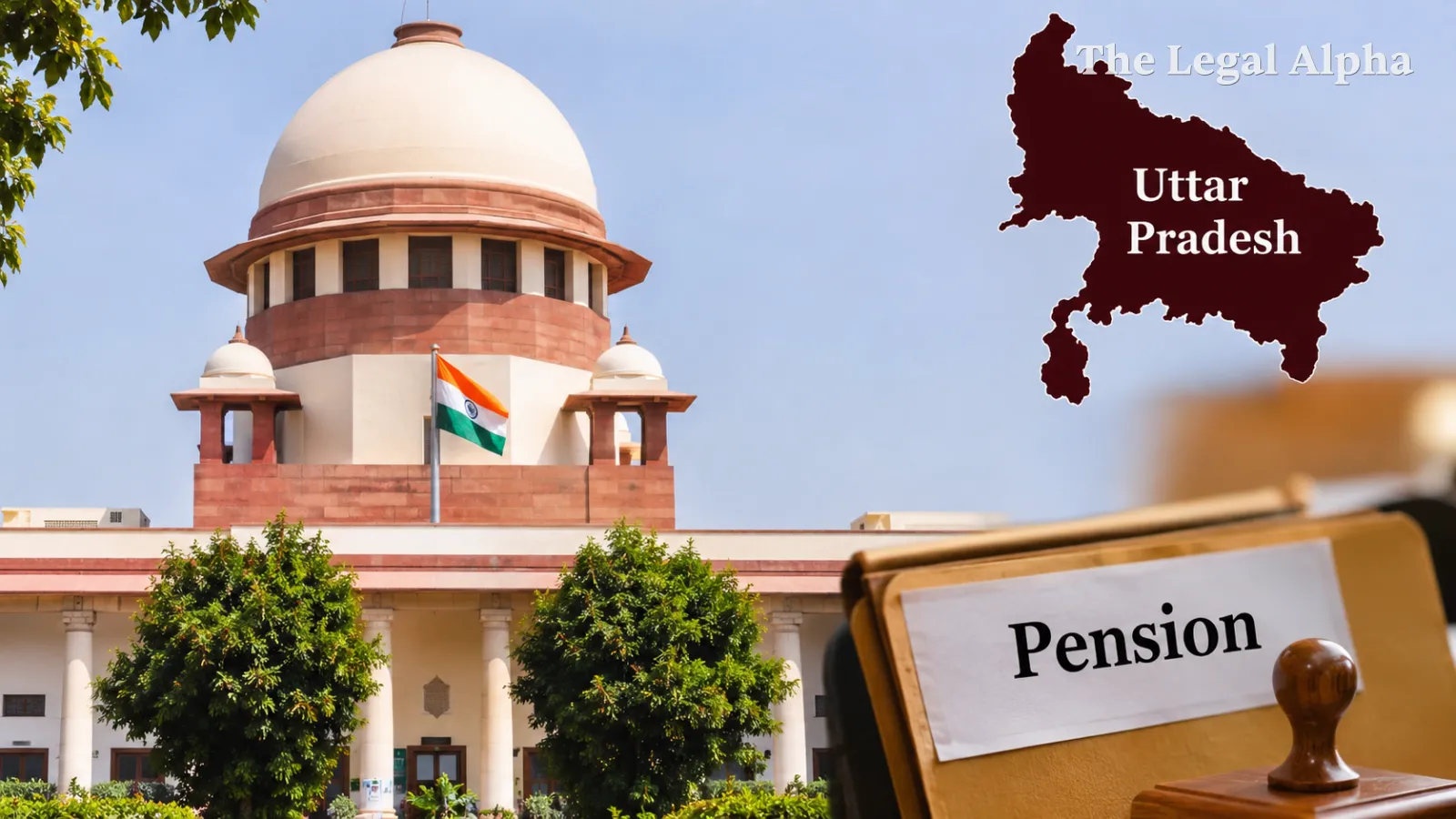
The Supreme Court of India has declared two Uttar Pradesh laws unconstitutional for excluding employees’ service before regularisation while calculating pension benefits. The ruling protects the retirement rights of employees who initially worked in temporary, work-charged, daily-wage or muster-roll positions before being regularised into government service.
The Court has also directed the Uttar Pradesh authorities to reconsider eligible pension claims and extend the benefits due within six months.
What Happened?
In a significant ruling concerning government employees' retirement benefits, the Supreme Court struck down the Uttar Pradesh Qualifying Service for Pension and Validation Act, 2021, and the Uttar Pradesh Entitlement to Pension and Validation Act, 2025.
The judgment was delivered on November 18, 2026, by a Bench comprising Justice Dipankar Datta and Justice Satish Chandra Sharma in Uttar Pradesh Ground Water Department Non-Gazetted Employee Association (Regd.) & Anr. v. The Chief Secretary & Ors.
The two state laws sought to exclude service rendered in non-regular employment categories from qualifying service for pension, even where employees were subsequently regularised.
The Court found that the legislation effectively attempted to revive an exclusion that had already been rejected in an earlier Supreme Court judgment.
Legal Topic
Area of Law: Constitutional Law and Service Law
Sub-topic: Pension Entitlement, Qualifying Service and Regularisation of Government Employees
Core Legal Issue
The central question before the Supreme Court was whether the Uttar Pradesh Legislature could retrospectively enact laws excluding the initial period of work-charged, temporary, daily-wage or muster-roll service from pension calculations after employees had been regularised.
The Court also examined whether changing statutory definitions could overcome the legal principles established in its earlier decision in Prem Singh v. State of Uttar Pradesh (2019).
What Did the Supreme Court Decide?
The Supreme Court held that both Uttar Pradesh pension laws were unconstitutional. It ruled that employees who had been regularised under a duly formulated scheme could not be denied retirement benefits merely because their initial appointments were not on a regular basis.
The Bench explained that regularisation changes an employee's legal status by bringing them into the regular establishment. The government cannot subsequently rely on the nature of their initial appointment to deprive them of pensionary rights.
The Court further held that retrospective legislation must genuinely remove the legal defect identified in an earlier judicial decision. Merely changing the terminology used to describe excluded employees cannot make an otherwise unconstitutional exclusion valid.
Key Legal Points
-
Regularisation and pension rights: Employees who enter regular government service through regularisation cannot automatically be deprived of pension benefits by excluding their earlier qualifying service.
-
Retrospective legislation: A legislature cannot overcome an earlier judicial ruling merely by introducing different statutory definitions without curing the constitutional defect.
-
Equal treatment: The exclusion of similarly situated employees raises concerns under Articles 14 and 16 of the Constitution.
-
Protection of retirement benefits: Pensionary entitlements cannot be retrospectively taken away through legislation that violates constitutional protections.
-
Benefits beyond association members: The Supreme Court clarified that its directions would operate in rem, meaning eligible employees can claim benefits irrespective of whether they belong to the associations involved in the litigation.
Relevant Law
Constitution of India
-
Article 14 – Equality before the law and equal protection of laws.
-
Article 16 – Equality of opportunity in matters of public employment.
-
Article 21 – Protection of life and personal liberty.
Statutory Provisions
-
Uttar Pradesh Retirement Benefits Rules, 1961 – Particularly Rule 3(8), concerning qualifying service for pension.
-
Regulation 370 of the Civil Service Regulations.
-
Uttar Pradesh Qualifying Service for Pension and Validation Act, 2021.
-
Uttar Pradesh Entitlement to Pension and Validation Act, 2025.
Important Judicial Precedent
Prem Singh v. State of Uttar Pradesh (2019) 10 SCC 516 – The Supreme Court held that service rendered in a work-charged establishment must be counted as qualifying service for pension, subject to the directions in that judgment.
Arguments of the Parties
Employees and Petitioners
The employees argued that they had served various Uttar Pradesh government departments for several years before their services were regularised. Having accepted their services and subsequently regularised their appointments, the State could not retrospectively exclude their earlier service from pension calculations.
They also contended that the 2021 and 2025 laws merely reintroduced an exclusion that the Supreme Court had already found legally impermissible in Prem Singh.
Uttar Pradesh Government
The State argued that work-charged establishments were legally and administratively different from regular government establishments. It maintained that pension entitlements were governed by statutory service conditions and that the legislature had the authority to prescribe the requirements for qualifying service.
The State also defended the retrospective operation of the two laws, arguing that they changed the statutory framework governing pension eligibility. It further requested reconsideration of the earlier Prem Singh judgment by a larger Bench.
Why Does It Matter?
The judgment is important for thousands of government employees who spent substantial portions of their careers in work-charged, temporary, daily-wage or muster-roll positions before obtaining regular appointments.
By invalidating the two laws, the Supreme Court has reinforced the principle that the State cannot use retrospective legislative changes to circumvent constitutional requirements or undermine pension rights recognised through judicial decisions.
The ruling also provides a practical remedy for retired employees who may have been denied pension benefits because their initial service was excluded from qualifying service.
Importantly, the Court has directed the authorities to decide eligible claims within six months. Any rejection must follow an opportunity of hearing and a reasoned order. If payments are not released within the prescribed timeframe, the State will be liable to pay simple interest at 9% per annum until payment.
The Court has also clarified that the monetary benefits will generally remain subject to the three-year restriction established in Prem Singh. However, this restriction will not apply to qualifying claims by legal heirs of employees who retired and died before the 2019 judgment, provided they produce conclusive proof of their entitlement.
Legal Takeaway
The Supreme Court has reaffirmed that regularisation cannot be used as a reason to erase an employee's earlier qualifying service when determining pension entitlement. The judgment also establishes that retrospective legislation cannot simply reintroduce a constitutional defect through changed statutory language.
Eligible retired employees in Uttar Pradesh can now approach the competent authorities with their service records and seek pensionary benefits in accordance with the Supreme Court's directions.
Sources
Primary Source:
- Supreme Court of India – Judgment dated November 18, 2026 (2026 INSC 1252).
Additional Sources: