TVK MLA Faces Police Case Over Alleged Obscene Messages to Woman District Collector
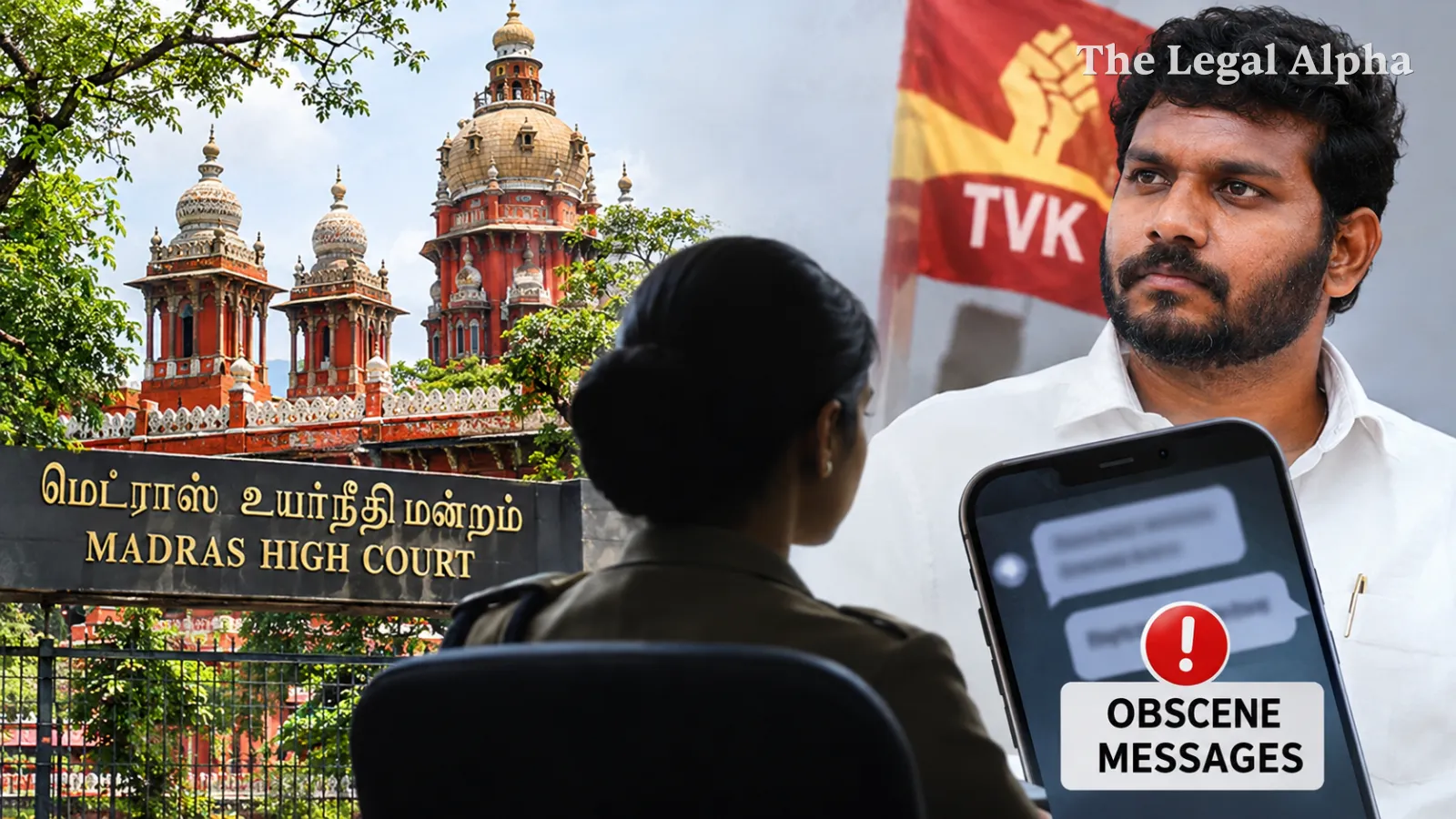
Tamil Nadu police have registered a case against Tamilaga Vettri Kazhagam (TVK) MLA C. Arul Vignesh following allegations that he sent obscene text messages to a woman District Collector serving in Kallakurichi district.
The case was registered after the woman officer submitted a written complaint to the Kallakurichi Superintendent of Police on November 23, 2026. The complaint alleges that the legislator sent inappropriate messages to her mobile phone and engaged in unwelcome conduct.
The development comes amid growing scrutiny of the authorities' handling of the allegations, which had already reached the Madras High Court. The matter attracted judicial attention after an advocate approached the court seeking directions for registration of an FIR and an impartial investigation.
Legal Topic
Area of Law: Criminal Law and Women's Protection
Sub-topic: Sexual Harassment, Workplace Harassment and Criminal Investigation
Core Legal Issue
The central legal issue concerns the criminal and legal consequences of allegedly sending obscene or sexually inappropriate communications to a woman public servant and the responsibility of law enforcement authorities to investigate such complaints.
The matter also raises questions about the protection available to women government officers against harassment, particularly when the person accused holds an elected public position. Another important issue is whether the investigation can proceed independently and without interference when allegations involve a sitting legislator.
What Did the Court and Authorities Decide?
The Kallakurichi All-Women Police Station registered a case against MLA C. Arul Vignesh following the District Collector's complaint. Media reports have identified Section 4(1) of the Tamil Nadu Prohibition of Harassment of Women Act and Section 294 of the Bharatiya Nyaya Sanhita (BNS) among the provisions invoked.
The matter was also brought before Justice V. Lakshminarayanan of the Madras High Court. During the earlier hearing on November 23, the State informed the court that neither the police nor the Chief Secretary had received a formal complaint from the woman officer.
The court subsequently directed the State Public Prosecutor to verify the position directly with the District Collector and the Chief Secretary.
On November 24, the State informed the High Court that the Collector had submitted a complaint and an FIR had been registered. The court also issued important directions concerning the investigation:
-
An officer of the rank of Inspector General of Police (IGP) or above must monitor and supervise the investigation.
-
The investigation must proceed promptly and impartially.
-
The State must constitute an Internal Complaints Committee (ICC) comprising IAS officers and independent members.
-
The final investigation report must be filed on or before December 22, 2026.
-
The court emphasised that no individual should receive protection from legal action because of their official or political position.
The High Court also addressed confidentiality requirements under Section 16 of the Sexual Harassment of Women at Workplace (Prevention, Prohibition and Redressal) Act, 2013, directing restrictions on publication of protected information relating to the complaint and proceedings. The matter has been listed for further hearing on November 27, 2026.
Key Legal Points
-
Protection Against Harassment: The Tamil Nadu Prohibition of Harassment of Women Act provides a legal framework for addressing harassment against women.
-
Criminal Investigation: Registration of an FIR initiates the criminal investigation process but does not establish the guilt of the accused.
-
Independent Supervision: The High Court's direction for IGP-level supervision seeks to ensure an impartial investigation.
-
Workplace Protection: The direction to constitute an Internal Complaints Committee highlights the importance of institutional mechanisms for addressing workplace harassment.
-
Confidentiality: Section 16 of the POSH Act imposes restrictions on disclosure of protected information concerning complaints and inquiry proceedings.
Relevant Law
Tamil Nadu Prohibition of Harassment of Women Act, 1998
Section 4(1) has been reported among the provisions invoked in the police case. The legislation provides for legal action against harassment of women in Tamil Nadu.
Bharatiya Nyaya Sanhita, 2023
Section 294 has also been reported among the provisions invoked in connection with the alleged obscene communications.
Sexual Harassment of Women at Workplace (Prevention, Prohibition and Redressal) Act, 2013
Section 16 protects the confidentiality of complaints, identities and inquiry-related information. It restricts the publication or communication of specified details to the public, press and media.
The Act also provides for Internal Complaints Committees to address workplace sexual harassment complaints.
Arguments of the Parties
Petitioner / Applicant
Advocate R. Thrishuli approached the Madras High Court seeking directions to the Director General of Police and the Kallakurichi Superintendent of Police to register an FIR and ensure a fair, impartial and expeditious investigation into the allegations against the MLA.
The petition referred to the alleged harassment of the woman officer and sought appropriate intervention from the authorities.
Respondent / State
Initially, the State informed the High Court that neither the police nor the Chief Secretary had received a formal complaint from the District Collector.
At the subsequent hearing, State Public Prosecutor R. John Sathyan informed the court that the Collector had lodged a complaint and an FIR had been registered.
MLA's Position
C. Arul Vignesh has denied the allegations, describing them as baseless and
politically motivated. The allegations remain subject to investigation, and no finding of guilt has been established.
Why Does It Matter?
The case highlights the importance of protecting women government officials from harassment and ensuring that complaints against politically influential individuals receive appropriate legal attention.
The High Court's direction for supervision by a senior police officer is particularly significant because it addresses concerns about the independence of investigations involving elected representatives.
The proposed Internal Complaints Committee also highlights the importance of institutional accountability. Workplace harassment complaints should be handled through appropriate mechanisms regardless of the seniority or public position of the person accused.
Another important aspect is the court's emphasis on confidentiality. Section 16 of the POSH Act seeks to protect the identities and privacy of individuals involved in workplace harassment proceedings. Compliance with these restrictions is essential for safeguarding the complainant and maintaining the integrity of the inquiry.
However, registration of an FIR should not be treated as proof of an offence. The allegations must be examined through a fair investigation, with the legal rights of all parties respected.
Legal Takeaway
The registration of an FIR against a sitting MLA demonstrates that allegations of harassment must be examined through the ordinary legal process, irrespective of the accused person's political position. The Madras High Court's directions for senior-level supervision, institutional safeguards and timely investigation underline the importance of accountability, independence and confidentiality in workplace harassment matters.
Sources
Primary Source:
- Madras High Court proceedings before Justice V. Lakshminarayanan. The complete court order was not independently available for examination.
Additional Sources: