Gujarat High Court Clarifies Magistrates Can Release Vehicles Seized in Liquor-Smuggling Cases Pending Trial
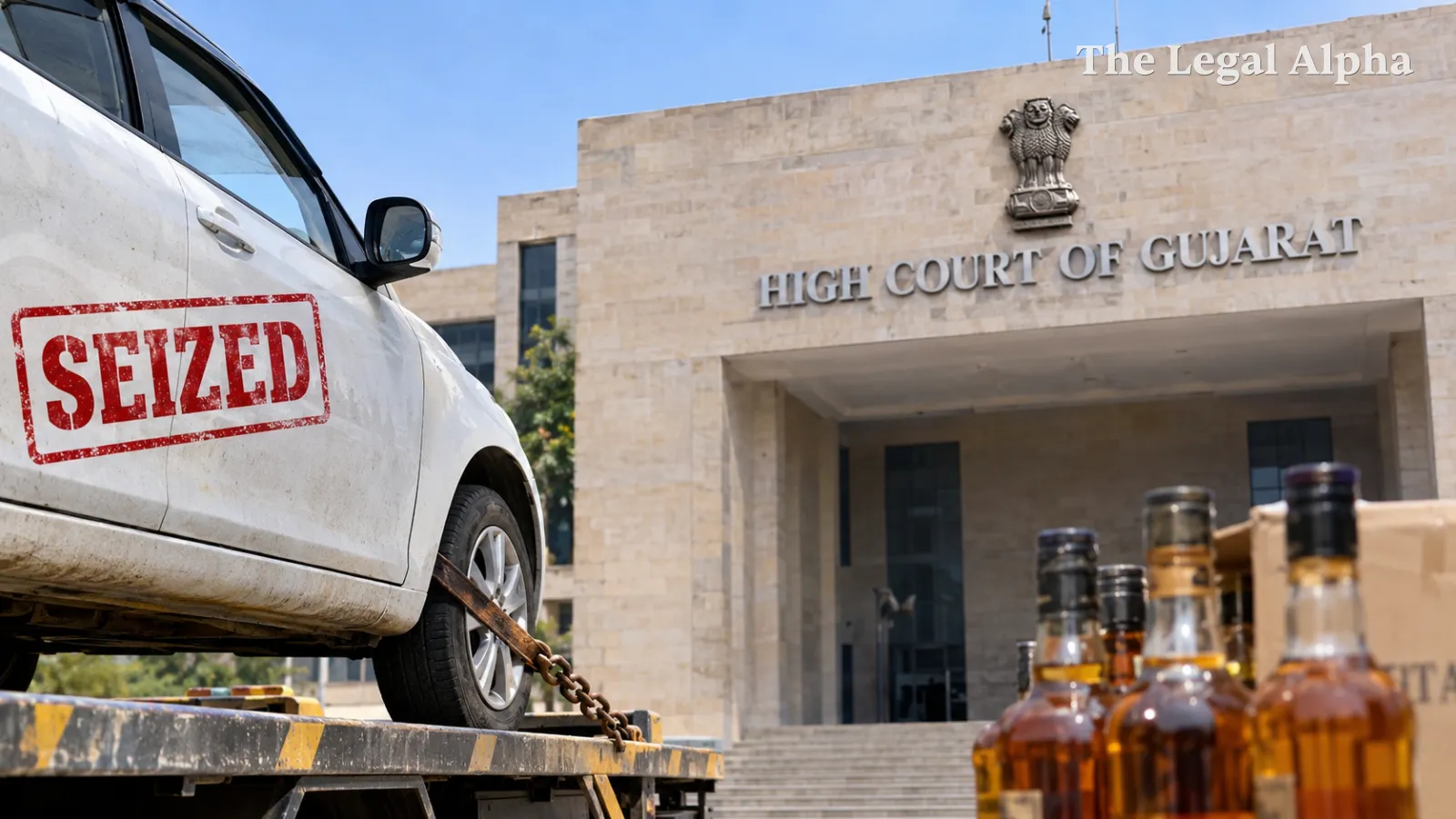
The Gujarat High Court has clarified that vehicles seized in connection with liquor-smuggling offences can be released to their owners while criminal proceedings are still pending, even when the quantity of liquor recovered exceeds 20 litres.
Justice J.C. Doshi held that Section 98(2) of the Gujarat Prohibition Act does not impose an absolute prohibition on the interim release of seized vehicles. Magistrates retain the authority to consider applications for interim custody under Section 497 of the Bharatiya Nagarik Suraksha Sanhita (BNSS), subject to appropriate safeguards.
The ruling came in a petition filed by the owner of a Swift car seized in connection with a liquor-related offence registered at the DCB Police Station in Surat.
Legal Topic
Area of Law: Criminal Law
Sub-topic: Interim Custody of Seized Property / Gujarat Prohibition Law
Core Legal Issue
The central legal question before the High Court was whether Section 98(2) of the Gujarat Prohibition Act completely prevents magistrates from releasing vehicles seized in liquor-related offences when the quantity of liquor recovered exceeds the prescribed threshold of 20 litres.
The court examined whether the possibility of eventual confiscation automatically requires a seized vehicle to remain in police custody throughout the criminal trial or whether magistrates can exercise their powers under Section 497 of the BNSS to grant interim custody.
What Did the Gujarat High Court Decide?
The High Court rejected the interpretation that Section 98(2) creates an absolute bar against interim release of seized vehicles.
Justice J.C. Doshi clarified that magistrates are competent to consider applications for the return of vehicles on their individual merits. The possibility that a vehicle may eventually be confiscated does not, by itself, justify keeping it in police custody until the conclusion of the criminal proceedings.
The court also highlighted the practical problems associated with keeping vehicles in police station compounds for extended periods. Exposure to weather and prolonged neglect can cause deterioration, depreciation and loss of utility.
It observed that the evidentiary value of a seized vehicle can be preserved through a detailed panchnama, photographs and videography instead of requiring its continued physical detention.
The High Court directed that the petitioner's Swift car be released against a personal bond and solvent surety equivalent to the vehicle's value mentioned in the FIR.
The release was subject to the following conditions:
-
The owner must furnish a personal bond and solvent surety equivalent to the vehicle's value mentioned in the FIR.
-
The vehicle must be produced before the court whenever required.
-
The owner cannot sell, transfer, mortgage or create any third-party interest in the vehicle without permission from the trial court.
-
The owner must furnish an undertaking that the vehicle will not be used for further prohibition-related offences.
The High Court clarified that interim release does not amount to acquittal or prevent the competent authorities from ordering confiscation of the vehicle at the appropriate stage.
It also directed that a copy of the judgment be circulated among judicial officers of subordinate courts.
Key Legal Points
-
Section 98(2) of the Gujarat Prohibition Act does not create an absolute prohibition on interim release of vehicles seized in liquor-related offences.
-
Magistrates can exercise jurisdiction under Section 497 of the BNSS while considering applications for interim custody.
-
The possibility of eventual confiscation does not automatically justify keeping a vehicle in police custody throughout the trial.
-
Photographs, videography and a detailed panchnama can help preserve the evidentiary identity of seized vehicles.
-
Interim release is subject to safeguards and does not affect the final decision on confiscation.
Relevant Law
Gujarat Prohibition Act, 1949 – Section 98(2)
This provision deals with the confiscation of specified conveyances and other property involved in offences under the prohibition law. Its interpretation was central to the dispute concerning the release of the seized vehicle.
Bharatiya Nagarik Suraksha Sanhita, 2023 – Section 497
This provision concerns the custody and disposal of property pending trial or inquiry. The High Court recognised the magistrate's jurisdiction under this provision to consider applications for interim custody.
Arguments of the Parties
Petitioner / Vehicle Owner
The petition was filed by the owner seeking the release of his Swift car, which had been seized in connection with a liquor-related offence.
State / Prosecution
The prosecution opposed the release, arguing that the quantity of liquor recovered exceeded the permissible limit and that the vehicle was liable for confiscation under Section 98(2) of the Gujarat Prohibition Act.
The prosecution's objection was not accepted as sufficient, by itself, to justify continued physical detention of the vehicle.
Why Does It Matter?
The ruling provides important clarification for vehicle owners whose vehicles are seized in connection with prohibition offences in Gujarat.
Previously, the interpretation of Section 98(2) had restricted lower courts from releasing vehicles when the quantity of liquor involved exceeded the prescribed threshold. This often resulted in vehicles remaining in police custody for extended periods while criminal proceedings continued.
The High Court's clarification recognises that the possibility of confiscation and the question of interim custody are separate legal considerations.
For vehicle owners, the decision provides an opportunity to seek the return of seized vehicles without necessarily waiting for the conclusion of the criminal trial. However, release is not automatic and depends on judicial consideration of the individual circumstances and appropriate safeguards.
The ruling also addresses the practical concern of vehicles losing their value while lying unattended in police station premises. At the same time, the conditions imposed ensure that vehicles remain available for evidentiary purposes and any eventual confiscation proceedings.
Legal Takeaway
The Gujarat High Court has clarified that the seizure of a vehicle in a liquor-related offence does not automatically require it to remain in police custody until the criminal trial concludes. Magistrates can consider interim release under Section 497 of the BNSS, even where the recovered liquor exceeds 20 litres, subject to appropriate safeguards. The question of final confiscation remains open for determination in accordance with law.
Sources
Primary Source: Gujarat High Court order in the petition concerning interim release of a Swift car seized in a liquor-related offence. The complete order and case number were not independently available in the material reviewed.
Additional Sources: