Supreme Court Declines to Reopen Acquittal of Former Major General Anand Kumar Kapur
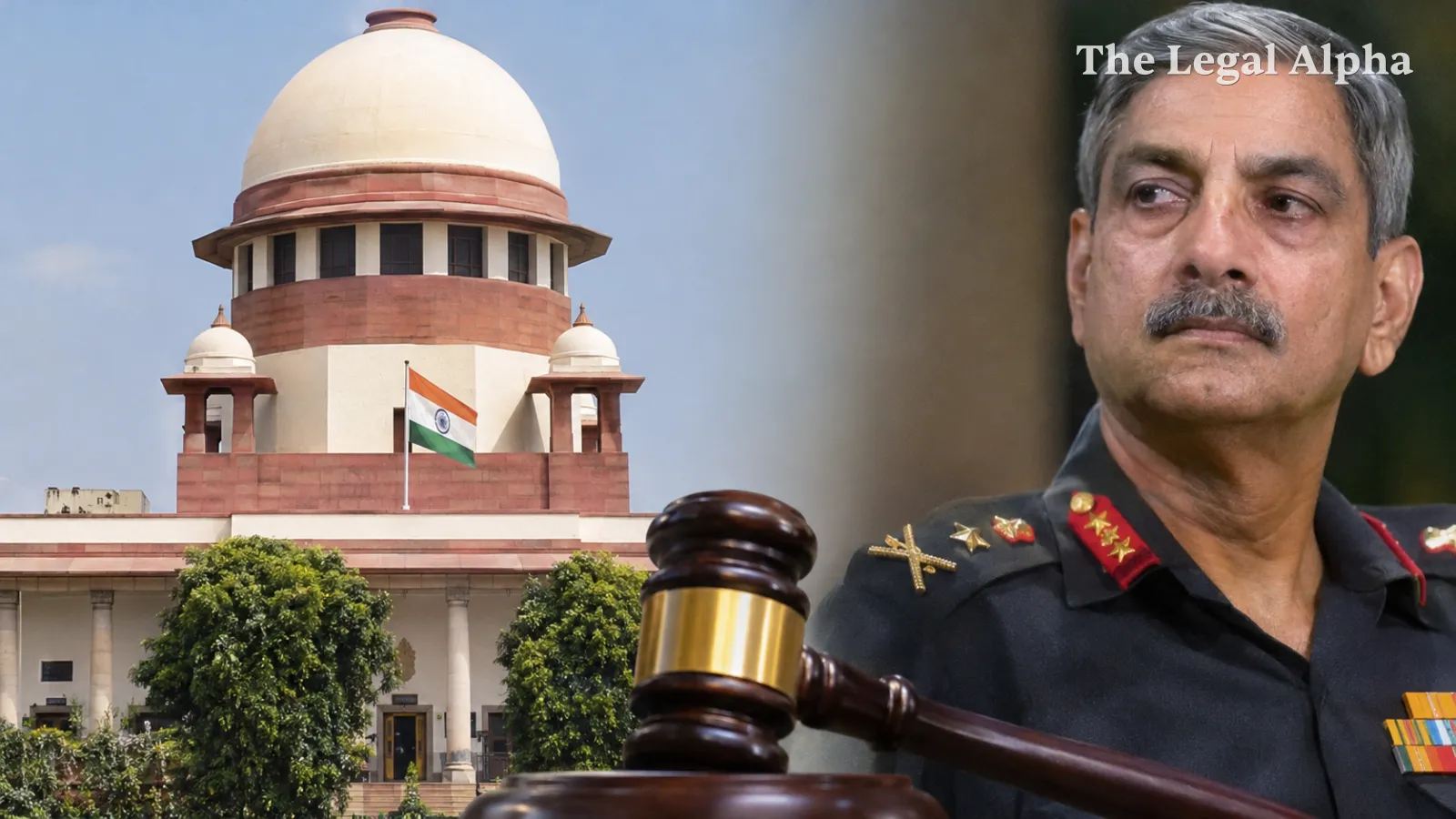
The Supreme Court of India has declined to interfere with the acquittal of retired Major General Anand Kumar Kapur in a disproportionate assets case investigated by the Central Bureau of Investigation (CBI).
The CBI had approached the Supreme Court challenging the Delhi High Court's decision dated July 1, 2026, which overturned Kapur's conviction by a Special CBI Court.
The matter was listed before the Supreme Court on November 23, 2026, as Special Leave Petition (Criminal) Nos. 21124–21125 of 2026, titled Central Bureau of Investigation v. Anand Kumar Kapur. The official cause list confirms that the petitions were listed for admission.
Legal Topic
Area of Law: Criminal Law
Sub-topic: Prevention of Corruption – Disproportionate Assets – Special Leave Petitions – Fair Trial
Core Legal Issue
The principal issue concerned whether the Delhi High Court's decision to acquit the retired Army officer warranted interference by the Supreme Court.
The proceedings arose from allegations that Kapur had accumulated assets disproportionate to his known sources of income during his service in the Indian Army.
What Did the Supreme Court Decide?
The Supreme Court declined to interfere with the acquittal, leaving the Delhi High Court's decision undisturbed.
The CBI had challenged the High Court's judgment through two connected special leave petitions.
The Supreme Court's refusal to interfere means that the acquittal granted by the Delhi High Court remains intact.
Background of the Case
The CBI registered a case alleging that Kapur had accumulated assets worth approximately ₹3.37 crore, disproportionate to his known sources of income, during the check period.
In September 2016, the Special CBI Court convicted him under Section 13(1)(e), read with Section 13(2), of the Prevention of Corruption Act, 1988.
He was sentenced to one year's rigorous imprisonment, fined ₹50,000 and subjected to an order for confiscation of assets worth approximately ₹2.22 crore. His wife had been acquitted by the trial court.
What Did the Delhi High Court Hold?
On July 1, 2026, Justice Jasmeet Singh of the Delhi High Court allowed Kapur's appeals and set aside his conviction and sentence.
The High Court identified several shortcomings in the trial and prosecution case:
-
Denial of fair trial: The defence was given substantially less time to present its evidence than the prosecution.
-
Article 21 protection: The Court emphasised that speedy disposal cannot override an accused person's constitutional right to a fair trial.
-
Defective prosecution sanction: The Court found deficiencies in the sanction granted for prosecuting Kapur.
-
Unreliable asset assessment: Certain properties and financial assets had been attributed to Kapur without sufficient supporting evidence.
-
Failure to establish guilt: The prosecution had not proved the disproportionate assets charge beyond reasonable doubt.
Relevant Law
Prevention of Corruption Act, 1988
-
Section 13(1)(e): Criminal misconduct involving possession of pecuniary resources or property disproportionate to known sources of income under the applicable pre-amendment provision.
-
Section 13(2): Provides punishment for criminal misconduct.
Constitution of India
-
Article 21: Protection of life and personal liberty, including the right to a fair trial.
-
Section 19 of the Prevention of Corruption Act, 1988: Requirement of previous sanction for prosecution of public servants, as applicable to the case.
Arguments of the Parties
Appellant – Anand Kumar Kapur
Kapur challenged the trial court's conviction on grounds including denial of adequate opportunity to present defence evidence, defects in the prosecution sanction and failure to establish that his assets were disproportionate to his lawful income.
He also disputed the inclusion and valuation of several properties and financial assets.
Respondent – Central Bureau of Investigation
The CBI defended the investigation and prosecution, maintaining that the evidence supported the allegations of disproportionate assets and that investigative shortcomings did not automatically invalidate the prosecution.
The CBI subsequently approached the Supreme Court challenging the High Court's acquittal.
Why Does It Matter?
The development highlights the importance of judicial scrutiny when reviewing corruption convictions involving public servants.
It also reinforces the distinction between expeditious criminal proceedings and the constitutional requirement of procedural fairness.
For investigating agencies, the case underscores the importance of properly establishing asset ownership, verifying financial sources and ensuring that prosecution evidence meets the applicable legal standards.
The Supreme Court's refusal to interfere also leaves the Delhi High Court's acquittal undisturbed.
Legal Takeaway
A conviction in a disproportionate assets case must rest on legally admissible evidence and a fair trial. The seriousness of corruption allegations cannot justify compromising the accused person's constitutional protections.
Sources
Primary Sources:
Additional Sources: