Delhi High Court Protects 85-Year-Old Man’s Right to Live Peacefully, Orders Son and Daughter-in-Law to Vacate House
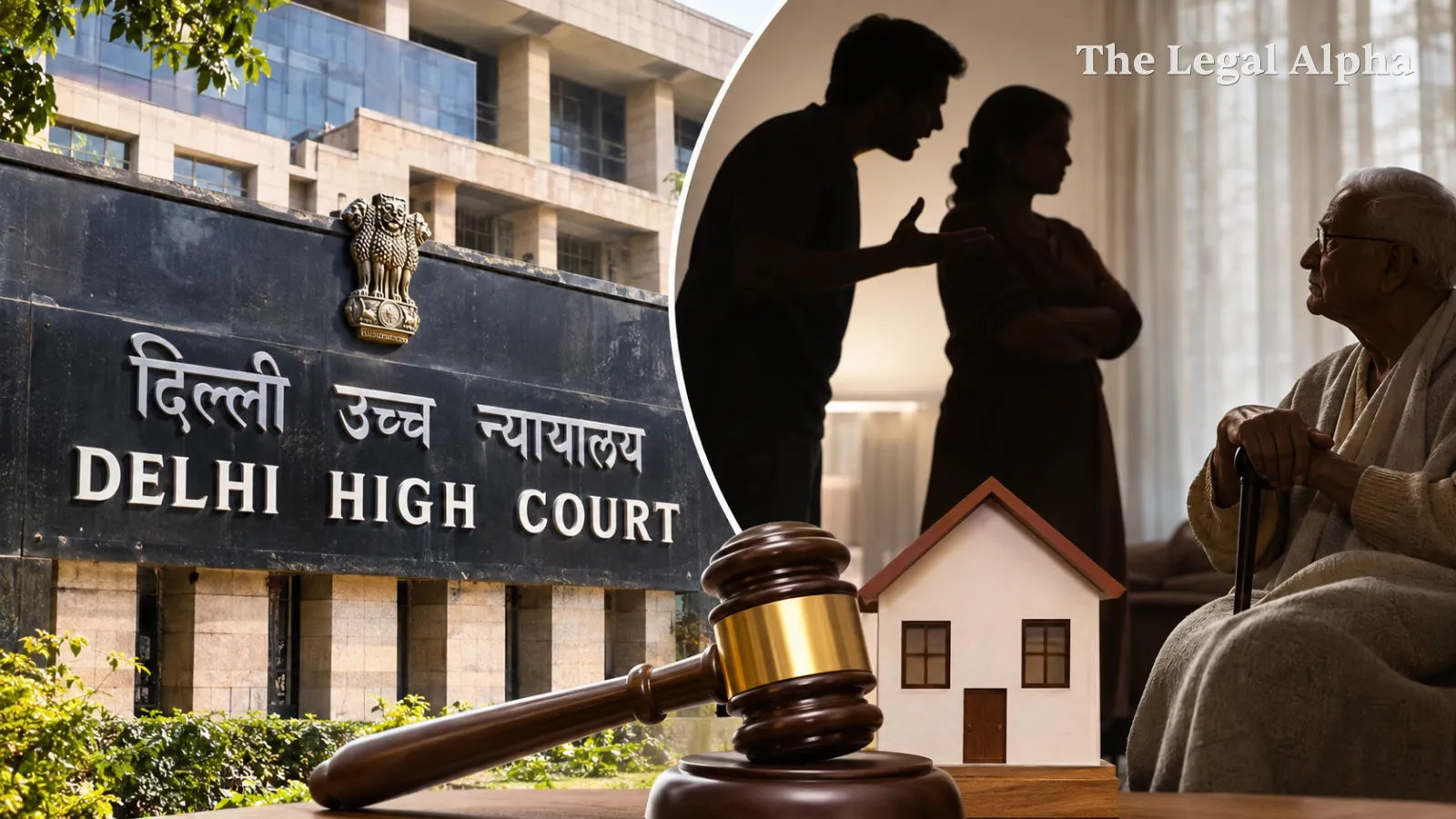
The Delhi High Court has directed an elderly man's son and daughter-in-law to vacate his self-acquired residential property within four weeks, emphasising that senior citizens should not be compelled to share their homes against their wishes.
The ruling reinforces the protection available to elderly parents under the Maintenance and Welfare of Parents and Senior Citizens Act, 2007, particularly where disputes within the family affect their ability to live peacefully and with dignity.
Legal Topic
Area of Law: Senior Citizens Welfare and Property Law
Sub-topic: Eviction of Children from Self-Acquired Property of Senior Citizens
Core Legal Issue
The central question before the Delhi High Court was whether an elderly property owner must establish clear and convincing evidence of harassment or ill-treatment before seeking eviction of his children under the Maintenance and Welfare of Parents and Senior Citizens Act, 2007.
The Court also examined whether authorities could reject an eviction request merely because the dispute appeared to involve family or business disagreements, despite the senior citizen being the undisputed owner of the property.
Background of the Dispute
The petitioner, Subhash Chander Malhotra, an 85-year-old senior citizen, approached the Delhi High Court seeking eviction of his eldest son, Raman Malhotra, and daughter-in-law from his self-acquired property at Masjid Moth, New Delhi.
The petitioner had acquired the property from the Delhi Development Authority in 1980 and converted it into freehold property in 2000. His son and daughter-in-law had continued living there following their marriage in 2003.
According to the petitioner, their behaviour deteriorated over the years, and they stopped providing him financial support. He also alleged that incidents of threats and harassment intensified following his wife's death in November 2020.
After approaching the authorities under the Senior Citizens Act, his eviction request was rejected by the District Magistrate and subsequently by the Divisional Commissioner. Both authorities considered the allegations of harassment insufficiently established.
The petitioner challenged these decisions before the High Court.
What Did the Delhi High Court Decide?
Justice Amit Mahajan set aside the orders passed by the District Magistrate and Divisional Commissioner and directed the son and daughter-in-law to vacate the property within four weeks.
The Court found that the authorities had incorrectly insisted on clear and substantial proof of harassment as a prerequisite for granting eviction.
It relied on the Supreme Court's ruling in Ravi Kant Gupta v. State of Uttar Pradesh and the Delhi High Court's earlier decision in Pritam Singh v. Government of NCT of Delhi.
The Court reiterated that a senior citizen seeking eviction of children from his property does not necessarily have to establish that he has been ill-treated. Demonstrating that the property requires protection to enable peaceful and dignified living can be sufficient.
The Court also observed that harassment within residential premises may be difficult to establish through independent evidence. Authorities dealing with proceedings under the Act should not insist on the same standard of proof applicable to civil or criminal trials.
Important Observations of the Court
The High Court made several significant observations:
-
A senior citizen cannot be compelled to share his own house with children against his wishes, particularly when family relationships have substantially deteriorated.
-
Protection of property and peaceful residence are important objectives of the Senior Citizens Act.
-
Authorities cannot introduce evidentiary requirements that are not contemplated by the legislation.
-
An ongoing business dispute between family members does not automatically make a senior citizen's grievance unreliable.
-
Enquiry reports must contain reasoned findings rather than unsupported conclusions.
The Court particularly criticised the enquiry reports because they failed to properly examine the material submitted by the parties and the complaints previously made to the police.
Relevant Legal Provisions
Maintenance and Welfare of Parents and Senior Citizens Act, 2007
-
Section 4: Provides for maintenance of parents and senior citizens.
-
Section 5: Deals with applications for maintenance.
-
Section 7: Provides for the constitution of Maintenance Tribunals.
-
Section 8: Deals with the procedure and powers of the Maintenance Tribunal.
-
Section 16: Provides for appeals against orders of the Maintenance Tribunal.
-
Section 27: Excludes the jurisdiction of civil courts in matters covered by the Act.
Delhi Maintenance and Welfare of Parents and Senior Citizens Rules, 2009
-
Rule 22(3)(1)(i): Provides the procedure for seeking eviction of children or legal heirs from the property of senior citizens.
-
Rule 22(3)(4): Provides the relevant appellate mechanism under the Delhi Rules.
Constitution of India
-
Article 21: Protects the right to life and personal liberty, including the right to live with dignity.
-
Article 41: Contains a Directive Principle concerning public assistance in cases including old age, subject to the State's economic capacity.
Arguments Presented by the Parties
Petitioner
The senior citizen argued that he was the absolute owner of the property and was entitled to seek eviction of his son and daughter-in-law to protect his peaceful residence.
His counsel submitted that establishing ill-treatment was not a mandatory precondition for seeking eviction under the Senior Citizens Act.
Respondents
The son and daughter-in-law disputed the allegations and argued that the proceedings arose from a business dispute between the petitioner's sons.
They also contended that the authorities had already returned concurrent findings against the petitioner and pointed out that they had offered to pay him monthly maintenance.
The High Court rejected the approach adopted by the authorities and found that the statutory requirements had been incorrectly interpreted.
Why Does This Judgment Matter?
The decision reinforces the protective purpose of the Maintenance and Welfare of Parents and Senior Citizens Act, 2007.
It clarifies that elderly property owners should not be required to undergo an unnecessarily demanding evidentiary process before seeking protection of their residential property.
The ruling is particularly relevant in situations where elderly parents face prolonged family disputes and find it difficult to establish incidents of harassment through independent witnesses or documentary evidence.
It also highlights the responsibility of administrative authorities to properly examine complaints, police records and supporting material rather than mechanically accepting inconclusive enquiry reports.
Importantly, the judgment does not establish that every eviction request by a senior citizen must automatically succeed. The facts, ownership, statutory requirements and circumstances of each case remain relevant.
Final Directions of the Court
The Delhi High Court issued the following directions:
-
The Divisional Commissioner's order dated April 28, 2026, was set aside.
-
The District Magistrate's order dated October 28, 2025, was also set aside.
-
The son and daughter-in-law were directed to vacate the property within four weeks from November 20, 2026.
-
The concerned Station House Officer was directed to provide necessary assistance to ensure compliance with the order, if required.
The writ petition was accordingly allowed, and the pending application was disposed of.
Legal Takeaway
The Delhi High Court has reaffirmed that the Senior Citizens Act protects more than the financial maintenance of elderly parents; it also safeguards their ability to live peacefully and with dignity. A senior citizen seeking protection of his property need not necessarily prove ill-treatment as a mandatory condition for seeking eviction of children from the property.
Sources
Primary Source: Delhi High Court judgment in Subhash Chander Malhotra v. Raman Malhotra & Ors., W.P.(C) 6452/2026, Neutral Citation: 2026:DHC:10342, decided on November 20, 2026. Justice Amit Mahajan.
Read the full Delhi High Court judgment (PDF).
Additional Sources: