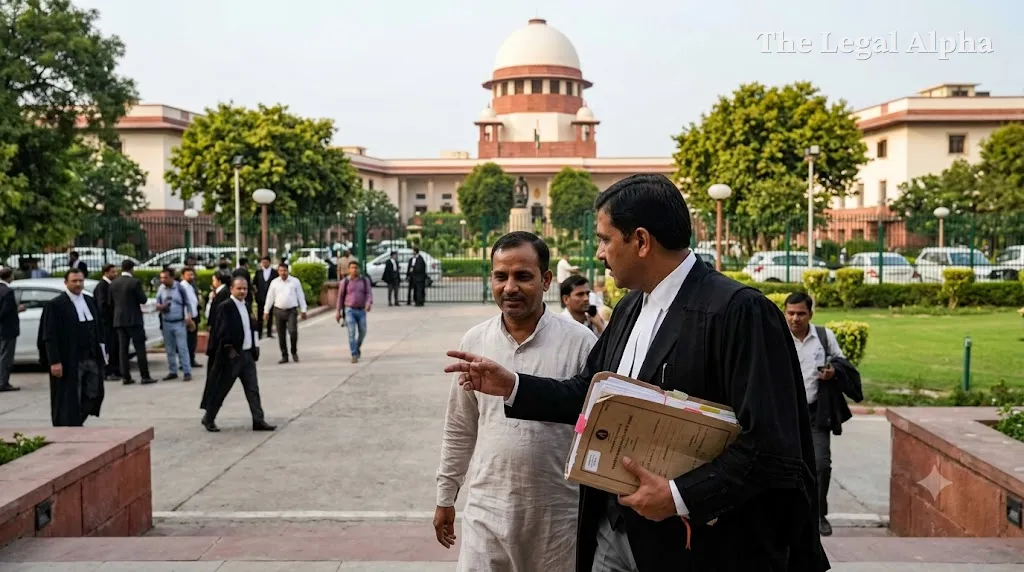
Supreme Court Restores Acquittal of Cashier in ₹8.73 Lakh Criminal Breach of Trust Case
Court: Supreme Court of India
Bench: Justice Ujjal Bhuyan & Justice Atul S. Chandurkar (Author: Justice Atul S. Chandurkar)
Case Record: Criminal Appeal No. 1432 of 2019 | Neutral Citation: 2026 INSC 1092 | Citation: 2026 LiveLaw (SC) 1032
Date of Pronouncement: October 08, 2026 | Reported: October 08, 2026
Subject: Criminal Breach of Trust (Section 409 IPC) & Search Procedure (Section 100 CrPC)
Category
Judgements
The appellant, Ramkrushna Prahllad Dongardive, was employed as a Cashier-cum-Counter Clerk with the Telephone Department at Aurangabad, Maharashtra. The prosecution alleged that between July 1, 1993, and October 9, 1993, Dongardive collected telephone bill payments from consumers aggregating to ₹8,73,737/-. It was alleged that out of the collected amount, ₹3,88,035/- was deposited into the Government treasury belatedly, constituting temporary criminal breach of trust, while ₹4,75,702/- was never credited to the Government account despite being entrusted to him. On October 11, 1993, the Assistant Accounts Officer lodged an official complaint, culminating in the registration of an FIR under Sections 409, 477, and 420 of the Indian Penal Code (IPC). Following investigation, a charge was framed under Section 409 IPC (criminal breach of trust by a public servant).
In February 2002, the Judicial Magistrate First Class, Aurangabad, acquitted Dongardive after a full trial. The Magistrate found that the prosecution evidence was vague, that foundational registers and cashbooks were never produced despite the defence calling for them, and that the alleged seizure of 46 counterfoil documents from the accused's house failed to comply with Section 100 of the Code of Criminal Procedure (CrPC). However, in an appeal against acquittal preferred by the State, the Bombay High Court (Aurangabad Bench) reversed the acquittal on October 12, 2017, convicted Dongardive under Section 409 IPC, and sentenced him to one year of rigorous imprisonment with a fine of ₹5,000/-. Aggrieved by the reversal, Dongardive appealed to the Supreme Court.
Legal Topic
Criminal Law & Law of Evidence – Section 405 & Section 409, Indian Penal Code, 1860 (Criminal Breach of Trust by Public Servant); Section 100, Code of Criminal Procedure, 1973 (Statutory Search and Seizure Procedures & Role of Independent Panch Witnesses); Section 114, Illustration (g), Indian Evidence Act, 1872 (Adverse Inference for Withholding Primary Records); Section 386(a), CrPC (Parameters Governing Reversal of Trial Court Acquittals by Appellate Courts).
Core Legal Issue
Whether procedural non-compliance with Section 100 of the CrPC during search and seizure, combined with the prosecution's failure to produce foundational collection registers and cashbooks to prove entrustment and dishonest intention, vitiates an appellate reversal of acquittal under Section 409 IPC.
What Did the Court / Authority Decide?
A Division Bench of the Supreme Court of India, comprising Justice Ujjal Bhuyan and Justice Atul S. Chandurkar (judgment authored by Justice Chandurkar), allowed Criminal Appeal No. 1432 of 2019, set aside the Bombay High Court's conviction order dated October 12, 2017, and restored the trial court's judgment of acquittal.
The Supreme Court held that to sustain a conviction under Section 409 IPC, the prosecution bears the strict burden of establishing both: (1) entrustment of property or dominion over property, and (2) dishonest misappropriation, conversion, or disposal. The Bench held that the prosecution failed to prove the foundational ingredient of entrustment because it did not produce the primary daily collection registers, original cashbooks, or contemporaneous audit reports. Furthermore, the Court ruled: "It is true that non-compliance of the requirements of Section 100 of the Code by itself would not vitiate a seizure and the same would be an irregularity in the investigation. However, when this factor is considered cumulatively with other factors that contribute to doubting the prosecution case, the same would weigh in favour of the appellant, especially in an appeal against acquittal." Holding that the trial court's view was a plausible one that ought not to have been disturbed, the Supreme Court restored the acquittal and discharged Dongardive's bail bonds.
Key Legal Points
- Entrustment and Dishonest Intention Are Indispensable: The Supreme Court reaffirmed that mere allegation of money shortage or delayed remittance cannot sustain a charge under Section 409 IPC. The prosecution must establish both actual entrustment of dominion over property and a dishonest mental state beyond reasonable doubt.
- Procedural Lapses Under Section 100 CrPC Erode Evidentiary Value: The Bench clarified that while procedural violations of search requirements under Section 100 CrPC do not render seized material automatically inadmissible, they constitute significant investigative irregularities. When panch witnesses turn hostile and no seizure memo is supplied to the accused, the defect severely damages the probative value of the seizure.
- Adverse Inference for Withholding Primary Records: The Court affirmed that when the prosecution withholds foundational daily cash registers and account books—even after the accused files a specific application for their production—an adverse inference must be drawn under Section 114, Illustration (g) of the Evidence Act.
- High Threshold for Reversing Acquittals: An appellate court exercising powers under Section 386(a) CrPC cannot overturn an acquittal merely because an alternative view is possible. Reversal is permissible only where the trial court's reasoning is perverse or palpably erroneous.
- Appellate Sentencing Discipline: The Bench emphasized that when an appellate court reverses an acquittal and records a conviction for the first time, it has a bounden duty under law to hear the convict on the question of sentence rather than mechanically imposing punishment or abdicating discretion.
Relevant Law
- Section 405 & Section 409, Indian Penal Code, 1860: Defines criminal breach of trust and prescribes punishment of up to life imprisonment or imprisonment up to 10 years for criminal breach of trust by a public servant, banker, or agent.
- Section 100, Code of Criminal Procedure, 1973: Prescribes mandatory procedures for searches of closed places, requiring two or more independent and respectable inhabitants of the locality to attend and witness the search, and mandating delivery of a signed list of seized articles to the occupant.
- Section 114, Illustration (g), Indian Evidence Act, 1872: Enables the court to presume that evidence which could be and is not produced would, if produced, be unfavourable to the person who withholds it.
- Section 386(a), Code of Criminal Procedure, 1973: Delineates powers of the appellate court in an appeal against an order of acquittal.
- Chandrappa v. State of Karnataka (2007) 4 SCC 415: Landmark Supreme Court precedent articulating the five cardinal principles governing appellate interference with orders of acquittal.
- Radha Kishan v. State of Uttar Pradesh AIR 1963 SC 822: Established that procedural irregularity in conducting a search under the CrPC affects the weight of evidence rather than its strict legal admissibility.
Arguments of the Parties
- Contentions of the Appellant (Ramkrushna Prahllad Dongardive):
- Represented by Senior Advocates B.H. Marlapalle and Sudhanshu S. Choudhari, the appellant submitted that the prosecution never placed on record the primary daily collection register or original cashbook to prove that the alleged sum of ₹8,73,737/- was physically received by or entrusted to him.
- Counsel pointed out that 46 counterfoils allegedly recovered from the appellant's residence suffered from gross procedural violations under Section 100 CrPC: both panch witnesses turned hostile, and no seizure memo was ever furnished to the appellant.
- It was argued that the trial court's acquittal was based on a thorough and plausible assessment of missing evidence, and the High Court committed grave error in overturning that acquittal.
- Contentions of the Respondent (State of Maharashtra):
- Represented by learned State Counsel, the respondent submitted that Dongardive admitted functioning as the counter clerk and cashier during the relevant period.
- The State contended that substantial amounts were credited into the Government account with massive delays, demonstrating temporary misappropriation of public revenue.
- It was argued that procedural irregularities in search and seizure do not vitiate the prosecution case when departmental audit reports revealed substantial financial shortages.
Why Does It Matter?
In prosecutions of public servants and corporate employees for alleged financial defalcation, investigative agencies and prosecution branches frequently rely upon internal audit notes and summary balance sheets while failing to bring primary cashbooks, daily scroll registers, and counterfoil receipt books into court. Accused counter clerks and cashiers often find themselves convicted on broad audit inferences without primary documentary proof establishing that they personally received and dishonestly retained the disputed funds.
The Supreme Court’s judgment in Ramkrushna Prahllad Dongardive provides an essential corrective to this practice. By ruling that internal audit assertions cannot substitute for primary accounts, and holding that non-compliance with Section 100 CrPC cumulatively undermines the prosecution's case, Justices Ujjal Bhuyan and Atul S. Chandurkar reinforce fundamental criminal due process. The ruling ensures that public servants cannot be convicted of criminal breach of trust without rigorous proof of entrustment, and upholds the constitutional sanctity of the trial court's presumption of innocence in appeals against acquittal.
Legal Takeaway
For an offence under Section 409 IPC, the prosecution must strictly prove both entrustment of property and dishonest intention beyond reasonable doubt through primary books of account. The non-production of foundational cashbooks and collection registers warrants a strong adverse inference against the prosecution under Section 114, Illustration (g) of the Evidence Act. While procedural non-compliance with Section 100 CrPC during search and seizure does not per se render seized property inadmissible, such irregularities cumulatively erode the evidentiary reliability of the prosecution, making interference with a trial court's order of acquittal legally unsustainable.
Sources (Primary & Additional)
- Primary Judicial Order: Supreme Court of India, Ramkrushna Prahllad Dongardive v. The State of Maharashtra [Criminal Appeal No. 1432 of 2019, Neutral Citation: 2026 INSC 1092, Citation: 2026 LiveLaw (SC) 1032, Decided on October 08, 2026], per Justice Ujjal Bhuyan and Justice Atul S. Chandurkar. Supreme Court Reportable Judgment PDF / LiveLaw.
- Authoritative Legal Reporting (LiveLaw): LiveLaw News Network, \"Procedural Violation Will Not Vitiate Seizure But Can Affect Evidentiary Value : Supreme Court\" (Article ID: 553763 / Judgment ID: 553764, Published on October 08, 2026). LiveLaw Article.
- Legal Analysis & Case Commentary (CourtBook): CB News Desk, \"Supreme Court Restores Acquittal of Telephone Department Cashier in ₹8.73 Lakh Criminal Breach of Trust Case\" (Published on October 08, 2026). CourtBook Analysis.
- Case Compilation & Digest (SupremeToday): Editorial Team, \"Ramkrushna Prahllad Dongardive vs State Of Maharashtra — Criminal Breach of Trust & Search Irregularities\" (Published on October 08, 2026). SupremeToday Digest.