Supreme Court Registry Flags Procedural Defects in Opposition Challenge to Special Intensive Revision Exercise
A writ petition moved before the Supreme Court by opposition leaders, including Rahul Gandhi and Congress President Mallikarjun Kharge, challenging the Election Commission of India’s Special Intensive Revision (SIR) of electoral rolls, has run into initial procedural hurdles at the scrutiny stage.
During standard registry verification, officials flagged over ten procedural shortcomings. These defects included a minor shortfall of approximately ₹220 in court fees, illegible and missing pages, pagination discrepancies, and the absence of a legible identity document for Kharge as a co-petitioner. The petition will be cleared for judicial listing once the counsel cures the pointed defects.
Legal Topic
Area of Law: Constitutional & Election Law
Sub-topic: Writ Jurisdiction / Electoral Roll Verification & Scrutiny Procedures
Core Legal Issue
The substantive question raised in the underlying petition concerns the constitutional validity and administrative execution of the Election Commission’s Special Intensive Revision (SIR) process. The petitioners question whether the mass deletion and revision of electoral rolls without mandatory individualized notice violates the constitutional right to vote and statutory procedural fairness under Article 324 and the election laws.
At this preliminary stage, however, the registry’s scrutiny tests strict compliance with Supreme Court Rules governing document admissibility, legible record presentation, and statutory court fee compliance required before an Article 32 petition can be formally registered and allocated a bench.
What Did the Court / Authority Decide?
The Supreme Court bench has not yet adjudicated the substantive merits or issued an order on the petition.
The Registry marked the petition defective following initial filing verification. The petitioners’ legal team must remove these clerical and technical defects—such as replenishing the court fee shortfall, re-uploading illegible annexures, and furnishing clear identity records—before the registry issues a regular case number and places the matter before the bench for admission hearing.
Key Legal Points
-
Scrutiny Standards for Writ Filings: Under the Supreme Court Rules, 2013, the Registry functions as a procedural filter, requiring all writ petitions to satisfy strict filing criteria regarding legible documentation, complete annexures, verified identification of parties, and accurate court fee payments.
-
Procedural Curing Process: Marking defects in a petition does not constitute dismissal; it represents an administrative requirement under which the filing advocate is given time to rectify deficiencies prior to listing.
-
Substantive Challenge to Electoral Roll Integrity: The petition seeks an independent audit of electoral databases, questioning whether algorithmic or administrative deletions under the SIR adhere to natural justice and Section 18 of the Chief Election Commissioner and other Election Commissioners Act, 2023.
-
Article 32 Invocation: The challenge directly approaches the Apex Court seeking prerogative writs against the Election Commission of India to enforce voter roll transparency and halt unnotified roll expulsions.
Relevant Law
-
Article 32 of the Constitution of India: Right to approach the Supreme Court directly for the enforcement of fundamental rights.
-
Article 324 of the Constitution of India: Superintendence, direction, and control of elections vested in the Election Commission of India.
-
Supreme Court Rules, 2013: Provisions governing registry scrutiny, curing of clerical and technical defects, formatting of paper books, and verification of annexures.
-
Chief Election Commissioner and other Election Commissioners (Appointment, Conditions of Service and Term of Office) Act, 2023 (Section 18): Provisions governing the collective transaction of business by the Commission.
-
Representation of the People Act, 1950 & Registration of Electors Rules, 1960: Statutory framework regulating the preparation and revision of electoral rolls.
Arguments of the Parties
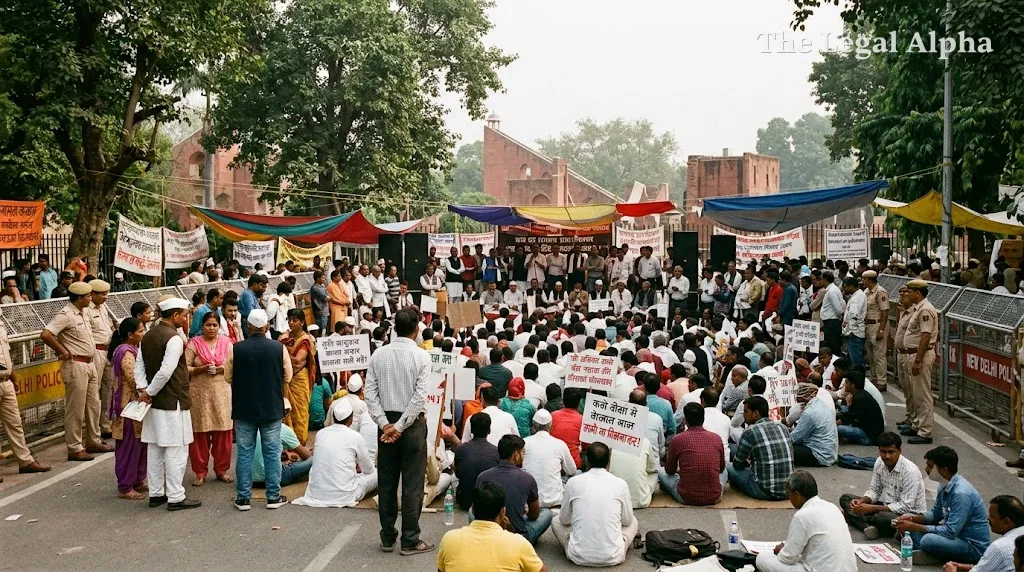
Petitioners (Opposition Leaders): The petitioners contended that the ongoing Special Intensive Revision has resulted in large-scale, arbitrary voter roll expulsions affecting young voters and marginalized groups without due notice or hearing. They submitted that the decision-making process of the Election Commission, including alterations in Form 6 and the technical functioning of portals like ERONET, bypassed statutory requirements. They requested court directives for the production of internal Commission minutes and an independent technical audit of the databases.
Respondents (Election Commission of India): Because the petition remains pending at the scrutiny stage before the registry and has not yet been taken up for an admission hearing, formal counter-affidavits have not been submitted. The Commission maintains administratively that the SIR exercise is a routine statutory revision aimed at cleaning duplicate entries and updating accurate rolls in accordance with election law guidelines.
Why Does It Matter?
The procedural delay illustrates how strictly the Supreme Court Registry enforces filing standards regardless of the political profile of the litigants or the public attention on the dispute. In high-stakes public interest litigation, incomplete paper books, uncertified translations, and fee mismatches routinely delay urgent interim hearings.
Substantively, once the defects are cured and the petition is taken up alongside connected matters, the case will address key legal questions about democratic safeguards: how far court oversight can review the Commission's automated roll-cleansing tools, and whether summary voter roll deletions without individual hearing notices violate the guarantee of natural justice.
Legal Takeaway
Registry objections over defective filings do not reflect the judicial merits of a constitutional challenge. Every petition under Article 32 must strictly comply with documentation and procedural requirements under the Supreme Court Rules before substantive legal remedies can be examined by the bench.
Sources
Primary Source:
-
Supreme Court of India Filing & Defect Scrutiny Log / Diary Proceedings (Rahul Gandhi & Ors. v. Election Commission of India & Ors.)
Additional Sources:
-
Press Trust of India / National Court Reporting Records
-
Constitution of India (Articles 32 and 324)
-
Supreme Court Rules, 2013