Supreme Court Clarifies Stance on Voter Form 6 Modifications, Schedules Full Hearing for Late October
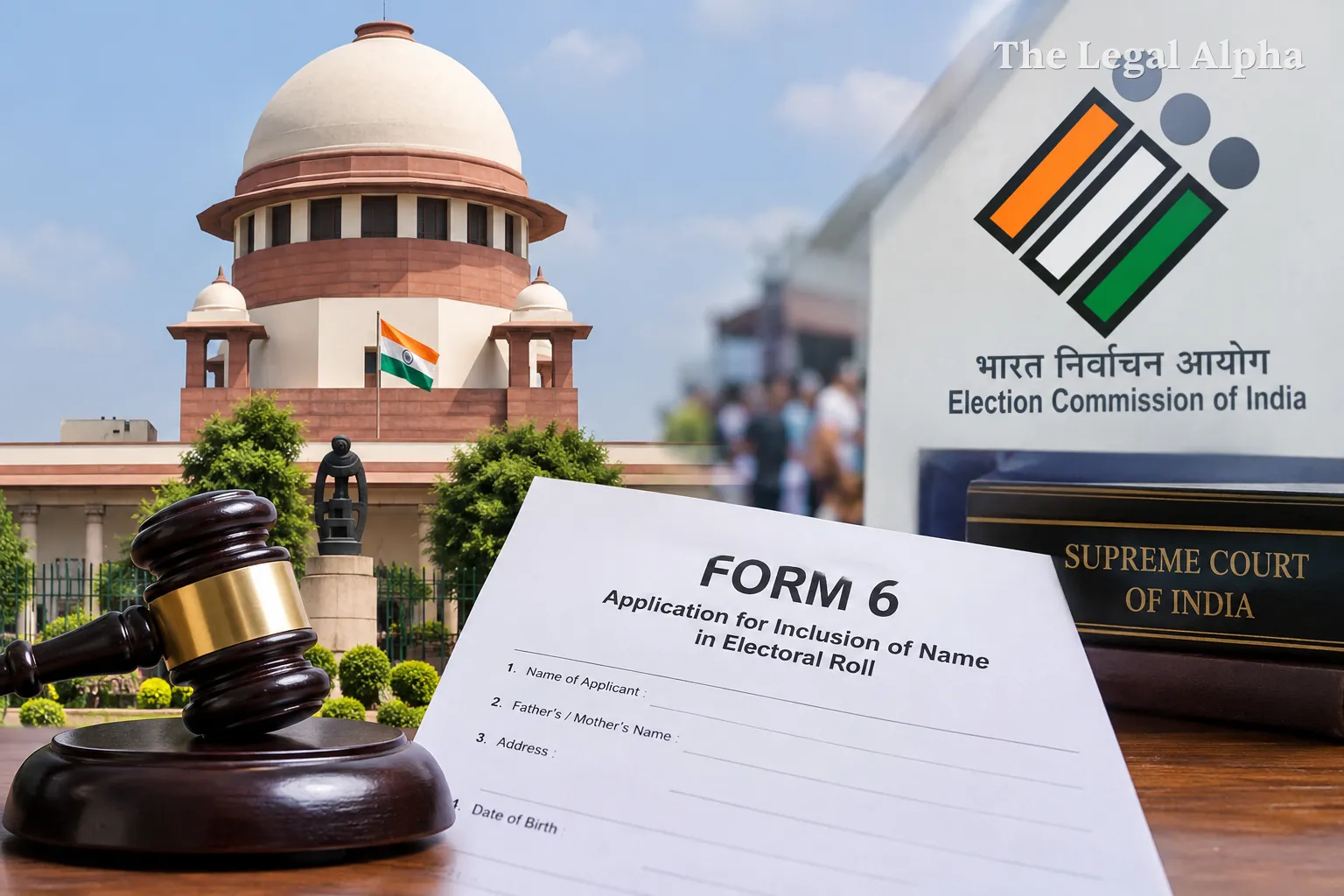
The Supreme Court of India cautioned litigants against projecting judicial observations as formal rulings, explicitly stating that it has neither endorsed nor disapproved alterations made by the Election Commission of India (ECI) to voter registration Form 6.
A three-judge bench led by Chief Justice of India Surya Kant, alongside Justices Joymalya Bagchi and V. Mohana, addressed counsel during the hearing of a fresh writ petition challenging unilateral changes introduced in the portal-based registration process. The bench made it clear that preliminary remarks made during previous proceedings regarding the Special Intensive Revision (SIR) in Bihar did not amount to constitutional adjudication.
The court has tagged the challenge alongside related petitions concerning the revision of electoral rolls and the wider regulatory conduct of the Election Commission, scheduling the matter for a detailed hearing on October 27.
Legal Topic
Area of Law: Election Law / Constitutional Law
Sub-topic: Electoral Rolls / Subordinate Legislation & Form Verification
Core Legal Issue
The legal dispute centres on whether the Election Commission possesses the administrative power to introduce mandatory declarations or alter statutory application forms prescribed under subordinate legislation without formal statutory amendment.
Specifically, the petition questions whether incorporating extra eligibility and parent-verification declarations into the online Form 6 on portals like ECINet/ERONet creates extra-statutory barriers for citizens seeking inclusion in electoral rolls.
What Did the Court Decide?
The Supreme Court declined to treat prior judicial queries as an authoritative stamp of approval or disapproval on the revised voter registration form. The court clarified that when it previously dealt with the Bihar SIR, the modified form was not part of the adjudication record.
The bench decided to examine the merits of the challenge rather than dismissing it out of hand, formally listing the plea alongside other pending challenges related to the SIR process for October 27. The question of the validity of the additional declarations remains undecided and pending.
Key Legal Points
-
Bench Observations vs Constitutional Adjudication: Casual remarks and preliminary inquiries by judges during oral arguments do not constitute formal adjudication or judicial precedent.
-
Statutory Rigidity of Prescribed Forms: Forms enacted under legislative rules retain distinct statutory standing, and whether executive portals can append substantive conditions to them requires judicial scrutiny.
-
Preservation of the Sub Judice Question: The Supreme Court left the substantive legality of the modified online Form 6 open for argument on October 27, rejecting claims that it had previously validated the commission's modifications.
Relevant Law
-
The Representation of the People Act, 1950: Sections governing the preparation and revision of electoral rolls.
-
Registration of Electors Rules, 1960: Rule 13 and the statutory framework prescribing Form 6 for fresh entry into electoral rolls.
-
Article 324 of the Constitution of India: The plenary superintendence, direction, and control of elections vested in the Election Commission of India.
Arguments of the Parties
The Petitioner
The petitioner contended that the Election Commission altered the statutory format of Form 6 on its digital portals by embedding additional mandatory declarations—such as details concerning parental verification from prior revision exercises. It was argued that such administrative additions exceed regulatory authority and create unlawful hurdles for first-time applicants seeking inclusion on the voter rolls.
The Election Commission of India
The Commission maintained that the statutory template under the Registration of Electors Rules, 1960, remains untouched outside specific revision drives. The regulator asserted that the supplementary declaration acted merely as an addendum tailored strictly to the intensive revision exercise to maintain roll integrity, previously suggesting that the court’s broader review of the process had permitted such procedural measures.
Why Does It Matter?
This development draws a clear boundary between court commentary and binding judicial precedent. When administrative agencies or litigants cite bench observations to legitimize policy shifts, it risks undermining the rule of law.
Beyond the procedural clarification, the case bears significant consequences for universal adult suffrage. If statutory application forms can be altered by executive circular or portal updates to add verification requirements, it directly impacts the fundamental ease of enrolling as a voter across the country. The upcoming hearing on October 27 will test the exact limits of the Election Commission’s authority to adapt statutory enrollment forms under the umbrella of administrative efficiency.
Legal Takeaway
Oral remarks from the bench during hearings carry no precedential weight and cannot be cited as judicial sanction of executive policy. The legality of the Election Commission's alterations to online voter registration forms remains fully open and will be decided on statutory grounds on October 27.
Sources
Primary Source:
Supreme Court of India, Proceedings/Order dated October 12, 2026, Bench comprising CJI Surya Kant, Justice Joymalya Bagchi, and Justice V. Mohana.
Additional Sources:
-
Registration of Electors Rules, 1960 (Statutory Form 6 framework).
-
Official Record of Proceedings and Press Releases, Election Commission of India.