Supreme Court Curbs Pre-Emptive Detentions in Delhi Demonstrations, Reaffirming Due Process Safeguards
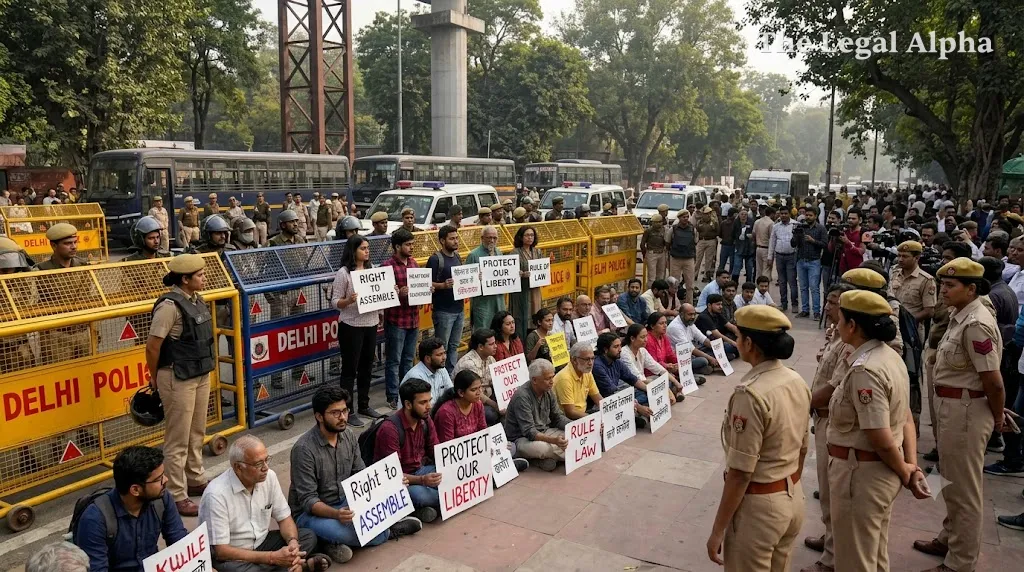
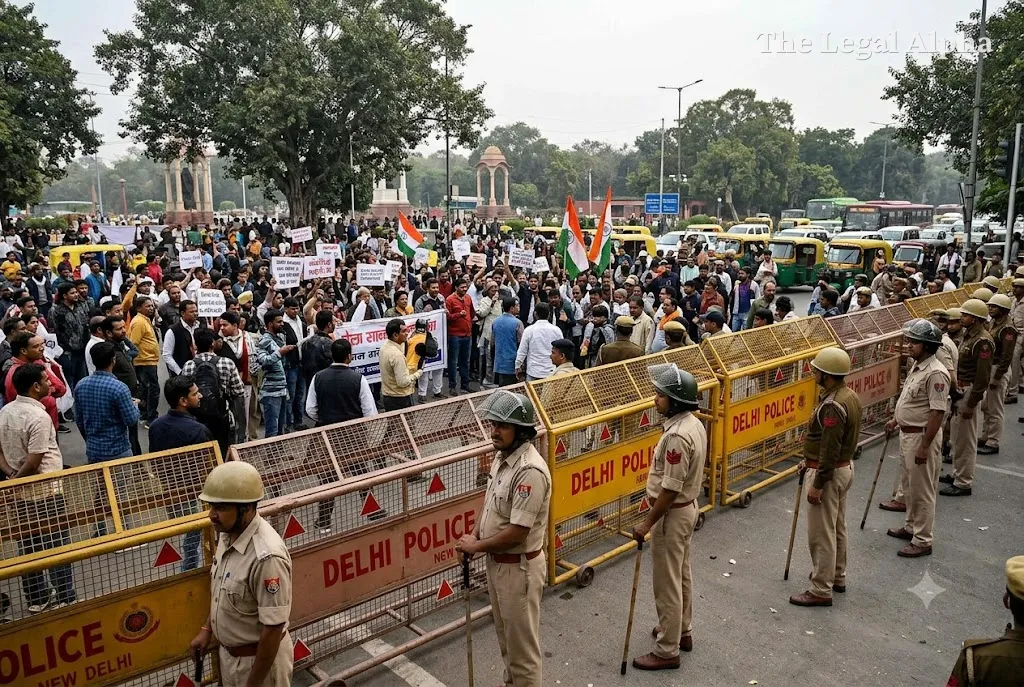
The Supreme Court of India intervened following widespread preventive detentions by the Delhi Police ahead of a planned demonstration at Jantar Mantar. Organisers and participants arriving in the capital to stage a demonstration concerning Chief Election Commissioner Gyanesh Kumar faced large-scale detentions, barricading, transit disruptions, and internet restrictions before the protest could commence.
Hearing urgent petitions against the administrative clampdown, a special bench directed law enforcement authorities that peaceful, unarmed demonstrators cannot be detained except strictly in accordance with procedure established by law. The intervention placed administrative crowd-control measures under immediate judicial scrutiny, restoring transit access and clarifying limits on preventive police custody.
Legal Topic
-
Area of Law: Constitutional Law / Criminal Procedure
-
Sub-topic: Preventive Detention, Personal Liberty, and the Right to Peaceful Assembly
Core Legal Issue
The controversy centres on whether police authorities can invoke broad public order powers to detain individuals pre-emptively solely to avert an unpermitted demonstration, or if such restraint violates constitutional guarantees.
The primary legal question is whether preventive arrest under procedural criminal law can be used as a blanket administrative tool against peaceful, unarmed citizens, bypassing statutory thresholds and the constitutional protections guaranteed under Articles 19(1)(b) and 21 of the Constitution of India.
What Did the Court Decide?
A special vacation bench comprising Justice Joymalya Bagchi and Justice V. Mohana ruled that peaceful and unarmed demonstrators cannot be subjected to detention outside the strict parameters of the procedure established by law.
The bench issued interim directions requiring metro and railway operations to run without arbitrary halts, internet connectivity to remain undisturbed according to statutory frameworks, and public movement to remain unhindered. While the court did not make a final determination on the overarching legality of every specific detention or associated contempt pleas, it imposed immediate curbs on preemptive executive action while keeping the substantive petitions pending for further examination.
Key Legal Points
-
Due Process Pre-condition: Preventive apprehension cannot be used as an administrative shortcut; personal liberty under Article 21 can only be curtailed by following precise statutory procedures.
-
Threshold for Preventive Custody: The power of preventive arrest requires a genuine, demonstrable apprehension that a cognizable offence cannot otherwise be prevented, rather than serving as routine crowd suppression.
-
Proportionality in Public Order: Imposing blanket transit shutdowns, communications blockades, and mass detentions against peaceful assemblies fails the test of proportionality.
-
Mandatory Safeguards: Anyone taken into custody under preventive provisions must be produced before a competent magistrate within statutory timeframes and cannot be detained indefinitely.
Relevant Law
-
Constitution of India: Article 19(1)(a) (freedom of speech), Article 19(1)(b) (right to assemble peaceably without arms), and Article 21 (protection of life and personal liberty).
-
Bharatiya Nagarik Suraksha Sanhita, 2023 (BNSS):
-
Section 170 (formerly Section 151, CrPC): Arrest to prevent the commission of cognizable offences.
-
Section 126 & Section 127 (formerly Section 107, CrPC): Security proceedings for keeping the peace.
-
Section 58: Requirement that detained persons not be held beyond 24 hours without magisterial sanction.
-
Section 163 (formerly Section 144, CrPC): Power to issue urgent orders in cases of nuisance or apprehended danger.
-
-
Judicial Precedent: Ramlila Maidan Incident v. Home Secretary, Union of India (2012), establishing that the right to assemble peacefully cannot be extinguished by arbitrary executive action.
Arguments of the Parties
Petitioners / Detained Demonstrators Counsel for the petitioners argued that the police action amounted to arbitrary mass preventive detention aimed at stifling peaceful democratic dissent. They submitted that peaceful protesters travelling to assembly sites were rounded up without having committed or threatened any cognizable offence. It was contended that deploying blanket prohibitory orders and snapping transit infrastructure fundamentally breached the core freedoms guaranteed under Articles 19 and 21.
Respondent / Law Enforcement Authorities The State maintained that preventive measures were strictly taken to safeguard public order and avoid vehicular gridlock in central government zones. Authorities submitted that the organisers lacked valid permits and that prohibitory orders under Section 163 of the BNSS were already operative in the area. It was contended that the police acted within their statutory remit under Section 170 of the BNSS to forestall potential breaches of the peace and protect critical infrastructure.
Why Does It Matter?
The development sets a significant benchmark for how law enforcement can exercise preventive powers under the newly enacted Bharatiya Nagarik Suraksha Sanhita. By holding that the denial of assembly permission does not automatically authorise indefinite or pre-emptive custodial restraint, the ruling restricts the misuse of Section 170 as a default mechanism for handling public protests.
The decision serves as an important precedent for civil liberties across India. It confirms that while the State possesses regulatory power over the time, place, and manner of demonstrations, executive convenience cannot override constitutional due process.
Legal Takeaway
Preventive arrest cannot be deployed as an automatic preemptive tool merely because an assembly lacks police permission. Law enforcement agencies must demonstrate an imminent risk of a cognizable offence and strictly follow magisterial oversight rules before curtailing personal liberty.
Sources
-
Primary Source: Supreme Court of India, Interim Order in the Writ Petitions concerning Delhi Protest Detentions (Bench of Justice Joymalya Bagchi and Justice V. Mohana, October 2026).
-
Additional Sources: Bharatiya Nagarik Suraksha Sanhita, 2023 (Sections 58, 126, 163, and 170); Constitution of India (Articles 19 and 21).