Karnataka High Court Strikes Down Law Expanding SC and ST Quotas Beyond 50% Limit
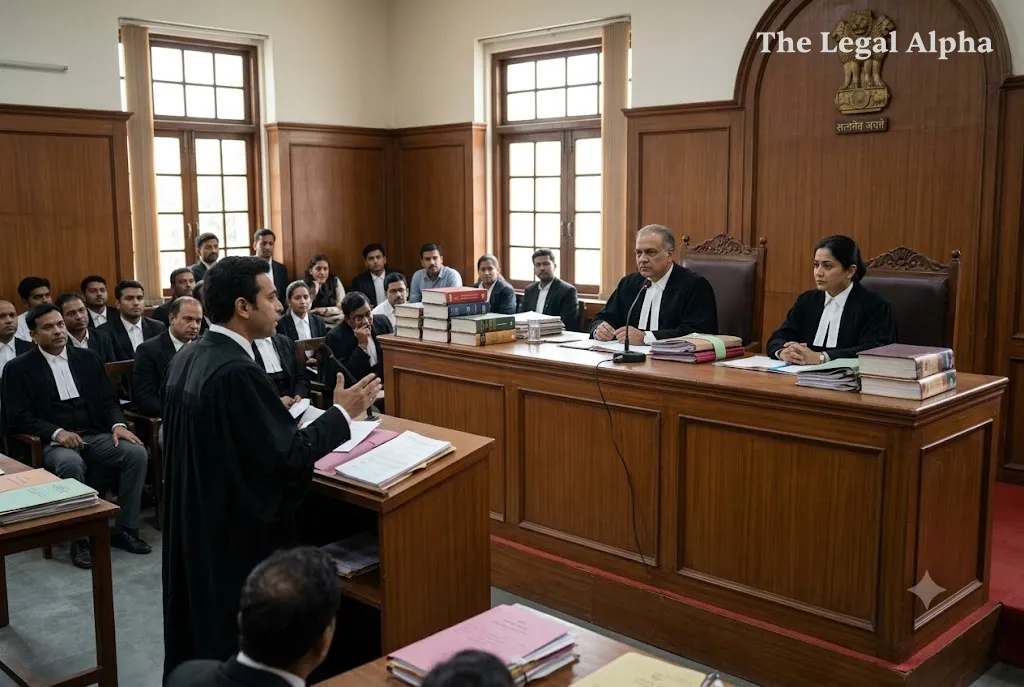
The High Court of Karnataka declared key provisions of a 2022 state enactment unconstitutional, invalidating an increase in reservations for Scheduled Castes (SC) and Scheduled Tribes (ST) that pushed the state’s total quota ceiling to 56%.
A Division Bench comprising Chief Justice Vibhu Bakhru and Justice K.S. Hemalekha ruled on a batch of petitions challenging Sections 3 and 4 of the Karnataka Scheduled Castes and Scheduled Tribes (Reservation of Seats in Educational Institutions and of Appointments or Posts in the Services under the State) Act, 2022. The bench held that breaching the 50% ceiling established under binding Supreme Court precedent without establishing extraordinary circumstances was constitutionally impermissible.
Legal Topic
Area of Law: Constitutional Law
Sub-topic: Affirmative Action / Public Employment & Educational Admissions
Core Legal Issue
The core question before the High Court was whether a state legislature can breach the judicial 50% reservation ceiling solely based on demographic expansion and historical under-representation of marginalized communities.
Specifically, the court examined whether data demonstrating that backward communities constitute a majority of the state’s population satisfies the constitutional threshold of "extraordinary circumstances" required to depart from the equality principles set out under Articles 14, 15, and 16 of the Constitution.
What Did the Court Decide?
The Division Bench struck down Sections 3 and 4 of the 2022 Act as ultra vires the Constitution.
-
Quota Increase Invalidated: The provisions had raised SC reservations from 15% to 17% and ST reservations from 3% to 7% in educational admissions and state public employment, taking aggregate quotas from 50% to 56%.
-
No Blanket Demographic Exception: The court ruled that numerical dominance of marginalized groups cannot override the 50% ceiling, noting that accepting population share as a sole ground to exceed limits would erode the foundational right to equality.
-
Procedural Lapses Noted: The bench observed that the state enacted the legislation without mandatory consultations with the National Commission for Scheduled Castes and the National Commission for Scheduled Tribes.
The decision effectively restores the state’s reservations to the baseline 50% ceiling, leaving open an anticipated appeal by the State government before the Supreme Court of India.
Key Legal Points
-
Adequate vs. Proportionate Representation: The Constitution mandates adequate representation under Article 16(4), not strict proportionate representation matching census figures.
-
Strict Application of the 50% Ceiling: The 50% cap formulated in Indra Sawhney circumscribes the state's affirmative action powers, and general data demonstrating under-representation does not automatically establish extraordinary grounds to exceed it.
-
Separation of Quota Pools: The bench clarified that the Economically Weaker Sections (EWS) quota operates out of the general merit pool and does not grant states a license to expand caste-based quotas beyond the judicial ceiling.
-
Institutional Consultation: Bypassing statutory consultations with national commissions for SCs and STs constitutes a significant procedural defect when legislating on community entitlements.
Relevant Law
-
The Constitution of India: Article 14 (Equality before Law), Article 15 (Prohibition of Discrimination), Article 16 (Equality of Opportunity in Public Employment), and Articles 338/338A (National Commissions for SCs and STs).
-
State Legislation: Sections 3 and 4 of the Karnataka Scheduled Castes and Scheduled Tribes (Reservation of Seats in Educational Institutions and of Appointments or Posts in the Services under the State) Act, 2022.
-
Judicial Precedents: Indra Sawhney v. Union of India (1992) (nine-judge bench establishing the 50% ceiling rule) and M.R. Balaji v. State of Mysore (1963).
Arguments of the Parties
Petitioners
The petitioners—including civil engineering job aspirants and civic organizations—argued that expanding aggregate reservation to 56% directly infringed their fundamental rights under Articles 14 and 16. They contended that the state legislature acted beyond its competence by overriding the settled nine-judge bench ceiling in Indra Sawhney, thereby shrinking the open-competition pool arbitrarily.
Respondent (State of Karnataka)
The State defended the law by relying on empirical data from the Justice H.N. Nagamohan Das Commission and subsequent committees. The State contended that the demographic expansion of SC and ST communities over several decades warranted an adjustment in representation, arguing that the 50% ceiling should not act as an unbending barrier when addressing entrenched backwardness and historical marginalization.
Why Does It Matter?
This verdict reaffirms the constitutional boundary separating targeted affirmative action from open merit. For state governments across India, it reiterates that demographic surveys and committee recommendations showing under-representation are not sufficient by themselves to breach the 50% quota ceiling.
On an administrative level, the ruling directly impacts pending recruitment drives—such as those within the Bruhat Bengaluru Mahanagara Palike (BBMP)—and higher education seat matrix allocations in Karnataka, requiring authorities to realign seat matrices back to previous quotas.
Legal Takeaway
A state cannot cite population figures or general under-representation to bypass the 50% reservation ceiling. Affirmative action guarantees adequate representation rather than proportionate quotas, and the equality code under Articles 14 and 16 continues to cap total reservations unless truly extraordinary circumstances are proved.
Sources
Primary Source:
Judgment of the High Court of Karnataka in the batch petitions concerning the Karnataka Scheduled Castes and Scheduled Tribes (Reservation of Seats in Educational Institutions and of Appointments or Posts in the Services under the State) Act, 2022 (Division Bench of Chief Justice Vibhu Bakhru and Justice K.S. Hemalekha, October 12, 2026).
Additional Sources:
News on AIR official broadcast report; High Court reporting via The Hindu and Bar and Bench.