Supreme Court Pauses Bhopal Trial in Twisha Sharma Death Case, Considers Transfer to Delhi
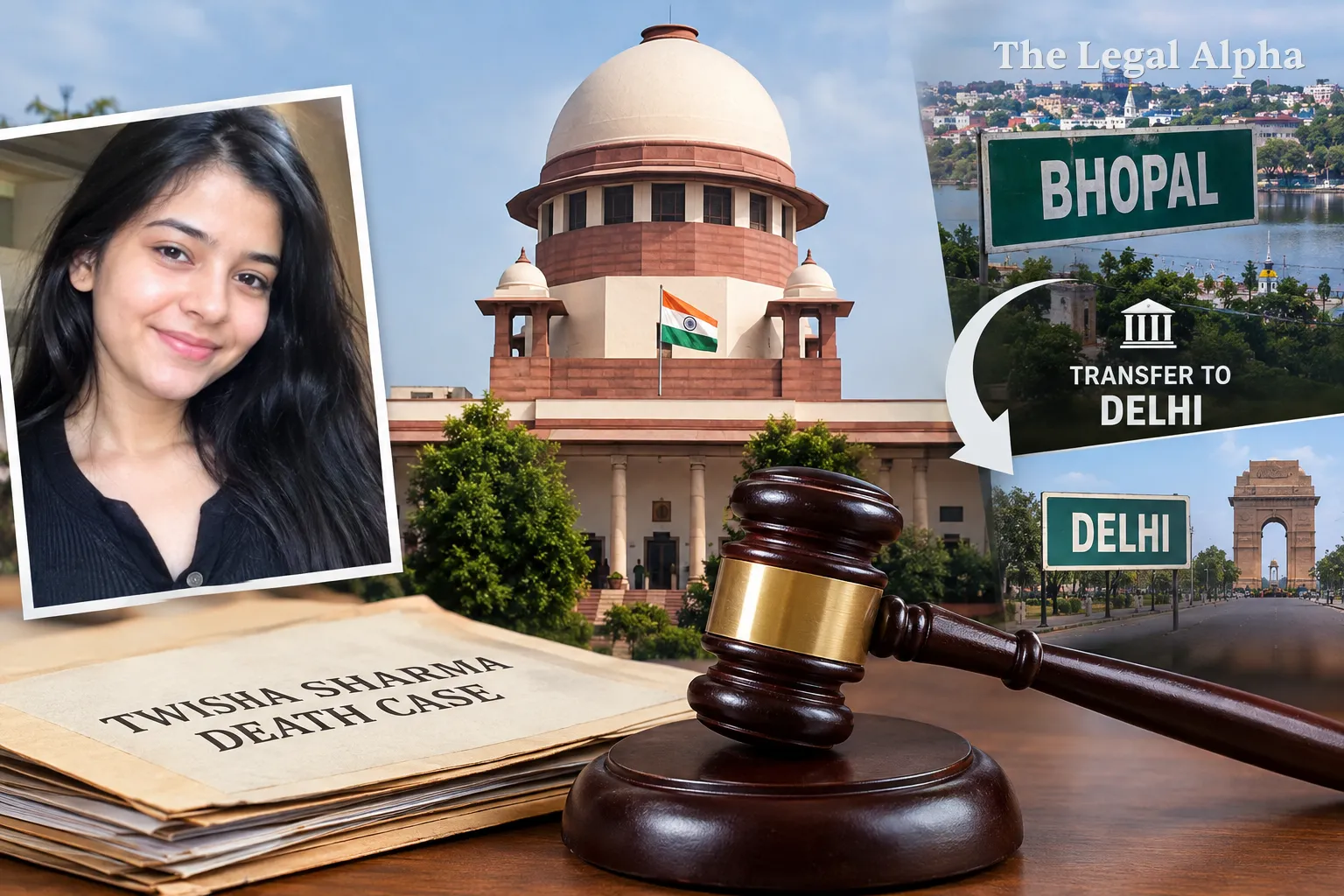
The Supreme Court of India intervened in the ongoing proceedings concerning the death of Twisha Sharma, ordering an interim stay on the trial currently pending before a Bhopal sessions court. The order came in response to a transfer petition moved by the victim’s father, Navnidhi Sharma, who sought to shift the entire criminal trial from Madhya Pradesh to Delhi.
Twisha Sharma, a 33-year-old resident of Noida, was found dead at her matrimonial residence in Bhopal on May 12, 2026, approximately five months after marrying Bhopal-based advocate Samarth Singh. Following allegations of persistent dowry harassment and cruelty, police registered a criminal case against her husband and her mother-in-law, Giribala Singh, a former judicial officer and former president of a District Consumer Forum.
Amid concerns over the impartiality of the initial local police investigation, the probe was previously transferred to the Central Bureau of Investigation (CBI). With the trial court in Bhopal moving toward the stage of framing charges, Sharma’s family approached the apex court, arguing that a fair trial remained compromised within the local jurisdiction.
Legal Topic
Area of Law: Criminal Law and Procedure
Sub-topic: Transfer of Criminal Cases / Fair Trial Jurisprudence
Core Legal Issue
The legal question before the Supreme Court is whether a criminal trial can be transferred across state jurisdictions under Section 406 of the Code of Criminal Procedure, 1973 (and its corresponding Section 447 of the Bharatiya Nagarik Suraksha Sanhita, 2023) on the basis of a reasonable apprehension of bias and local administrative influence.
The Court must determine whether the professional and institutional standing of an accused person in the local jurisdiction creates conditions that prejudice the victim's family's fundamental guarantee to an impartial, fair, and transparent trial.
What Did the Court Decide?
A Bench comprising Chief Justice of India Surya Kant and Justice Joymalya Bagchi stayed further trial proceedings on the merits before the Bhopal Sessions Court until further orders.
The Bench issued formal notice to the CBI and the two accused persons—Samarth Singh and Giribala Singh—on the transfer petition.
While placing the main trial on hold, the Court clarified that the stay does not prevent the consideration of personal liberty, directing that the pending bail applications of the two accused persons be adjudicated within two weeks.
Key Legal Points
-
Preservation of the Res: The apex court halted substantive trial proceedings at the stage of charge framing to prevent irreversible procedural steps from taking place while the forum's jurisdiction is under review.
-
Balance Between Fair Trial and Personal Liberty: While trial proceedings on merits are stayed, the Court expressly separated the adjudicatory pause from personal liberty by ordering expeditious disposal of pending bail applications within two weeks.
-
Apprehension of Bias as a Ground for Transfer: The invocation of Supreme Court transfer powers reflects the established doctrine that justice must not only be done, but must manifestly and undoubtedly be seen to be done, especially when local institutional influence is alleged.
-
Scope of CBI-Prosecuted Cases: Even where the investigating agency is a central body (the CBI), questions of local judicial forum neutrality remain independent grounds for seeking interstate transfer.
Relevant Law
-
Section 406 of the Code of Criminal Procedure, 1973 / Section 447 of the Bharatiya Nagarik Suraksha Sanhita, 2023: Confers exclusive authority on the Supreme Court to transfer criminal cases and appeals from one High Court or subordinate criminal court to another across state boundaries whenever expedient for the ends of justice.
-
Sections 80, 85, and 108 of the Bharatiya Nyaya Sanhita, 2023: Substantive criminal provisions dealing with dowry death, cruelty by husband or relatives, and abetment of suicide.
-
Dowry Prohibition Act, 1961: Statutory provisions penalizing the demand and receipt of dowry.
-
Article 21 of the Constitution of India: The fundamental right to life and personal liberty, which encompasses the right to a free, fair, and speedy trial for victims and accused alike.
Arguments of the Parties
Petitioner
Counsel appearing for the victim’s father submitted that the trial could not proceed fairly or impartially in Madhya Pradesh. It was argued that the accused family commands significant local clout—the mother-in-law being a former consumer forum president and retired judicial officer, and the husband being a practicing advocate in the local courts. The petitioner expressed genuine apprehension that such stature could exert subtle pressure on witnesses and administrative processes, necessitating a transfer to Delhi in the interest of justice.
Respondents / Accused
Counsel representing the accused resisted the transfer plea, contending that the matter is already being prosecuted by an independent central agency, the CBI, eliminating any basis for claims of state-level bias. It was urged that transferring trial proceedings across state lines causes undue prejudice, increases procedural hardship, and disrupts the statutory forum established where the alleged cause of action arose.
Why Does It Matter?
Interstate transfer of criminal trials by the Supreme Court is an extraordinary equitable remedy used sparingly. The Court typically requires demonstrable, objective grounds indicating that the trial atmosphere is poisoned or that one party's influence makes a fair trial improbable.
This case highlights how courts assess perceived institutional influence when lawyers or former judicial figures face serious criminal charges in their home districts. By staying the trial while directing prompt disposal of bail applications, the Court struck a measured balance: safeguarding the integrity of the forum without curtailing the statutory right of the accused to seek liberty.
Legal Takeaway
A reasonable apprehension of institutional or regional bias remains a valid ground for the Supreme Court to stay criminal proceedings and consider shifting a trial outside the home state. However, procedural stays on a trial’s merits do not freeze an accused person’s entitlement to have their bail applications evaluated on schedule.
Sources
Primary Source:
Supreme Court of India, Navnidhi Sharma v. Central Bureau of Investigation & Ors. (Transfer Petition (Criminal)), Order dated October 16, 2026 (Coram: Surya Kant, CJI, and Joymalya Bagchi, J.).
Additional Sources:
-
Central Bureau of Investigation proceedings records.
-
High Court of Madhya Pradesh Bail & Miscellaneous Criminal Petitions records in Crime registered under Katara Hills PS, Bhopal.