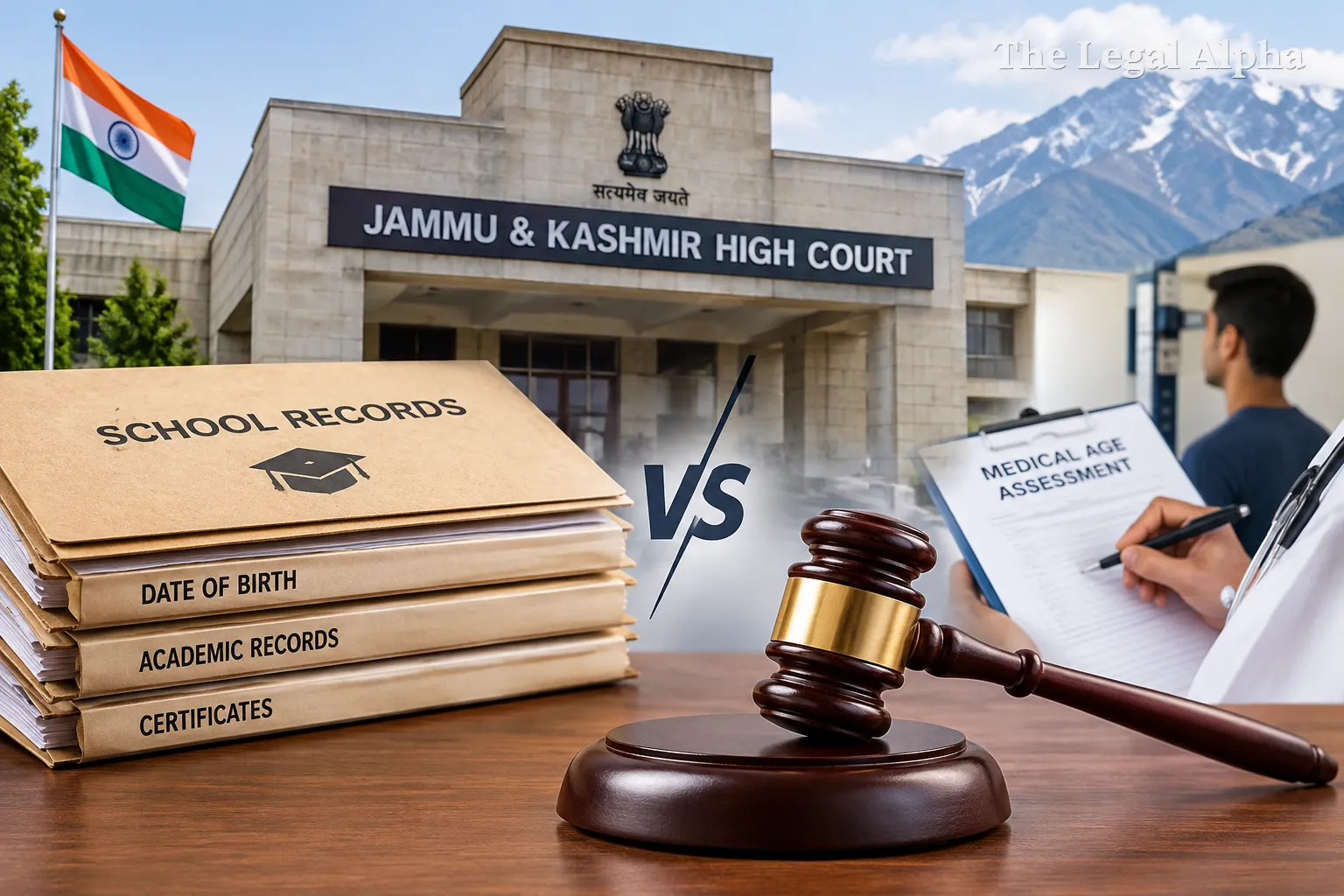
Official School Records Prevail Over Medical Age Assessment in Public Recruitment, Rules Jammu and Kashmir High Court
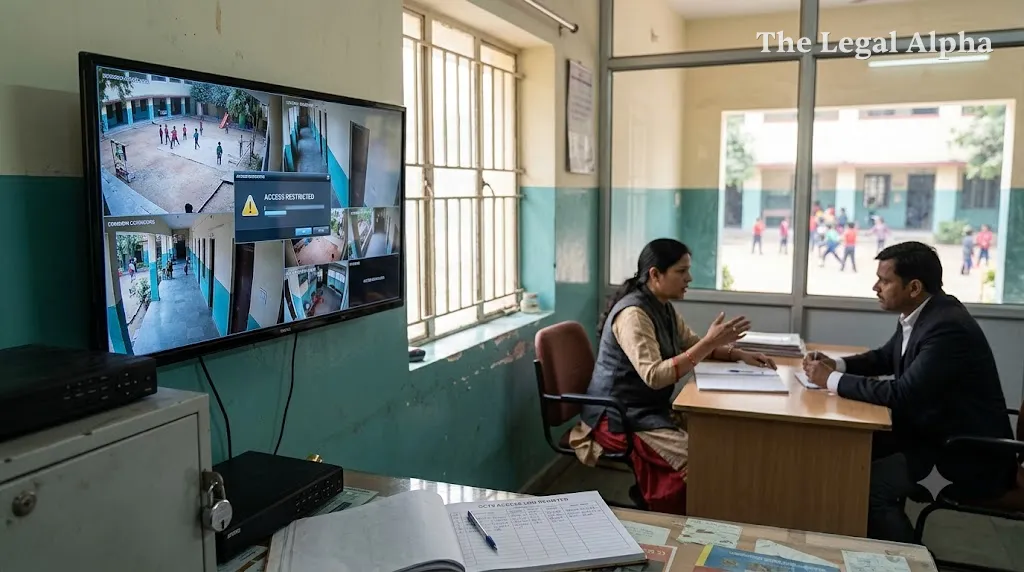
The High Court of Jammu & Kashmir and Ladakh has upheld the cancellation of a woman’s provisional selection for the post of aaya/helper at a government primary school in Baramulla district.
The petitioner was initially placed on a tentative selection list following a recruitment drive initiated in January 2023. However, following objections from competing applicants, selection authorities discovered that her official school discharge certificate placed her age below the mandatory threshold of 18 years as of the cut-off date of January 1, 2023. While the candidate produced a medical certificate estimating her age at 23 years, the authorities cancelled her provisional selection via a corrigendum and appointed another candidate. Justice Rajnesh Oswal dismissed her writ petition, holding that medical estimations cannot supersede official academic records.
Legal Topic
Area of Law: Service Law / Public Employment
Sub-topic: Eligibility Criteria / Proof of Date of Birth
Core Legal Issue
The petition turned on an evidentiary conflict in recruitment eligibility: whether an administrative selection committee must accept an estimated medical age certificate over contrary contemporaneous school records when assessing whether a candidate meets the minimum statutory age requirement.
The court had to resolve whether an applicant could dislodge the date of birth entered in school records through a secondary clinical opinion to sustain public appointment eligibility.
What Did the Court / Authority Decide?
Justice Rajnesh Oswal upheld the administration's decision, declaring that official school discharge certificates carry greater probative weight than medical age estimations.
The High Court dismissed the woman's challenge against the cancellation order and the appointment of the rival candidate. The court observed that whenever formal, authentic academic documents evidencing date of birth exist, authorities cannot substitute them with medical opinions. Furthermore, because the petitioner was disqualified on basic age eligibility, the court refused to entertain her collateral arguments regarding household income advantages.
Key Legal Points
-
Primacy of School Records: Where school records or school discharge certificates are available, medical age assessments cannot be invoked to establish a candidate's age for public employment.
-
Nature of Medical Age Evidence: Clinical ossification tests and medical age estimations offer approximations rather than exact dates of birth, making them secondary to official contemporaneous records.
-
Threshold Eligibility Before Merits: Preference factors such as lower family income only apply among candidates who independently fulfill the mandatory minimum age requirements.
-
Provisional Selection Creates No Vested Right: Inclusion in a tentative select list is subject to document scrutiny and objection resolution, giving authorities the right to issue corrigenda if ineligibility is identified.
Relevant Law
-
Article 226 of the Constitution of India: Writ jurisdiction invoked to challenge administrative cancellation orders.
-
Recruitment Guidelines for School Aayas/Helpers (2023): Prescribing a minimum eligibility age of 18 years as of January 1, 2023, along with economic criteria for preference.
-
Indian Evidence Act, 1872 (Section 35): Admissibility and evidentiary value of entries made in public or official registers, such as school admission registers.
Arguments of the Parties
Petitioner / Applicant
The petitioner argued that she was a major eligible for appointment, relying on a medical certificate that placed her age at 23 years. She also contended that she had a preferential right to the post under the recruitment guidelines because her verified annual income was ₹50,400, which was significantly lower than the selected candidate's annual income of ₹74,000.
Respondent / State
The State and recruitment authorities contended that the minimum qualifying age of 18 years was mandatory as of the cut-off date. They submitted that upon scrutiny of the petitioner’s school discharge certificate, she was demonstrably a minor on January 1, 2023. Consequently, the provisional selection was vitiated by lack of basic eligibility, rendering income comparisons irrelevant.
Why Does It Matter?
This ruling reinforces standard evidentiary hierarchies across public sector recruitment drives. Candidates frequently seek to use supplementary medical opinions or late ossification assessments to reconcile cut-off age shortfalls. The decision confirms that appointing bodies are legally sound in treating formal academic registers as conclusive on age verification, ensuring consistency and preventing arbitrary discretion by selection boards.
Legal Takeaway
When verifying candidate eligibility in government recruitment, formal school records and academic registers take precedence over clinical medical opinions. A medical age assessment cannot override contemporaneous educational records to cure a candidate’s failure to meet minimum statutory age requirements.
Sources
-
Primary Source: High Court of Jammu & Kashmir and Ladakh (Single Bench: Justice Rajnesh Oswal), Judgment dated October 12, 2026.
-
Additional Sources: Directorate of School Education Jammu & Kashmir Recruitment Guidelines (2023); Indian Express Legal News Report.