Prohibitory Orders Under Section 163 BNSS Invoked to Bar Connaught Place March
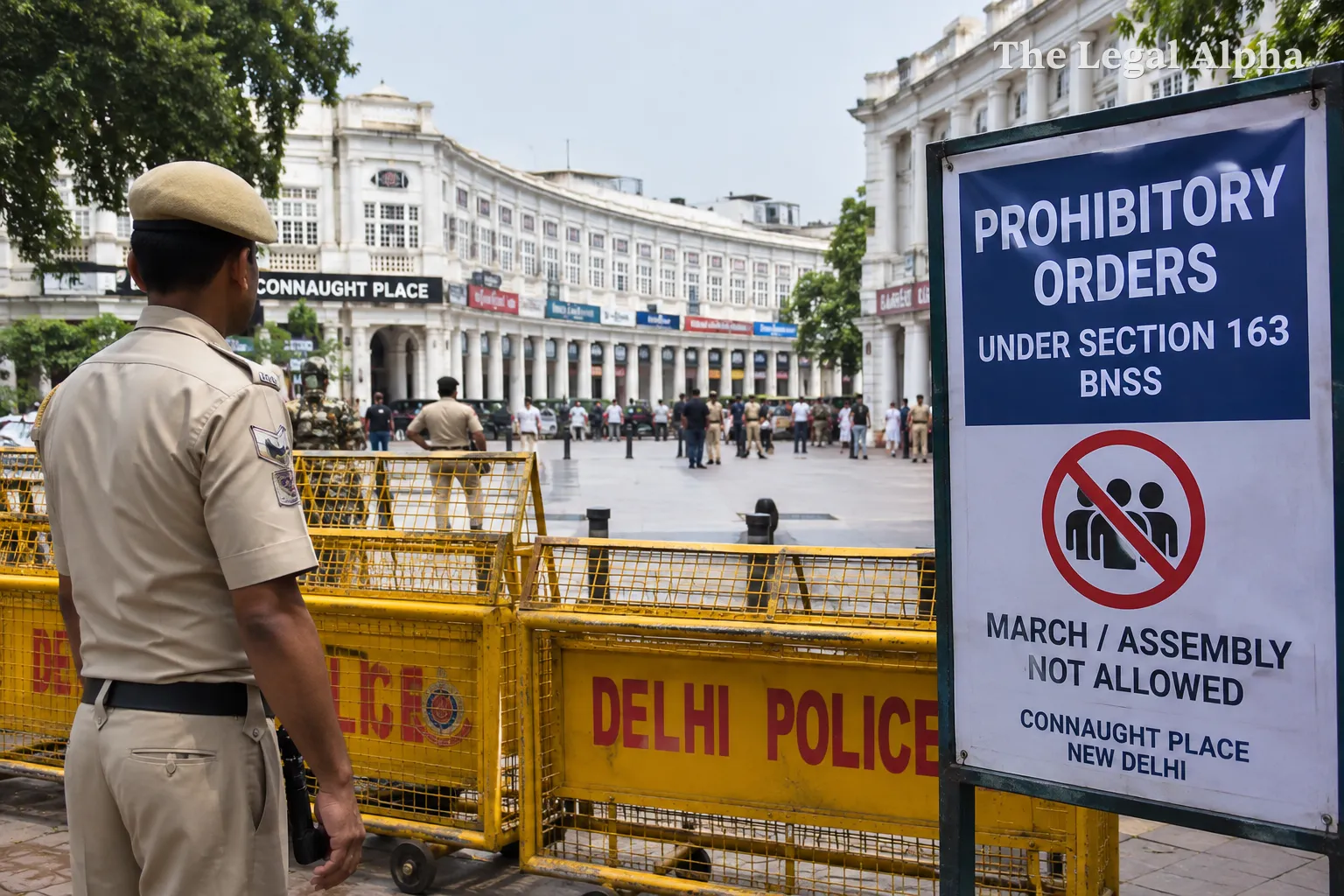
Delhi Police served a formal preventive notice on Cockroach Janta Party (CJP) founder Abhijeet Dipke at his Delhi residence, prohibiting him and his organisation from staging a planned "Lehra Do Tiranga" demonstration at Connaught Place.
The intervention follows escalating tensions in the national capital concerning protests directed at the Election Commission of India and the recent de-notification of Jantar Mantar as a designated protest zone. CJP had called for a public gathering and flag march at Central Park in Connaught Place. In response, the New Delhi Municipal Council (NDMC) shuttered Central Park for administrative reasons, and law enforcement declared that the commercial hub cannot be utilised as an assembly or protest venue.
Legal Topic
Area of Law: Constitutional and Criminal Procedural Law
Sub-topic: Preventive Orders, Public Order, and the Right to Peaceful Assembly
Core Legal Issue
The core issue centres on the scope of the State's executive power under preventive criminal provisions—specifically Section 163 of the Bharatiya Nagarik Suraksha Sanhita, 2023 (BNSS)—to preemptively restrict public gatherings in unnotified public spaces.
At stake is the constitutional friction between the fundamental rights to free expression and peaceful assembly without arms under Article 19(1)(a) and 19(1)(b) of the Constitution of India, and the authority of the police to enforce reasonable time, place, and manner restrictions to maintain public order and safeguard the rights of local residents and commercial establishments.
What Did the Authority Decide?
Delhi Police issued an official notice barring the proposed demonstration and warning that any gathering at Connaught Place would constitute an unlawful assembly under operative prohibitory orders.
The police highlighted that Connaught Place and its surrounding commercial corridors are not designated protest venues. The notice cautioned that while displaying the national flag is permissible within the framework of the Flag Code of India, holding an unsanctioned assembly in violation of Section 163 of the BNSS exposes participants to immediate detention, dispersal, and criminal prosecution. Concurrently, administrative authorities shut down access to Central Park to pre-empt large-scale congregation.
Key Legal Points
-
Operation of Section 163 BNSS: Prohibitory orders under Section 163 of the BNSS (the procedural successor to Section 144 of the Code of Criminal Procedure) empower executive authorities to issue urgent directions to prevent public disorder, nuisance, or obstruction to the general public.
-
Regulation of Protest Spaces: The State retains the regulatory authority to designate specific venues for assemblies; the constitutional right to protest does not extend to an unfettered entitlement to occupy any public thoroughfare or commercial market at will.
-
Pre-emptive Notice vs Detention: Service of an executive notice creates a formal evidentiary record of warning, placing organisers on express notice of potential criminal liability before coercive arrest powers are deployed.
-
Flag Code Compliance: Symbolic acts involving the national flag remain subject to both the Prevention of Insults to National Honour Act, 1971, and broader public assembly restrictions.
Relevant Law
-
Section 163, Bharatiya Nagarik Suraksha Sanhita, 2023 (BNSS): Power to issue orders in urgent cases of nuisance or apprehended danger (formerly Section 144 CrPC).
-
Article 19(1)(a) and 19(1)(b), Constitution of India: Fundamental rights to freedom of speech and expression, and to assemble peaceably and without arms.
-
Article 19(2) and 19(3), Constitution of India: Grounds for reasonable restrictions, including public order, sovereignty, and integrity of India.
-
Flag Code of India, 2002 & Prevention of Insults to National Honour Act, 1971: Statutory framework governing the dignity and exhibition of the national tricolour.
-
Judicial Precedents: Himat Lal K. Shah v. Commissioner of Police, Ahmedabad (regulating public assemblies) and Anita Thakur v. Govt. of J&K (balancing the right to protest with administrative maintenance of order).
Arguments of the Parties
Organisers and Protesters The organisers contended that carrying the national flag and holding a peaceful demonstration is a legitimate exercise of fundamental democratic rights guaranteed under Articles 19(1)(a) and 19(1)(b). They argued that administrative measures should not be weaponised to stifle legitimate political dissent or dismantle democratic scrutiny of public institutions, noting that holding a national symbol peacefully violates no statutory prohibition.
Law Enforcement and State Authorities The Delhi Police maintained that commercial centres such as Connaught Place cannot accommodate mass demonstrations without disrupting pedestrian movement, commercial livelihoods, and civic tranquility. The administration asserted that assembling in areas where Section 163 BNSS orders are actively enforced constitutes a willful contravention of the law, necessitating regulatory intervention to preserve public order.
Why Does It Matter?
This development underscores the escalating friction between urban protest movements and the State's administrative demarcations of permitted public spaces. Following the de-notification of conventional demonstration sites such as Jantar Mantar, civic and political groups increasingly turn to central urban landmarks, prompting law enforcement to deploy preventive criminal statutes.
The confrontation illustrates how local administrative machinery balances freedom of political expression against commercial enterprise and municipal order. For legal observers and civil rights practitioners, it highlights the continuing judicial debate over whether shrinking designated protest zones effectively curtails the constitutional core of peaceful assembly.
Legal Takeaway
The right to assemble and display national symbols remains subject to procedural and venue-specific regulations lawfully enacted under Section 163 of the BNSS. Engaging in public demonstrations in non-notified, commercially sensitive zones under active prohibitory orders exposes organisers and participants to direct preventive action and criminal liability.
Sources
-
Primary Source: Delhi Police Preventive Regulatory Notice under Section 163, Bharatiya Nagarik Suraksha Sanhita, 2023 (Served October 16, 2026).
-
Additional Sources: New Delhi Municipal Council Administrative Directives regarding Central Park closure; Delhi Police Public Safety and Traffic Advisory for Connaught Place.