Supreme Court Issues Notice on Detention of Journalists During Delhi Protests as Centre Flags Difficulty in Distinguishing Independent Media from Social Media Creators
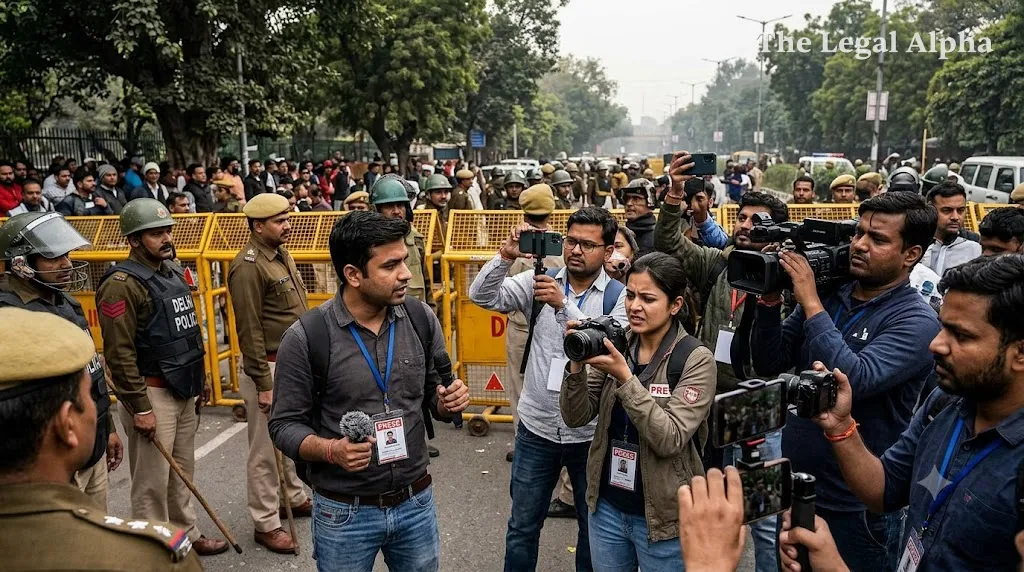
The Supreme Court of India stepped into the escalating controversy surrounding the mass detention, physical manhandling, and alleged harassment of journalists covering public demonstrations in New Delhi. A bench headed by Chief Justice of India Surya Kant issued formal notice to the Union government on a batch of petitions filed by the Delhi Union of Journalists (DUJ), media rights organisations, and affected reporters.
The petitions challenge police high-handedness during recent demonstrations in the capital, where reporters—including accredited press members, women journalists, and digital reporters—were forcibly bundled into police vehicles, obstructed from recording, and allegedly subjected to physical abuse and device seizures. During the hearing, Solicitor General Tushar Mehta resisted blanket relief, contending that law enforcement faces practical hurdles on the ground because individuals carrying handheld microphones and filming videos often identify as independent journalists while operating primarily as social media content creators.
Legal Topic
-
Area of Law: Constitutional Law / Criminal Procedure
-
Sub-topic: Freedom of the Press, Right to Report Public Assemblies, and Police Powers of Preventive Detention
Core Legal Issue
The proceedings require the court to address two intertwined constitutional questions: whether the fundamental guarantee of freedom of speech and expression extends institutional press protections to independent, freelance, and digital media practitioners, and to what extent law enforcement can restrict media coverage under the guise of preventive public-order measures.
The court must define where legitimate public-order policing ends and unconstitutional censorship begins, particularly when law enforcement detains individuals recording police action at public protest sites without verifying credentials or formal criminal allegations.
What Did the Court Decide?
-
Notice Issued: CJI Surya Kant’s bench formally issued notice to the Union of India and Delhi Police, clubbing the media protection petitions with related ongoing challenges arising from the protest crackdowns.
-
Preservation of Evidence: The Supreme Court passed an explicit direction ordering all relevant law enforcement agencies to preserve all CCTV recordings, body camera footage, and digital video material gathered in and around the protest sites and court precincts. Private litigants and journalists were also granted permission to place their recorded visual evidence on record.
-
Individual Protection: The bench recorded the Solicitor General's assurance that a woman journalist facing an FIR lodged by a police official would not face arrest provided she joined the investigation, while reiterating its previous position that legitimate professional discharge of duty by the press must not be unlawfully obstructed.
-
Pending Status: The court declined to grant an immediate, sweeping order prohibiting all police actions against digital reporters across the board, reserving final adjudication pending the Central government's counter-affidavit.
Key Legal Points
-
Protection Not Dependent on Corporate Employment: The petitions assert that Article 19(1)(a) protects reporting irrespective of formal employment status with legacy media organisations, covering freelance and digital video reporters.
-
Evidence Tampering Safeguards: The directive to preserve all digital and CCTV footage establishes an immediate evidential baseline to test whether preventive police detentions exceeded statutory necessity under criminal law.
-
Reelmakers vs. Independent Reporters: The Centre raised a regulatory threshold argument, asserting that the proliferation of handheld digital setups creates operational friction for police attempting to distinguish between bona fide reporters and public influencers or agitators.
-
Public Right to Receive Information: The core legal argument posits that unlawful interference with reporters infringes not merely the private rights of journalists, but the collective constitutional right of citizens to receive unvetted information.
Relevant Law
-
Article 19(1)(a) of the Constitution of India: Freedom of speech and expression, which encompasses the freedom of the press and the citizen's right to information.
-
Article 19(2) of the Constitution of India: Reasonable restrictions on free speech, specifically regarding public order and incitement to an offence.
-
Article 21 of the Constitution of India: Protection of life and personal liberty against arbitrary state detention and police excess.
-
Section 163 of the Bharatiya Nagarik Suraksha Sanhita, 2023 (BNSS) / Section 144 CrPC: Powers to issue prohibitory orders and prevent unlawful assemblies, and their proportionality when applied against observers and press personnel.
Arguments of the Parties
Petitioners (Delhi Union of Journalists & Media Bodies) Senior advocates appearing for the media associations and journalists argued that police personnel engaged in sweeping, arbitrary detentions to prevent live reportage of public assemblies. They submitted that journalists carrying valid institutional accreditation cards, press credentials, and obvious recording equipment were forcibly dragged into custody and had their devices confiscated without procedural compliance. The petitioners emphasized that the constitutional right to report belongs to every citizen under Article 19(1)(a) and does not require approval or accreditation from the state.
Respondent (Union Government & Delhi Police) Solicitor General Tushar Mehta, appearing for the authorities, submitted that law enforcement personnel were managing sensitive, dynamic law-and-order situations based on credible intelligence inputs. Addressing the claims regarding independent media, the SG contended that virtually anyone equipped with a mobile phone and a microphone claims to be an independent journalist while generating promotional content or social media reels. The state argued that maintaining public safety becomes impossible if police cannot regulate crowd movement because individuals claim blanket media immunity.
Why Does It Matter?
This development directly confronts a critical friction point in modern Indian legal jurisprudence: the definition of a "journalist" in the digital age. In past decades, press protections practically applied to accredited reporters associated with established print and television networks. Today, significant on-the-ground reportage is conducted by independent digital reporters, freelance journalists, and internet-native platforms.
If the Supreme Court limits journalistic protections strictly to accredited or legacy media, it risks leaving independent watchdog reporters vulnerable to arbitrary criminal detention under public-order statutes. Conversely, if the court establishes clear, enforceable protocols mandating that police must respect the right to record public actions, it will provide vital procedural immunity for civil liberties observers across the country.
Legal Takeaway
The Supreme Court has reasserted judicial scrutiny over arbitrary police actions against the press by ordering the preservation of digital and CCTV evidence. While the state has sought to differentiate traditional media from social media commentators, the proceedings signal that the constitutional exercise of reporting public events under Article 19(1)(a) cannot be curtailed by routine executive categorisation.
Sources
-
Primary Source: Supreme Court of India proceedings and oral directions, Bench of Chief Justice of India Surya Kant and Justice Joymalya Bagchi (October 15, 2026).
-
Additional Sources: Writ Petition filed by the Delhi Union of Journalists (DUJ) through Advocate Shashank Singh; affidavits submitted by the Delhi Police Commissioner Anurag Kumar; contemporaneous court reporting by LiveLaw, Bar & Bench, and The Hindu.