Supreme Court Directs FSSAI to Display Total Sugar and Saturated Fat on Packaged Food Warning Labels
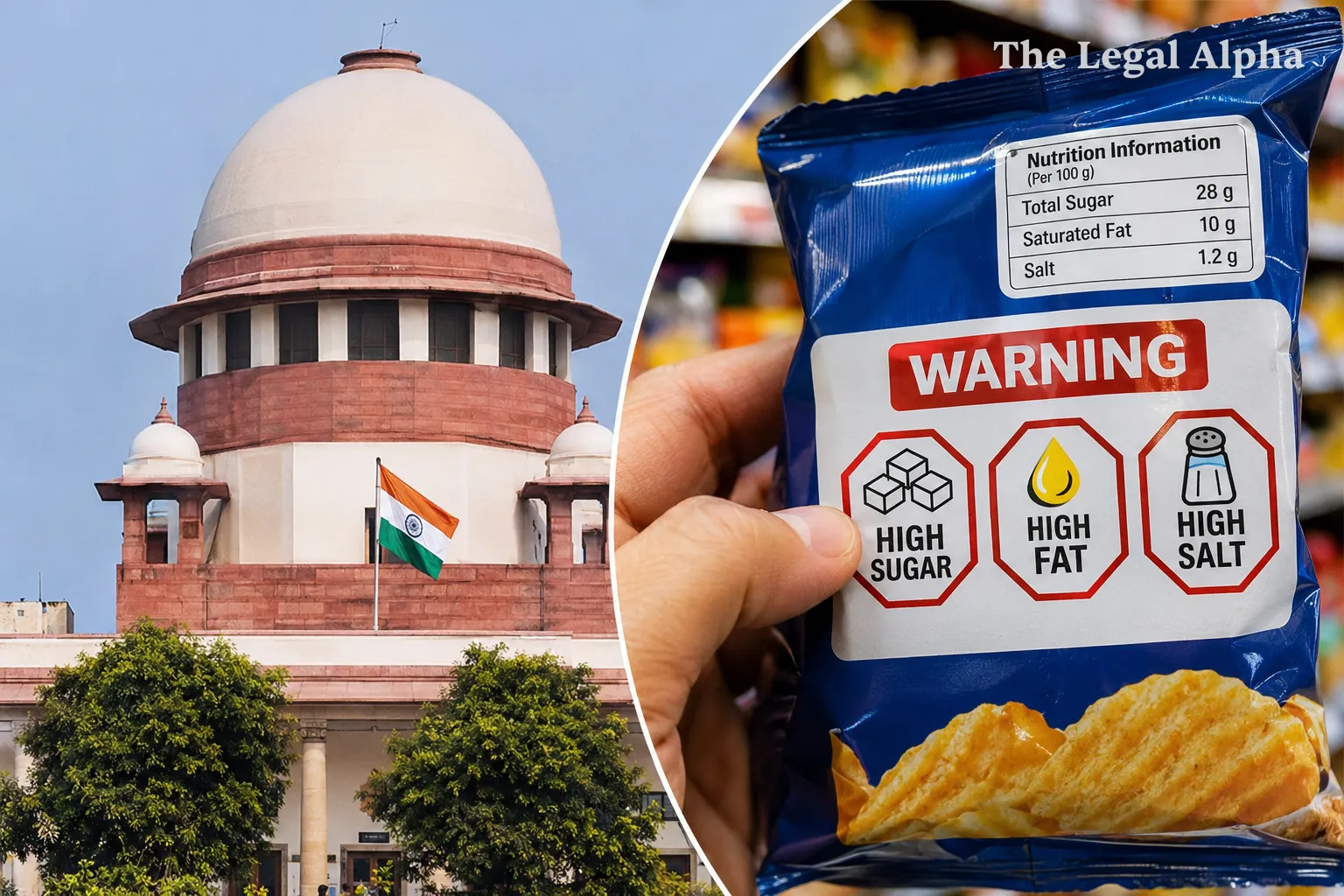
The Supreme Court of India has directed the Food Safety and Standards Authority of India (FSSAI) to strengthen front-of-package nutrition labelling on packaged food products, requiring warning labels to disclose total sugars and saturated fat rather than limiting the disclosure to added sugar and added fat.
A Bench comprising Justice JB Pardiwala and Justice K. Vinod Chandran delivered the judgment on November 26, 2026, while deciding a public interest litigation concerning warning labels on packaged food products.
The Court also directed the food regulator to introduce separate warning symbols for products containing high levels of sugar, fat and salt. The directions aim to ensure that consumers receive clear nutritional information when purchasing packaged food.
Legal Topic
Area of Law: Consumer Protection Law and Food Safety Law
Sub-topic: Food Labelling, Public Health and Nutritional Disclosure
Core Legal Issue
The central legal issue before the Supreme Court was whether the proposed front-of-package nutrition labelling framework adequately informed consumers about the nutritional risks associated with packaged food products.
The Court examined whether limiting warning labels to added sugar and added fat would leave consumers unaware of products containing high levels of total sugars and saturated fat. It also considered whether the proposed warning symbols, nutrient thresholds and implementation framework would provide meaningful information to consumers.
What Did the Supreme Court Decide?
The Supreme Court directed FSSAI to revise its proposed front-of-package nutrition labelling framework and ensure that total sugars and saturated fat, alongside salt, are treated as nutrients of concern.
The Court issued several important directions:
- Total Sugar and Saturated Fat: FSSAI must calculate warning thresholds using total sugars and saturated fat rather than added sugar and added fat alone.
- Revised Nutritional Thresholds: The regulator must reconsider and reformulate the nutrient thresholds. The values specified in Table 15.1 of the Dietary Guidelines for Indians, 2024, cannot be adopted as they stand because they were calculated using added sugar and added fat.
- Separate Warning Symbols: Each nutrient exceeding the prescribed threshold must have its own hexagonal warning label. A single combined warning symbol for multiple nutrients will not suffice.
- Pictorial Representations: Each hexagon must contain a standardised pictorial representation alongside the corresponding words HIGH FAT, HIGH SUGAR or HIGH SALT.
- Prominent Display: The warning labels must be sufficiently visible and readable, with FSSAI required to prescribe appropriate dimensions and font sizes.
The Court also emphasised that nutrient thresholds must be evidence-based. Setting them too low could result in excessive warnings and consumer desensitisation, while excessively high thresholds could allow products with unhealthy nutritional compositions to escape warnings.
FSSAI has been directed to finalise the regulations within its proposed timeline of four months. The Court also directed that the matter be listed after ten weeks to review the regulator's progress.
Key Legal Points
-
Total sugars and saturated fat must be considered when determining whether packaged food products require nutritional warning labels.
-
Separate hexagonal warning symbols are required for high fat, high sugar and high salt.
-
Warning thresholds must be scientifically supported and appropriately calibrated.
-
FSSAI must ensure that warning labels remain prominent, understandable and easily noticeable by consumers.
-
The regulator must monitor product reformulation and prevent manufacturers from using artificial preservatives or other additives to undermine the objectives of the labelling framework.
Relevant Law
Food Safety and Standards Act, 2006
The legislation provides the statutory framework governing food safety, food standards and the regulation of food products in India.
Food Safety and Standards (Labelling and Display) Regulations, 2020
These regulations govern nutritional information and labelling requirements for food products.
Food Safety and Standards (Safe Food and Balanced Diets for Children in School) Regulations, 2020
These regulations are relevant to the Court's directions concerning nutritional awareness and the protection of children's health.
Article 21 of the Constitution of India
The right to life has been interpreted to include the right to health, making public health an important constitutional consideration.
Article 47 of the Constitution of India
The provision directs the State to regard the improvement of public health and nutrition as among its primary duties.
Arguments of the Parties
Petitioner – 3S and Our Health Society
The petitioner approached the Supreme Court seeking effective front-of-package warning labels on packaged food products containing high levels of sugar, salt and fat.
The petition raised concerns regarding the adequacy of the proposed labelling framework and the need for consumers to receive clear information about the nutritional composition of food products.
Advocate Rajiv Shankar Dvivedi represented the petitioner.
Respondents – Union of India and FSSAI
FSSAI had placed its proposed warning-label framework before the Court, initially suggesting red-coloured hexagonal warnings for products containing high levels of two or more specified nutrients.
The regulator subsequently proposed changes to the framework, including warnings triggered when a product exceeded the prescribed threshold for any one nutrient.
The Supreme Court examined these proposals and issued directions to strengthen the framework.
Why Does It Matter?
The judgment has important implications for consumers, food manufacturers and India's food regulatory framework.
For consumers, the decision could make it easier to identify packaged products containing excessive amounts of sugar, saturated fat or salt without having to examine detailed nutritional tables on the back of packages.
For food manufacturers, the directions may require changes to packaging designs, nutritional assessments and product formulations to comply with the revised labelling requirements.
The ruling also reinforces the responsibility of food regulators to ensure that nutritional information is meaningful rather than merely technical. By requiring separate warning symbols and scientifically determined thresholds, the Court has emphasised the importance of transparency in food marketing.
The directions concerning children's nutritional awareness further underline the relationship between food regulation, consumer information and public health.
Legal Takeaway
The Supreme Court has made it clear that front-of-package nutrition warnings must provide consumers with meaningful information about the actual nutritional composition of packaged food. By requiring disclosures based on total sugars and saturated fat, alongside separate warnings for salt, the Court has strengthened the proposed framework for nutritional transparency and public health protection.
Sources
Primary Source:
- Supreme Court of India, 3S and Our Health Society v. Union of India, Miscellaneous Application No. 1177 of 2025 in Writ Petition (Civil) No. 437 of 2024, judgment dated November 26, 2026, reported as 2026 INSC 1275.
Supreme Court of India – Official Website and Judgments
Additional Sources: