Supreme Court Seeks Response on Challenge to Allahabad High Court’s Hijab Ruling, Clarifies It Is Not a Precedent
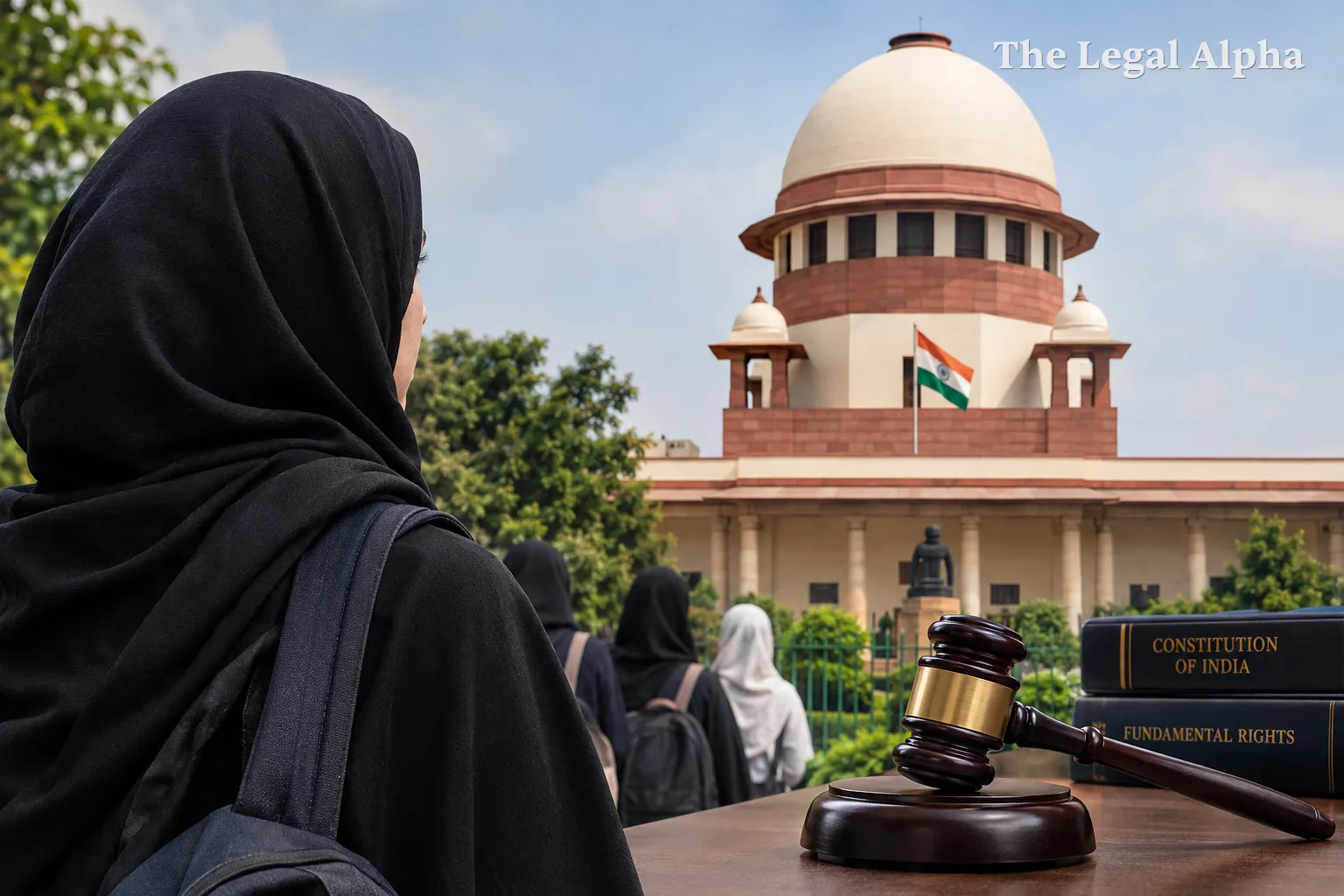
The Supreme Court of India has sought responses from the respondents on a petition challenging the Allahabad High Court's judgment concerning the wearing of hijab in educational institutions. The apex court has also directed that the challenged High Court judgment shall not be treated as a precedent.
A Bench comprising Justice Aravind Kumar and Justice Vipul M. Pancholi passed the order on November 20, 2026, in a petition filed by the Muslim Women's Study Circle against the State of Uttar Pradesh and others. The Court directed that the matter be tagged with the pending appeals arising from the Karnataka hijab controversy.
The challenge concerns an August 21, 2026 judgment of the Allahabad High Court involving Sukaina Rizvi, a student who was denied admission to Class XI at Tagore Public School in Attarsuiya, Prayagraj, after seeking permission to wear a headscarf with the prescribed school uniform.
Legal Topic
Area of Law: Constitutional Law
Sub-topic: Freedom of Religion, Right to Education and Religious Dress Codes in Educational Institutions
Core Legal Issue
The central legal question is whether wearing a hijab is protected under the constitutional guarantee of religious freedom under Article 25 and whether educational institutions can restrict religious attire through prescribed uniform policies.
The proceedings also raise questions about the application of the essential religious practices doctrine, the protection of individual religious beliefs and the extent to which institutional discipline can justify restrictions on religious clothing.
What Did the Supreme Court Decide?
The Supreme Court permitted the petitioner to file the petition and issued notice in the matter. It also directed that the proceedings be tagged with Civil Appeal No. 7095/2022, which forms part of the pending Karnataka hijab case.
Importantly, the Bench expressly ordered that the Allahabad High Court judgment shall not be treated as a precedent.
The Supreme Court has not delivered a final ruling on whether wearing a hijab constitutes an essential religious practice or whether schools can prohibit it under their uniform policies. These substantive questions remain open for consideration.
Key Legal Points
-
The Supreme Court has issued notice on the challenge to the Allahabad High Court's judgment concerning the hijab.
-
The Allahabad High Court ruling shall not be treated as a precedent, as expressly directed by the Supreme Court.
-
The petition challenges the application of the essential religious practices test in determining constitutional protection for wearing a hijab.
-
The petitioner has invoked Articles 14, 15, 19(1)(a), 21 and 25 of the Constitution, alleging violations of equality, religious freedom and other fundamental rights.
-
The matter has been tagged with the pending Karnataka hijab appeals, where the Supreme Court had delivered a split verdict in October 2022.
Relevant Law
Article 14 – Right to Equality: Guarantees equality before the law and equal protection of the laws.
Article 15 – Prohibition of Discrimination: Prohibits discrimination on specified grounds, including religion.
Article 19(1)(a) – Freedom of Speech and Expression: Protects the freedom of speech and expression, which the petitioner relies upon in challenging restrictions on wearing the hijab.
Article 21 – Right to Life and Personal Liberty: Protects life and personal liberty, forming part of the broader constitutional arguments concerning individual autonomy and dignity.
Article 25 – Freedom of Conscience and Religion: Guarantees freedom of conscience and the right freely to profess, practise and propagate religion, subject to constitutional limitations.
Essential Religious Practices Doctrine: A judicial principle used in determining whether a particular religious practice receives constitutional protection under Article 25.
Relevant Precedents:
-
Commissioner, Hindu Religious Endowments, Madras v. Sri Lakshmindra Thirtha Swamiar of Shirur Mutt
-
Bijoe Emmanuel v. State of Kerala
-
M. Siddiq v. Mahant Suresh Das
Arguments of the Parties
Petitioner – Muslim Women's Study Circle
The petitioner has argued that the Allahabad High Court's judgment is arbitrary and discriminatory and violates the fundamental rights of Muslim women. It contends that wearing the hijab is protected under Article 25 and that restrictions on the practice adversely affect religious freedom and access to education.
The petition also relies on Quranic references, particularly Surah Al-Noor, Verse 31 and Surah Al-Ahzab, Verse 59, to support its position that covering is rooted in religious teachings.
It further questions the High Court's reliance on the essential religious practices test, arguing that constitutional courts should exercise caution when examining matters involving religious beliefs and competing theological interpretations.
Respondents – State of Uttar Pradesh and Others
The respondents' detailed submissions before the Supreme Court are not established by the order currently available. Their responses to the notice remain to be placed before the Court.
Why Does It Matter?
The Supreme Court's direction that the Allahabad High Court judgment shall not be treated as a precedent is an important procedural development in the continuing constitutional debate over religious attire in educational institutions.
The case brings together questions concerning religious freedom, equality, individual conscience and the authority of educational institutions to prescribe dress codes.
By tagging the petition with the pending Karnataka hijab appeals, the Supreme Court has connected the dispute with a broader controversy that remains unresolved following the split verdict delivered in 2022.
The outcome may have implications for students, educational institutions and the interpretation of constitutional protections relating to religious practices. However, the latest order does not settle these questions or establish a final position on the legality of hijab restrictions.
Legal Takeaway
The Supreme Court has agreed to examine the challenge to the Allahabad High Court's hijab ruling and has expressly directed that the judgment shall not be treated as a precedent. The constitutional questions concerning religious freedom and uniform policies in educational institutions remain pending, with no final determination on the merits at this stage.
Sources
Primary Source: Supreme Court of India, Record of Proceedings dated November 20, 2026, Muslim Women's Study Circle v. State of Uttar Pradesh & Ors., SLP (Civil) Diary No. 69103/2026.
Additional Sources: LiveLaw, Bar & Bench and other legal news reports concerning the Supreme Court proceedings.