Punjab and Haryana High Court Examines Legal Basis for Diverting State Transport Buses to Moga Event
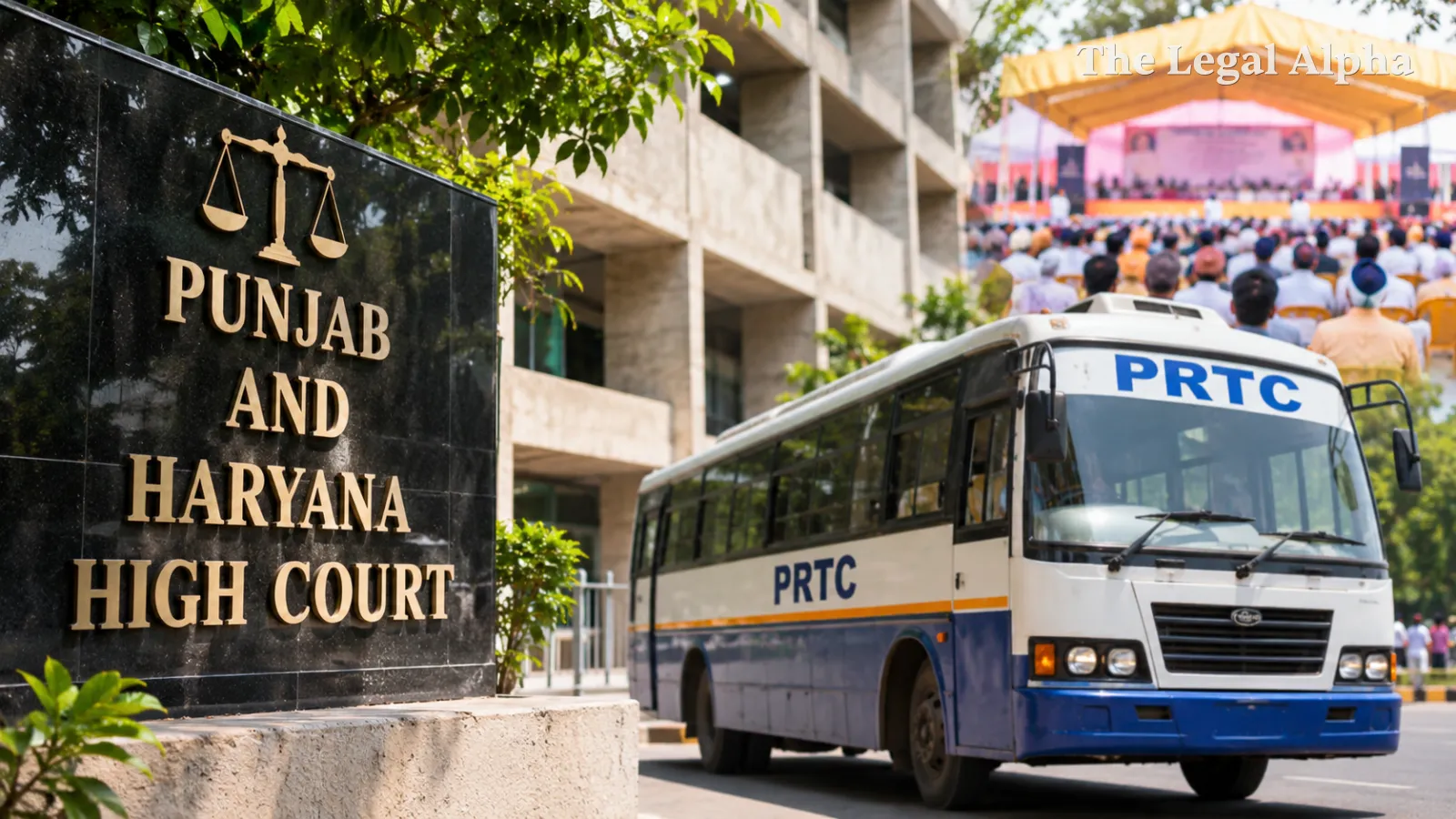
The Punjab and Haryana High Court has questioned the Punjab Government’s authority to divert buses operated by the PEPSU Road Transport Corporation (PRTC) and Punjab Roadways from their designated routes for a major event in Moga. The proceedings raise important questions about the statutory restrictions governing public transport services and the impact of government decisions on ordinary commuters.
The controversy arose after a large number of government buses were assigned to transport people to a state-level programme scheduled in Moga on November 26, 2026. The programme involved the distribution of smart ration cards and food kits to beneficiaries, while the petitioner alleged that public transport resources were being used to facilitate a political rally.
What Happened?
A Public Interest Litigation (PIL) filed by Arshdeep Singh Sra challenged the diversion of government buses from their regular routes to transport people to an event at Matwani village in Moga.
According to reports, approximately 680 PRTC buses were scheduled to be deployed for the programme, substantially affecting the corporation's regular fleet. The petitioner alleged that the diversion could disrupt public transport services and cause inconvenience to passengers who depend on these buses for their daily travel.
The petitioner also sought disclosure of the number of buses deployed, the financial approvals and the statutory authority relied upon by the government.
The Punjab Government defended the arrangement by maintaining that the programme was an official state-level function organised for the distribution of welfare benefits to approximately six lakh citizens.
Legal Topic
Area of Law: Constitutional Law and Administrative Law
Sub-topic: Judicial Review of Government Action / Regulation of State Transport Undertakings
Core Legal Issue
The central legal question is whether the State Government can divert buses operated by state transport corporations from their approved routes for a special public function without demonstrating specific statutory authority permitting such action.
The proceedings also raise the question of whether the inconvenience caused to ordinary passengers can be justified by the government's decision to deploy public transport resources for an event outside their regular operational duties.
What Did the High Court Observe?
A Division Bench comprising Chief Justice Ashwani Kumar Mishra and Justice Rohit Kapoor questioned the legal basis for diverting buses operating under statutory permits.
The Court observed that the provisions relied upon by the State Government appeared to operate in a different legal context. It noted that the State had not initially produced a temporary permit or demonstrated a specific statutory provision authorising the requisitioning or diversion of buses issued permits under Section 103 of the Motor Vehicles Act, 1988.
The Bench clarified that it was not questioning the distribution of smart ration cards or the provision of welfare benefits to citizens. Instead, the issue was whether diverting state transport buses was legally necessary or permissible for carrying out that programme.
The Court also questioned whether the inconvenience caused to ordinary commuters could be justified by the proposed deployment.
What Happened During the Subsequent Hearing?
During the proceedings, the State Government produced an order dated November 24, 2026, issued by the Moga District Magistrate, authorising the requisition of buses.
The petitioner's counsel sought time to examine the document and respond to its legality.
In the subsequent hearing on November 26, the High Court declined to pass an interim order and granted the petitioner time to amend the petition to challenge the District Magistrate's order.
Consequently, the legality of the bus diversion remains subject to further judicial examination. The Court has not finally determined whether the State Government's action is lawful.
Key Legal Points
-
Statutory restrictions on transport services: Buses operating under permits issued to State Transport Undertakings are required to comply with the applicable statutory transport scheme.
-
Section 87 of the Motor Vehicles Act, 1988: The State relied on this provision concerning temporary permits to justify the proposed deployment.
-
Section 103 of the Motor Vehicles Act, 1988: The Court examined the statutory framework governing permits issued to State Transport Undertakings.
-
Public inconvenience: The Bench raised concerns about the impact of withdrawing buses from regular routes on passengers who depend on public transport.
-
Judicial scrutiny: The Court is examining whether the District Magistrate's requisition order and the government's decision have sufficient legal backing.
Relevant Law
Motor Vehicles Act, 1988
-
Section 66: Requirement of permits for transport vehicles.
-
Section 87: Power to grant temporary permits in specified circumstances.
-
Section 99: Preparation and publication of schemes relating to State Transport Undertakings.
-
Section 103: Issue of permits to State Transport Undertakings.
The distinction between the provisions governing temporary permits and those regulating State Transport Undertakings is central to the dispute.
Arguments of the Parties
Petitioner – Arshdeep Singh Sra
The petitioner challenged the diversion of Punjab Roadways and PRTC buses from their designated routes, alleging that government transport resources were being used to facilitate a political event at the expense of ordinary passengers.
He also sought disclosure of the deployment details, financial approvals and statutory authorisation supporting the decision.
Punjab Government
The State Government argued that the Moga programme was an official state-level function organised for distributing smart ration cards and food kits to nearly six lakh beneficiaries.
It relied on Section 87 of the Motor Vehicles Act, 1988, to contend that temporary permits could be issued for the transportation arrangements. The government also relied on the order issued by the Moga District Magistrate authorising the requisition of buses.
Why Does It Matter?
The proceedings highlight an important issue concerning the use of public resources by government authorities. Public transport corporations operate under statutory frameworks designed to ensure that transport services remain available to passengers on approved routes.
If buses are withdrawn for special government programmes, the decision must have a proper legal foundation and must account for the interests of ordinary commuters.
The case also highlights the distinction between organising a legitimate welfare programme and determining whether the administrative arrangements made for that programme comply with the law.
The High Court's examination could have wider implications for how state transport authorities exercise their powers when public transport resources are required for special events.
Legal Takeaway
Government welfare programmes may be legitimate public initiatives, but the administrative measures adopted to implement them must also comply with statutory requirements. The Punjab and Haryana High Court is examining whether the diversion of PRTC and Punjab Roadways buses had the necessary legal authorisation, while the final determination remains pending.
Sources
Primary Source:
- Punjab and Haryana High Court proceedings in the PIL concerning diversion of Punjab Roadways and PRTC buses. The complete court order was not independently available for verification.
Additional Sources: